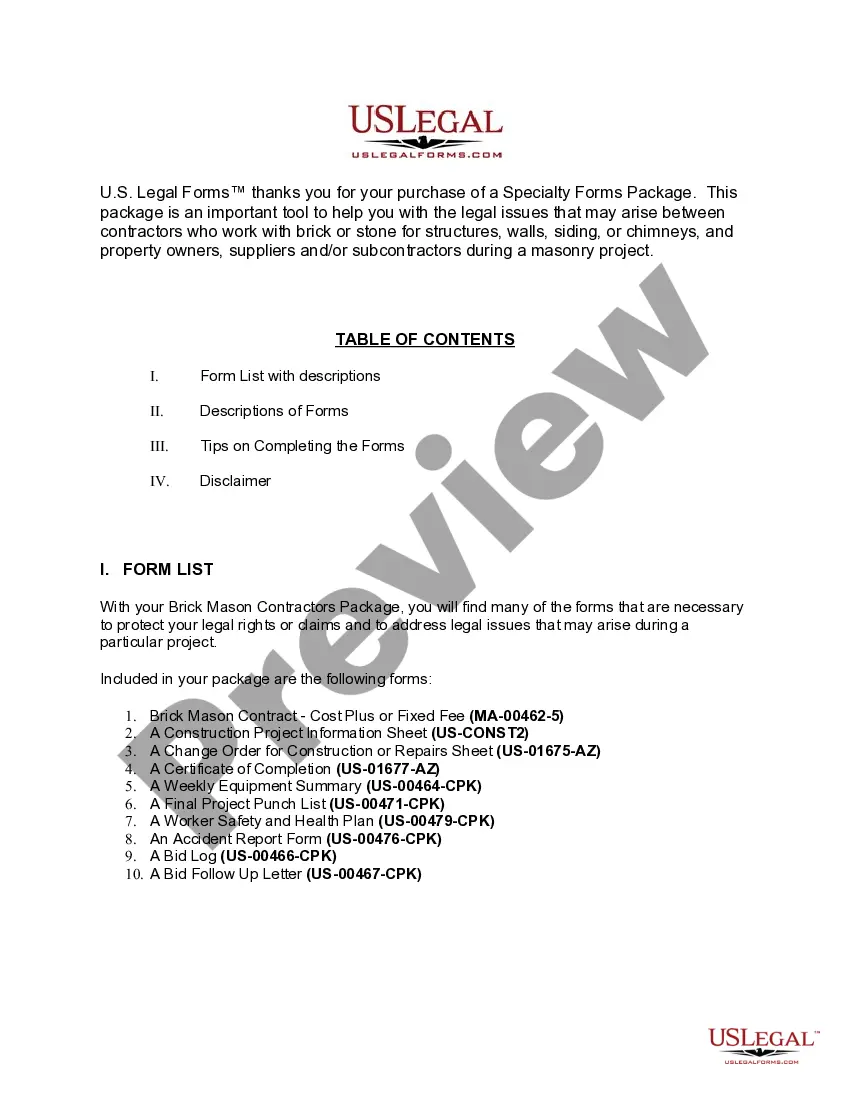
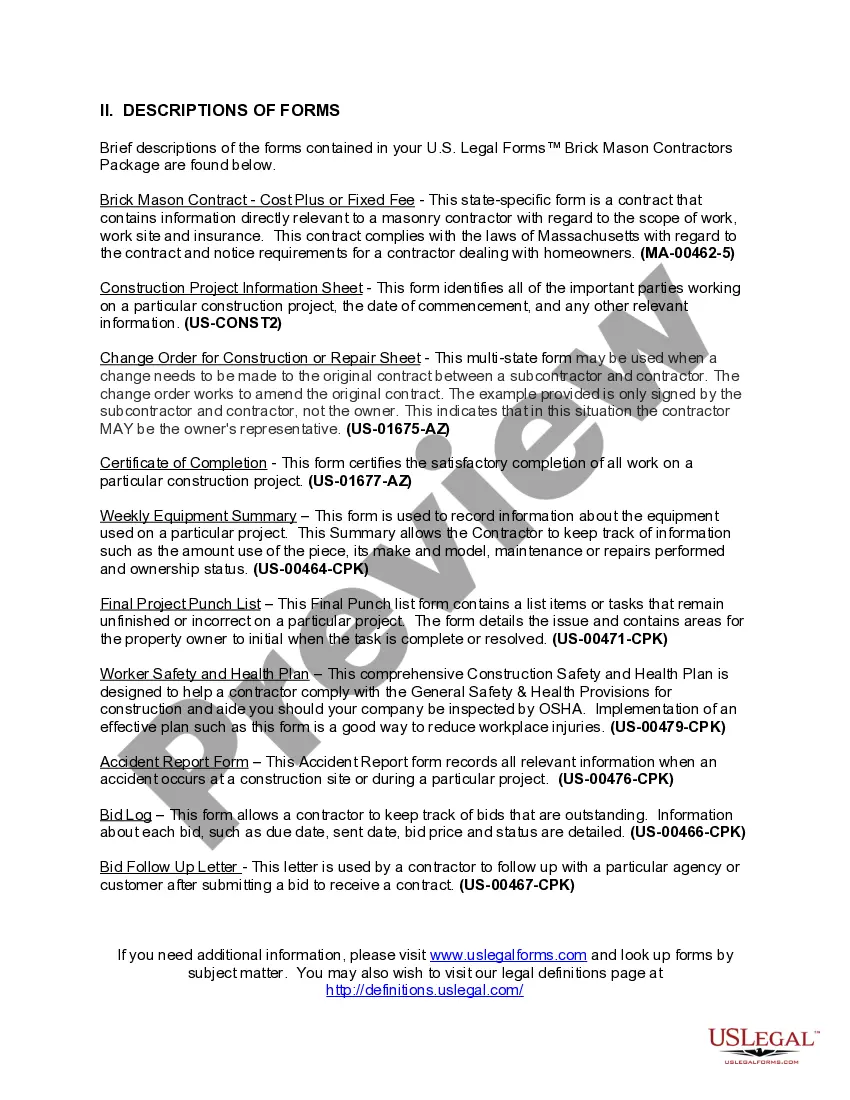
Brick Masonry For Walls
Description
Get your form ready online
Our built-in tools help you complete, sign, share, and store your documents in one place.
Make edits, fill in missing information, and update formatting in US Legal Forms—just like you would in MS Word.
Download a copy, print it, send it by email, or mail it via USPS—whatever works best for your next step.
Sign and collect signatures with our SignNow integration. Send to multiple recipients, set reminders, and more. Go Premium to unlock E-Sign.
If this form requires notarization, complete it online through a secure video call—no need to meet a notary in person or wait for an appointment.
We protect your documents and personal data by following strict security and privacy standards.

Make edits, fill in missing information, and update formatting in US Legal Forms—just like you would in MS Word.

Download a copy, print it, send it by email, or mail it via USPS—whatever works best for your next step.

Sign and collect signatures with our SignNow integration. Send to multiple recipients, set reminders, and more. Go Premium to unlock E-Sign.

If this form requires notarization, complete it online through a secure video call—no need to meet a notary in person or wait for an appointment.

We protect your documents and personal data by following strict security and privacy standards.
Looking for another form?

How to fill out Massachusetts Brick Mason Contractor Package?
It’s widely known that you can't instantly become a legal expert, nor can you swiftly learn how to efficiently prepare Brick Masonry For Walls without a specialized skill set.
Assembling legal paperwork is a lengthy endeavor demanding a specific education and expertise. So why not entrust the creation of the Brick Masonry For Walls to the specialists.
With US Legal Forms, one of the most extensive legal template libraries, you can access everything from court papers to templates for internal corporate communication. We recognize how vital compliance and adherence to federal and state laws and regulations are.
Select Buy now. Once the purchase is finalized, you can download the Brick Masonry For Walls, complete it, print it, and send or mail it to the necessary individuals or organizations.
You can access your forms again from the My documents tab at any time. If you’re an existing client, you can simply Log In, and find and download the template from the same tab.
- Here’s how you can initiate your journey with our website and acquire the document you need in just minutes.
- Locate the form you require using the search bar at the top of the page.
- Preview it (if this option is available) and review the accompanying description to determine if Brick Masonry For Walls is what you're searching for.
- Start your search anew if you need a different form.
- Create a free account and choose a subscription plan to purchase the form.
Form popularity
FAQ
Brick masonry is a structural technique in which the bricks are laid out in a systematic pattern and the joints are filled with mortar to make a solid structure. Some of the topics covered here include proper stacking, identifying high-quality bricks, and the importance of frog in bricks.
Masonry wall systems are building systems that use masonry materials such as brick, stone, or concrete blocks to construct walls. These materials are typically stacked on top of each other and held together with mortar. Masonry is the oldest technique used for constructing buildings or structures.
Masonry consists of building structures from single units that are laid and bound together with mortar. Brick, stone and concrete blocks are the most common materials used in masonry construction. Masonry is a popular construction technique around the world, due to its many advantages.
Fly ash clay bricks These bricks are made using clay and fly ash, which is a by-product of coal-burning. The mixture is fired at around 1000 degrees Celsius. Often used in structural walls or foundations, fly ash bricks are self-cementing ? when exposed to moisture, they expand meaning cement is not required.
Load-bearing Masonry Walls. Bricks, concrete blocks or stones are used to build load-bearing masonry walls. ... Reinforced Masonry Walls. Reinforced masonry walls are either load-bearing or non-load bearing. ... Cavity Masonry Walls. ... Composite Masonry Walls. ... Post-tensioned Masonry Walls.