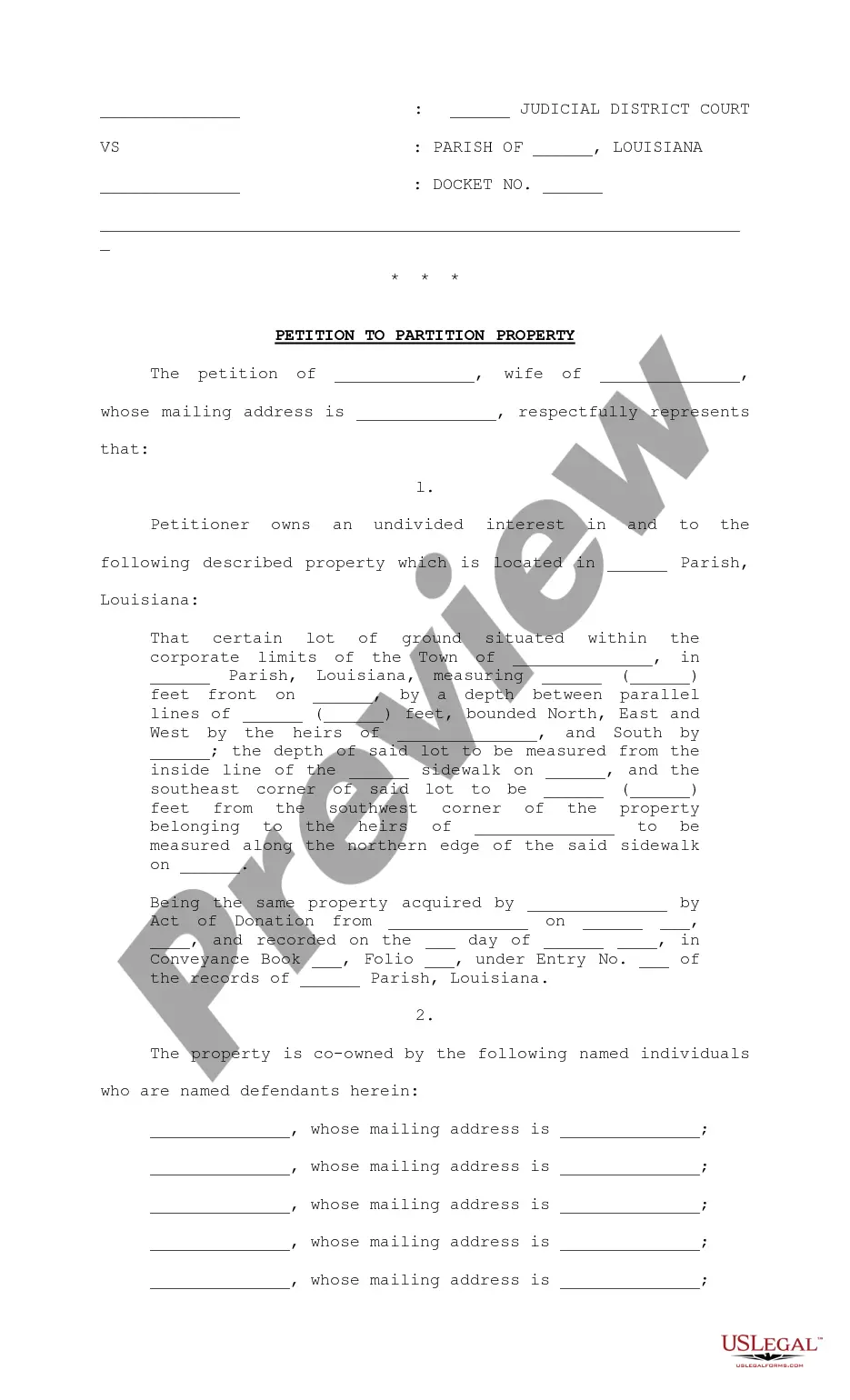
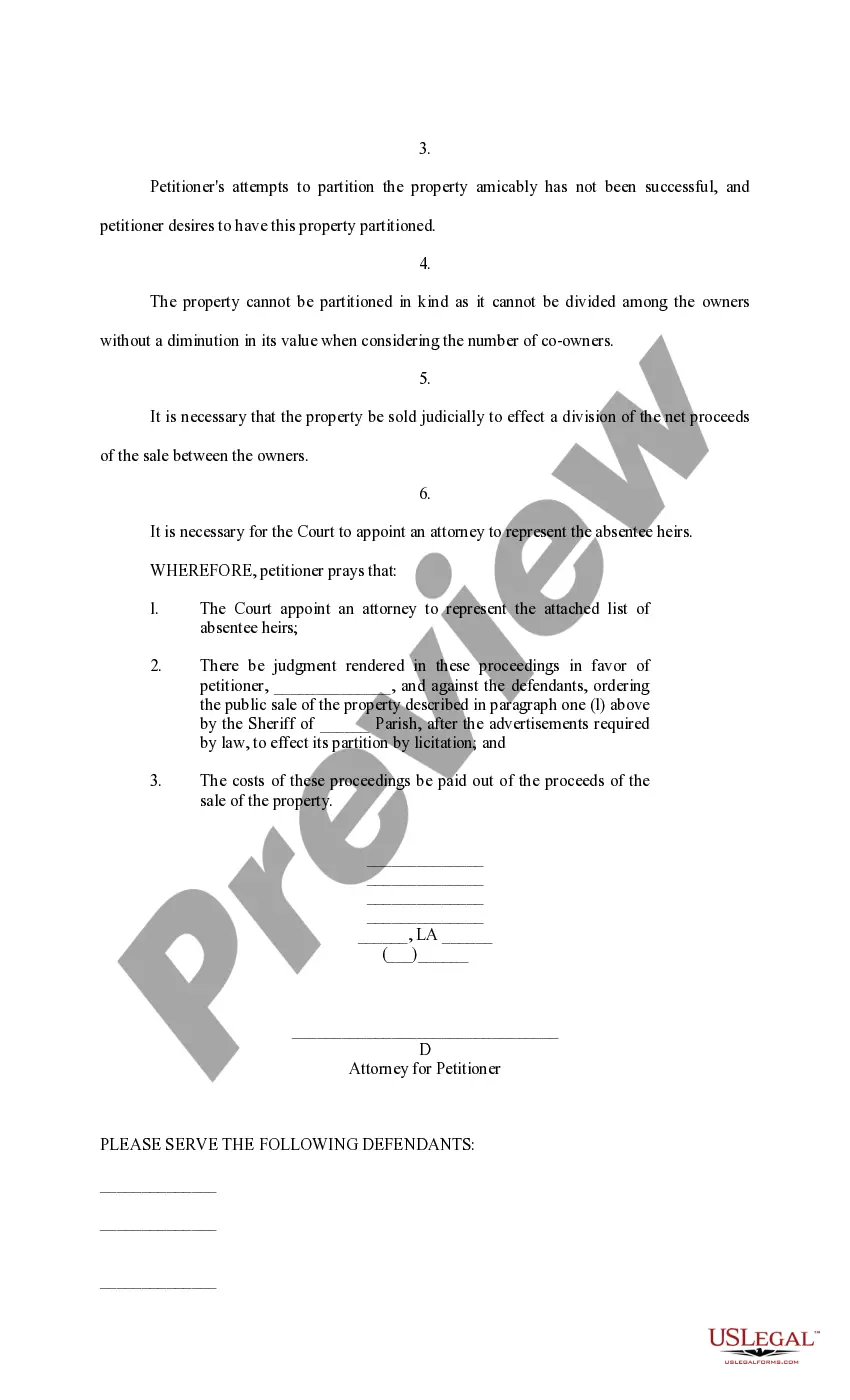
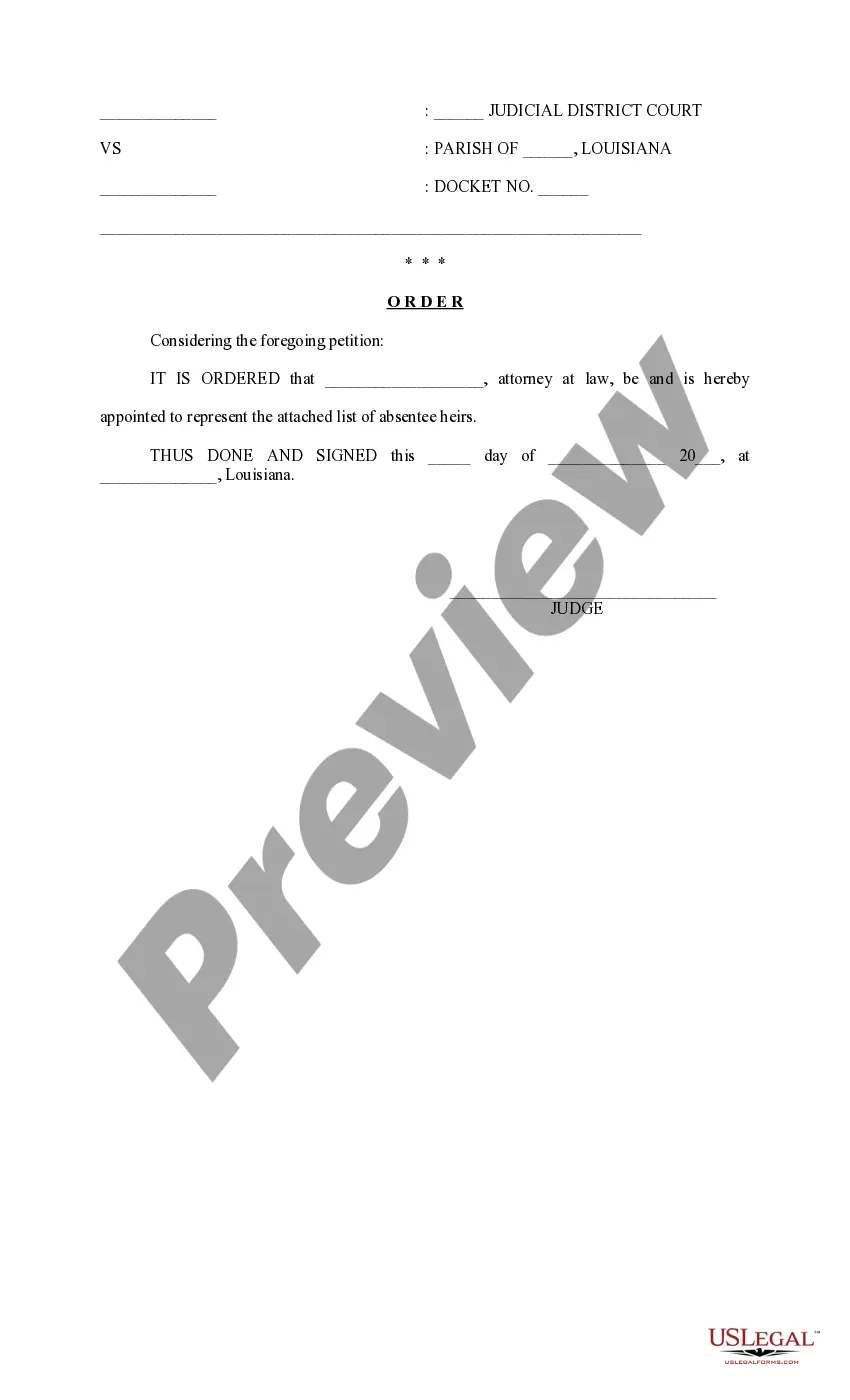
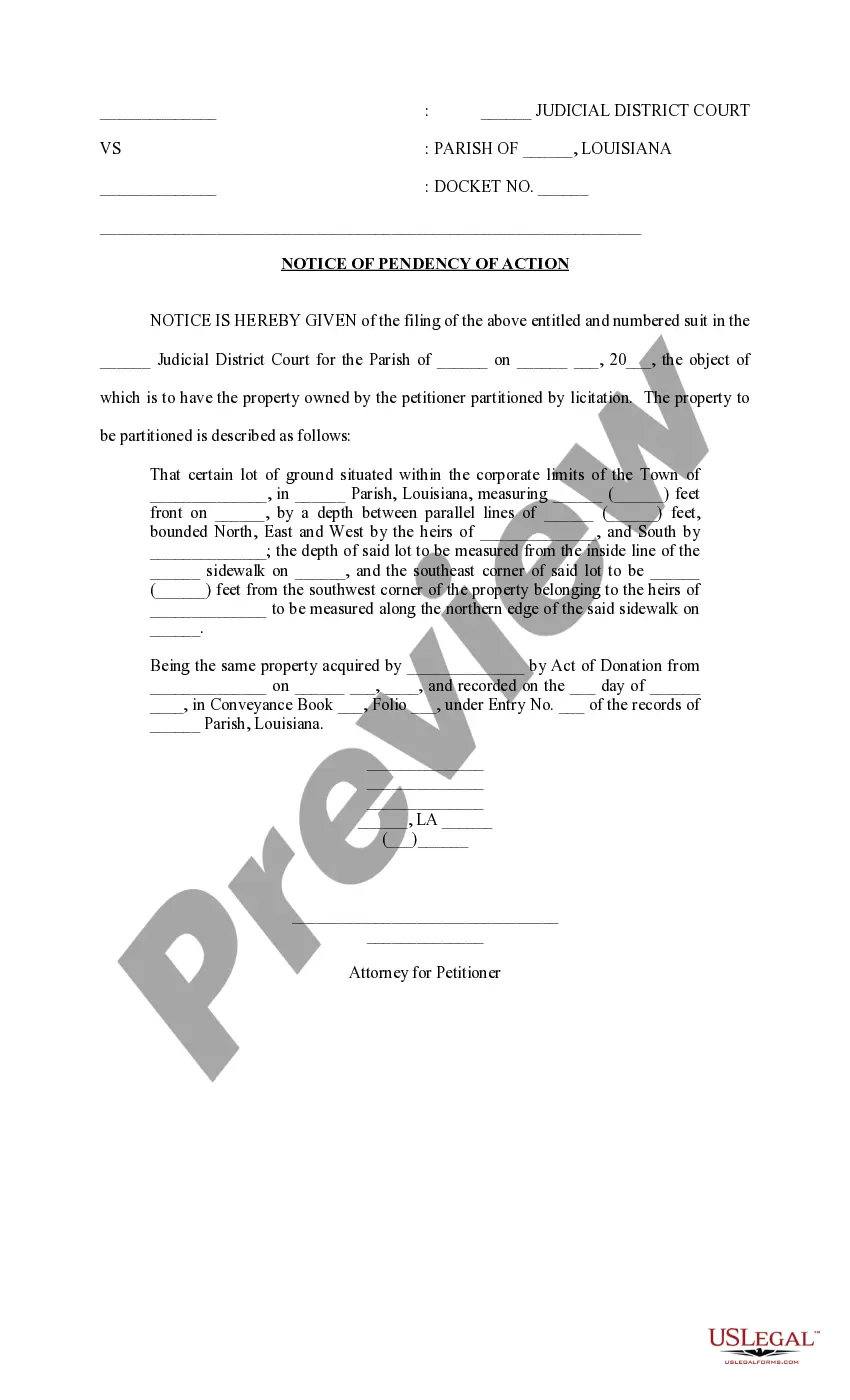
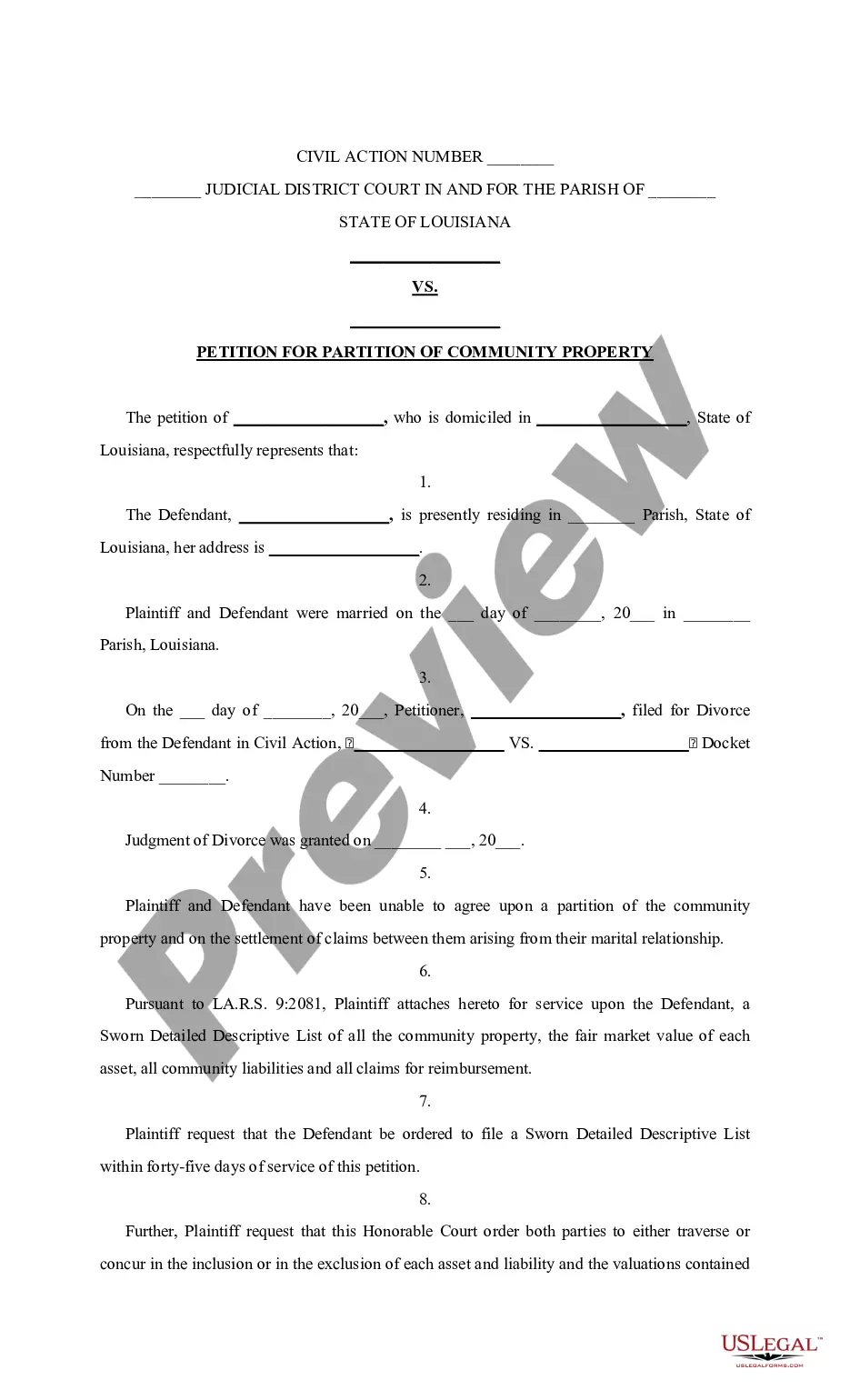
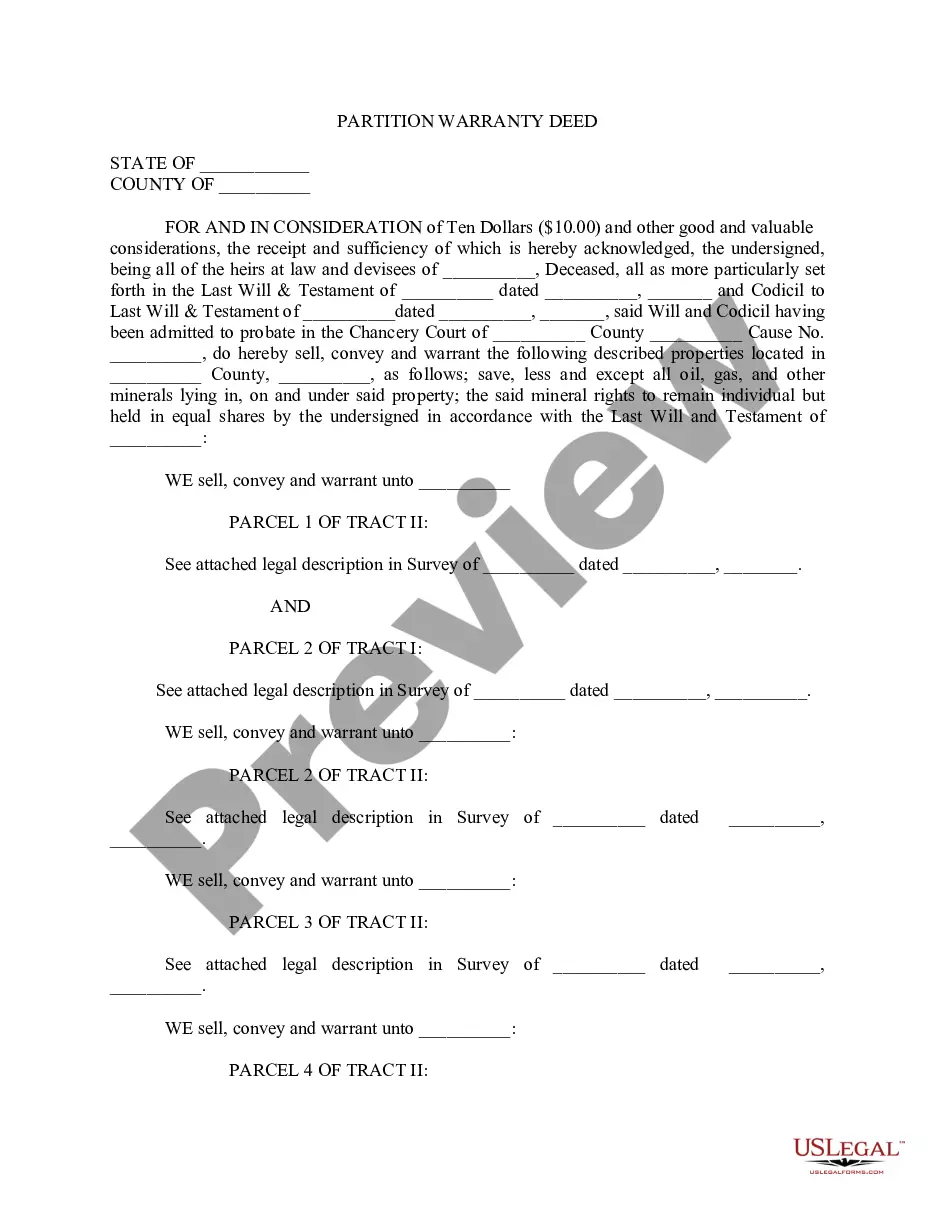
Petition For Partition Sample With Replacement
Description


Get your form ready online
Our built-in tools help you complete, sign, share, and store your documents in one place.
Make edits, fill in missing information, and update formatting in US Legal Forms—just like you would in MS Word.
Download a copy, print it, send it by email, or mail it via USPS—whatever works best for your next step.
Sign and collect signatures with our SignNow integration. Send to multiple recipients, set reminders, and more. Go Premium to unlock E-Sign.
If this form requires notarization, complete it online through a secure video call—no need to meet a notary in person or wait for an appointment.
We protect your documents and personal data by following strict security and privacy standards.

Make edits, fill in missing information, and update formatting in US Legal Forms—just like you would in MS Word.

Download a copy, print it, send it by email, or mail it via USPS—whatever works best for your next step.

Sign and collect signatures with our SignNow integration. Send to multiple recipients, set reminders, and more. Go Premium to unlock E-Sign.

If this form requires notarization, complete it online through a secure video call—no need to meet a notary in person or wait for an appointment.

We protect your documents and personal data by following strict security and privacy standards.
Looking for another form?



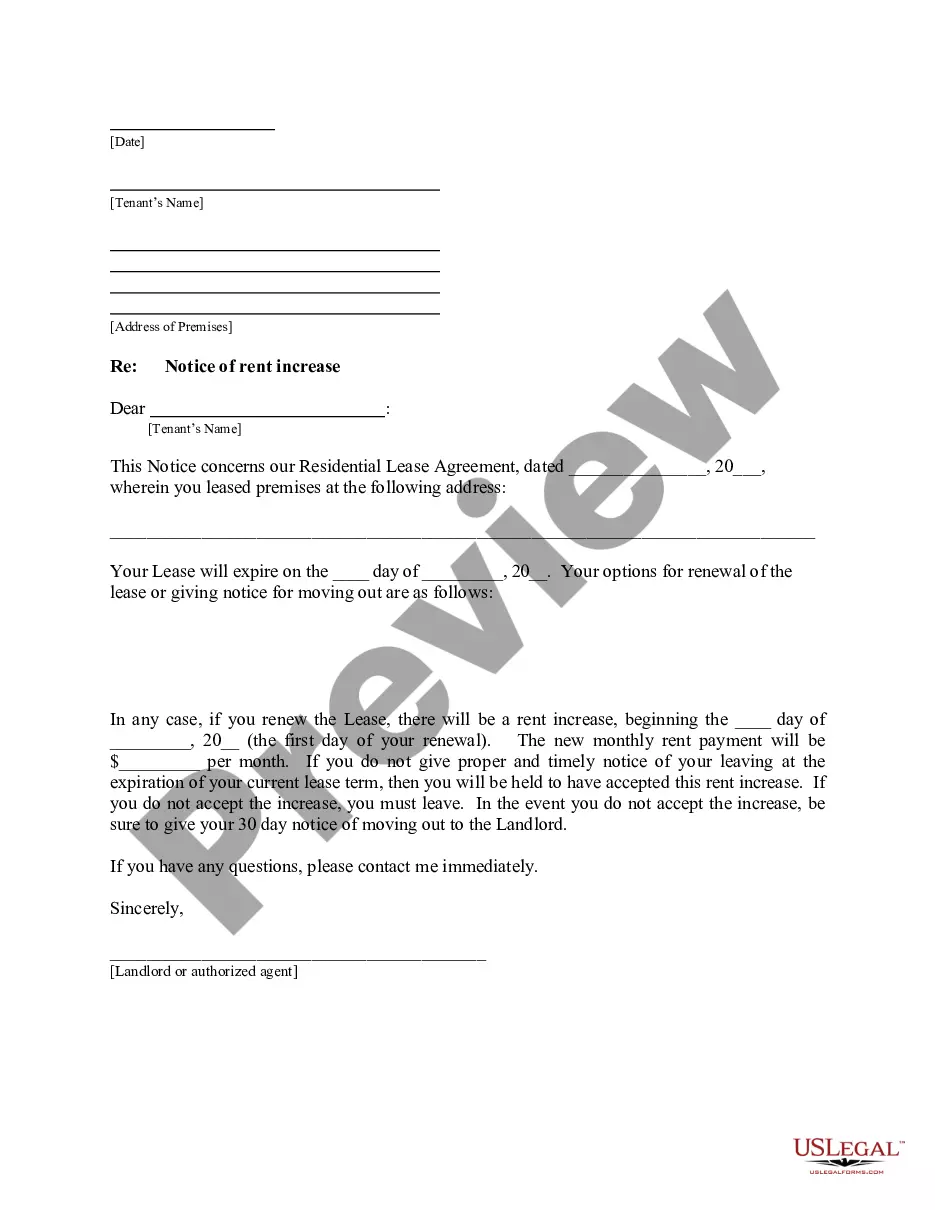
How to fill out Louisiana Petition To Partition Property?
Legal documents administration can be daunting, even for experienced professionals.
When you are seeking a Petition For Partition Sample With Replacement and lack the time to search for the appropriate and current version, the process can be challenging.
Tap into a valuable repository of articles, guides, handbooks, and resources pertinent to your circumstances and requirements.
Save time and effort looking for the documents you need, and use US Legal Forms’ sophisticated search and Review tool to find the Petition For Partition Sample With Replacement and obtain it.
Take pleasure in the US Legal Forms online library, supported by 25 years of experience and reliability. Streamline your everyday document management in an easy and user-friendly manner starting today.
- If you have a subscription, Log In to your US Legal Forms account, search for the form, and retrieve it.
- Check your My documents tab to review the documents you have saved and manage your folders as needed.
- If this is your first visit to US Legal Forms, create a free account for unlimited access to all the platform's advantages.
- Follow these steps after locating the desired form.
- Confirm it is the accurate form by previewing it and reading its details.
- Access state- or county-specific legal and business documents.
- US Legal Forms meets all your needs, from personal to corporate forms, all in one location.
- Utilize advanced tools to complete and manage your Petition For Partition Sample With Replacement.
Form popularity
FAQ
The timeline of a partition lawsuit typically depends on various factors, including the complexity of the case and court schedules. Initially, the filing can take several weeks to gather necessary evidence and documents. After that, the court may schedule hearings, which could last several months. It's advisable to refer to a petition for partition sample with replacement for an overview of typical timelines you might expect in this process.
Process of Filing Partition suit in India Name of the court. Name, description and of address the parties. Facts to determine the jurisdiction of the court. Facts that constitute the cause of action. Description of the property. Amount of relief claimed. Statement of value of the subject matter of the suit.
A legal notice for partition is required in most scenarios, but more so when one or more than one member of joint undivided property sells, gifts, mortgages, leases out or dispose of such property in any way without written consent of other co-owners.
A sale deed is a document that is of legal value and can be used to register the new owner's name in the papers. As per the Indian Registration Act, it is crucial to register a sale deed. The deed registration is done with the sub-registrar under whose jurisdiction the property is located.
In normal circumstances, the head of the family decides when to dispose of the share to all the coparceners. If you have been denied a share in your ancestral property, you can send a legal notice to the erring party. You can also file a suit for partition in the civil court, claiming your share.
There are three methods of Partition provided by state law: (1) Partition by Physical Division, (2) Partition by Sale, and (3) Partition by Appraisal. Also known as ?Partition in Kind,? a Partition by Physical Division requires the Court to divide the land by its proportional value.