Appointment Of Attorney General Article
Description

Get your form ready online
Our built-in tools help you complete, sign, share, and store your documents in one place.
Make edits, fill in missing information, and update formatting in US Legal Forms—just like you would in MS Word.
Download a copy, print it, send it by email, or mail it via USPS—whatever works best for your next step.
Sign and collect signatures with our SignNow integration. Send to multiple recipients, set reminders, and more. Go Premium to unlock E-Sign.
If this form requires notarization, complete it online through a secure video call—no need to meet a notary in person or wait for an appointment.
We protect your documents and personal data by following strict security and privacy standards.

Make edits, fill in missing information, and update formatting in US Legal Forms—just like you would in MS Word.

Download a copy, print it, send it by email, or mail it via USPS—whatever works best for your next step.

Sign and collect signatures with our SignNow integration. Send to multiple recipients, set reminders, and more. Go Premium to unlock E-Sign.

If this form requires notarization, complete it online through a secure video call—no need to meet a notary in person or wait for an appointment.

We protect your documents and personal data by following strict security and privacy standards.
Looking for another form?
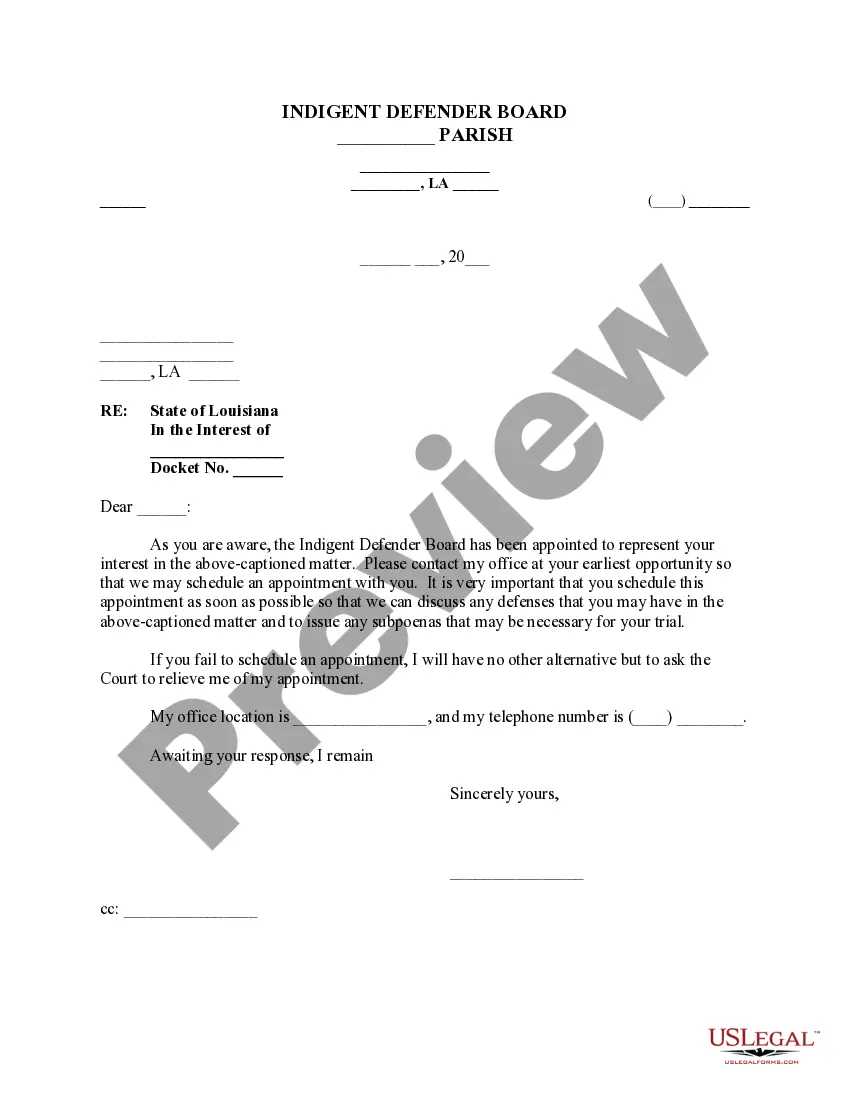
How to fill out Louisiana Letter To Indigent Defendant Regarding Appointment As Attorney?
- If you're a returning user, log in to your account and download your appointment of attorney general article template by clicking the Download button. Ensure your subscription is active; renew if necessary.
- For first-time users, start by reviewing the form description and checking the Preview mode to confirm the selected form meets your requirements.
- If you need an alternative form, utilize the Search tab to find another template that aligns with your local jurisdiction needs.
- Proceed to purchase the document by clicking the Buy Now button and selecting your preferred subscription plan. You'll need to create an account for access.
- Complete the payment using your credit card or PayPal credentials.
- Download your form and save it to your device. You can easily access it later in the My Forms section of your profile.
With US Legal Forms, not only do you gain access to a vast library of over 85,000 fillable and editable legal forms, but you also ensure that your documents are of the highest legally sound quality.
Start navigating the legal landscape with confidence—visit US Legal Forms today and take advantage of this invaluable resource!
Form popularity
FAQ
When writing a letter to the attorney general, start with a formal greeting, such as 'Dear Attorney General Last Name.' Clearly express your reason for writing in the opening paragraphs, and be respectful throughout the correspondence. Additionally, for guidance on legal matters and templates, you can explore resources available on uslegalforms, which can support you in crafting your message related to the Appointment of attorney general article.
The proper way to address the attorney general is as 'Mr.' or 'Ms.' followed by their last name, or simply as 'Attorney General' when referring to the office. This formality acknowledges the significance of the position. Understanding these nuances is part of the broader context in the Appointment of attorney general article, which emphasizes respect for legal authority.
The appointment clause of Article 2 grants the President the authority to appoint officers of the United States, which includes the attorney general. This clause also requires Senate confirmation for these appointments. By examining the Appointment of attorney general article, one can grasp the significance of this process in ensuring qualified individuals occupy vital governmental roles.
The appointments clause is found in Article 2 of the United States Constitution. This article outlines the President's powers, including the appointment of various officials. The Appointment of attorney general article falls under this constitutional framework, detailing how attorneys general are selected and the roles they play.
Clause 1 of Article 6 establishes that the Constitution, along with federal laws and treaties, is the supreme law of the land. This clause sets the groundwork for the legal framework within which the attorney general operates. Therefore, the Appointment of attorney general article is crucial for understanding how legal authority is structured and upheld in the United States.
Article 4 Clause 2 addresses the privileges and immunities of citizens among the states. It ensures that states cannot discriminate against a citizen from another state. While this may seem unrelated to the Appointment of attorney general article, it establishes a broader framework for the fairness and justice expected in appointments, including that of the attorney general.
The Article 3 Appointments Clause of the Constitution specifies how federal judges are appointed. It grants the President the power to nominate judges with the advice and consent of the Senate. Understanding this clause is essential when discussing the appointment of positions like the attorney general. Therefore, the Appointment of attorney general article connects closely to the judicial appointment process.
All 50 states in the US have an Attorney General, but the method of appointment varies. Some states elect their Attorney General through popular vote, while others are appointed by the Governor or the state legislature. This variation reflects the unique political structures of each state. To gain further insight into state-specific processes, explore our Appointment of attorney general article.
The Attorney General holds the highest legal authority in the United States, making them more powerful than a US attorney. While US attorneys handle cases at the district level, the Attorney General oversees the entire Department of Justice and shapes national legal policy. This distinction highlights the strategic importance of the Attorney General's position. For a deeper understanding of these roles, read our Appointment of attorney general article.
The President of the United States appoints the Attorney General. This key appointment is typically subject to confirmation by the Senate. The process emphasizes the importance of the Attorney General's role in upholding the law and representing the federal government. If you want to learn more about the appointment process, check out our Appointment of attorney general article.