Heirship Never Intestate For A Will
Description

Get your form ready online
Our built-in tools help you complete, sign, share, and store your documents in one place.
Make edits, fill in missing information, and update formatting in US Legal Forms—just like you would in MS Word.
Download a copy, print it, send it by email, or mail it via USPS—whatever works best for your next step.
Sign and collect signatures with our SignNow integration. Send to multiple recipients, set reminders, and more. Go Premium to unlock E-Sign.
If this form requires notarization, complete it online through a secure video call—no need to meet a notary in person or wait for an appointment.
We protect your documents and personal data by following strict security and privacy standards.

Make edits, fill in missing information, and update formatting in US Legal Forms—just like you would in MS Word.

Download a copy, print it, send it by email, or mail it via USPS—whatever works best for your next step.

Sign and collect signatures with our SignNow integration. Send to multiple recipients, set reminders, and more. Go Premium to unlock E-Sign.

If this form requires notarization, complete it online through a secure video call—no need to meet a notary in person or wait for an appointment.

We protect your documents and personal data by following strict security and privacy standards.
Looking for another form?



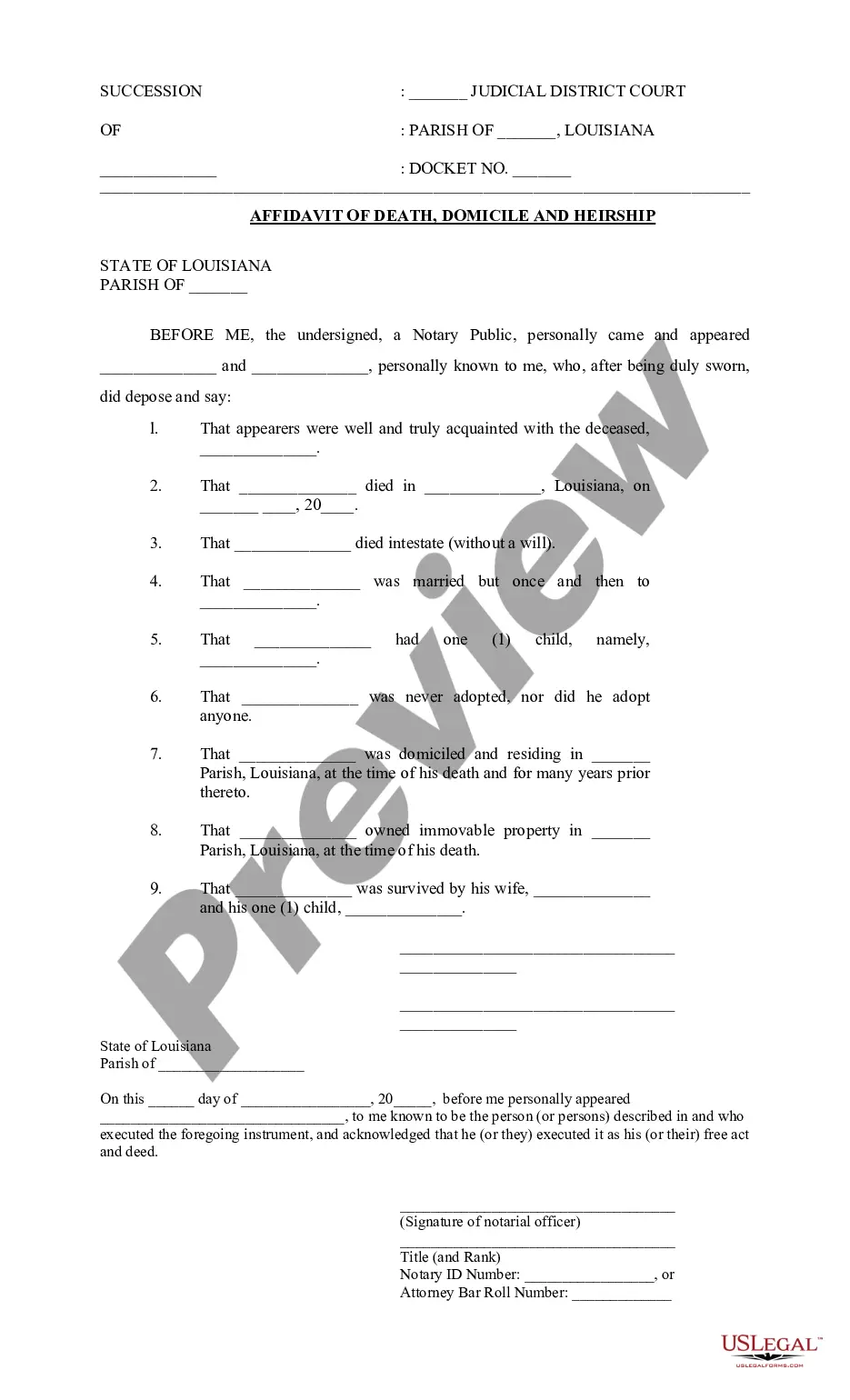
How to fill out Louisiana Affidavit Of Death, Domicile And Heirship Or Descent?
- Sign in to your account if you’re a returning user and ensure your subscription is active. If necessary, renew according to your chosen plan.
- For first-time users, start by reviewing the form descriptions in Preview mode to ensure you select the precise option that aligns with your local jurisdiction.
- If you find inconsistent information, utilize the Search tab to explore additional templates until you locate the correct one.
- Once you've identified the right document, click the Buy Now button and select your preferred subscription plan, creating a new account if required.
- Complete your purchase by entering your payment information, using either a credit card or PayPal.
- Finally, download your chosen form directly to your device, accessing it later from the My Forms section of your profile.
In conclusion, US Legal Forms provides a robust library that empowers you to handle your legal documentation efficiently. With over 85,000 editable forms and expert assistance available, you can ensure your documents are accurate and compliant with the law.
Visit US Legal Forms now to get started on your heirship documents and experience the ease of legal form completion today!
Form popularity
FAQ
To become the executor of an estate without a will, you typically need to file for administration in the probate court. This process involves submitting necessary documents and may require proof of your relationship to the deceased. Understanding the rules of heirship never intestate for a will can assist you in navigating these proceedings effectively. Platforms like uslegalforms can provide the forms and guidance to help simplify your role as the estate administrator.
If there is no will, the laws of intestacy dictate who inherits the deceased's assets. Generally, spouses, children, and other close relatives have priority based on state laws. Understanding the concept of heirship never intestate for a will can clarify the inheritance hierarchy and prevent disputes among family members. Knowing this can guide you in preparing for what may come next if a loved one passes away without a clear plan.
In Tennessee, when a person dies without a will, their assets are distributed according to the intestacy laws of the state. The court appoints an administrator to manage the estate and distribute it among the legal heirs. This process highlights the principle of heirship never intestate for a will, ensuring the estate is divided fairly among family members. Familiarizing yourself with these laws can help family members navigate their rights and responsibilities.
When there is no will, the court determines how to distribute the estate through legal proceedings. This situation is commonly referred to as being intestate. Without a will, the heirs will inherit based on state laws, and the concept of heirship never intestate for a will ensures that rightful beneficiaries receive their share. It's essential to understand this process to avoid complications in receiving your inheritance.
Without a will, an executor’s decisions follow state intestacy laws regarding asset distribution. An executor cannot arbitrarily determine who receives what; instead, they must distribute the estate according to statutory guidelines. This situation relates closely to heirship never intestate for a will, underscoring the importance of having a will to ensure your wishes are honored. Utilizing resources like US Legal Forms can simplify estate planning and avoid complications.
To establish yourself as an heir, you may need to provide documents such as a birth certificate or family tree that links you to the deceased individual. In situations involving heirship never intestate for a will, the absence of a will may require additional evidence in probate court. Keeping records and obtaining legal assistance can facilitate this process effectively.
Heirs typically have a specific time frame to claim property, which varies by state. Generally, this period can range from a few months to several years after a person's death, depending on local laws. In cases of heirship never intestate for a will, it's crucial to act promptly to secure your rights to the estate. Consulting an estate attorney can provide clarity on these timelines.
To obtain the deed to your deceased parents' house, you may need to begin the probate process. First, locate the original deed, then check with the local probate court for necessary documentation. This process may involve providing proof of heirship, especially when heirship never intestate for a will is in question. Using platforms like US Legal Forms can simplify this process, guiding you through the steps.
When there is no will, inheritance follows state laws known as intestacy laws. Typically, close relatives such as spouses, children, and parents inherit the estate. If no immediate family exists, more distant relatives may inherit. Understanding heirship never intestate for a will is essential, especially when planning for the future.
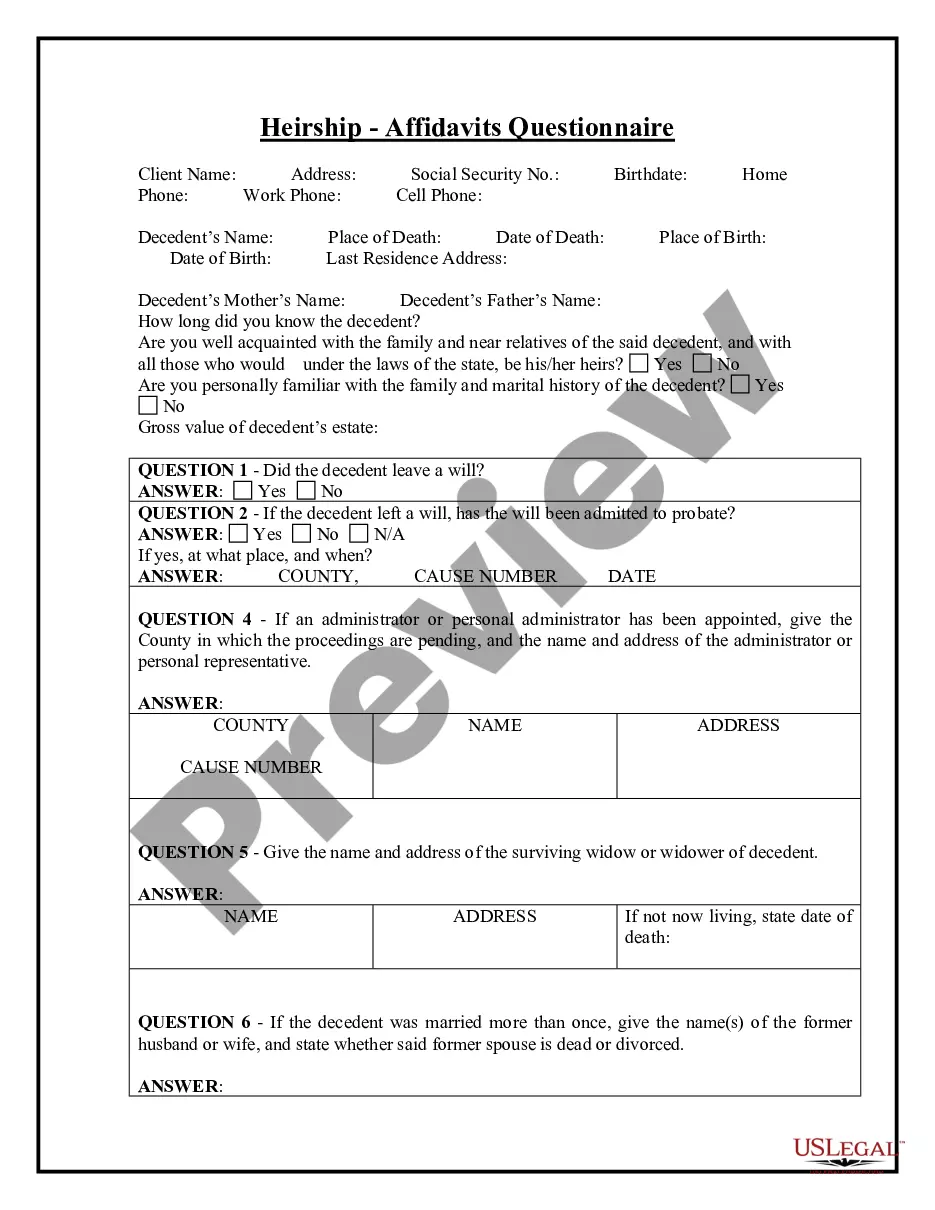
An affidavit is completed by the individual who has direct knowledge of the pertinent facts surrounding the inheritance. This may include details about the deceased's immediate family and their relationships. When dealing with matters of heirship never intestate for a will, having accurate information in the affidavit is vital for a smooth legal process, and platforms like US Legal Forms can assist you in preparing this essential document.