Kentucky Property Deed With Life Estate
Description
Get your form ready online
Our built-in tools help you complete, sign, share, and store your documents in one place.
Make edits, fill in missing information, and update formatting in US Legal Forms—just like you would in MS Word.
Download a copy, print it, send it by email, or mail it via USPS—whatever works best for your next step.
Sign and collect signatures with our SignNow integration. Send to multiple recipients, set reminders, and more. Go Premium to unlock E-Sign.
If this form requires notarization, complete it online through a secure video call—no need to meet a notary in person or wait for an appointment.
We protect your documents and personal data by following strict security and privacy standards.

Make edits, fill in missing information, and update formatting in US Legal Forms—just like you would in MS Word.

Download a copy, print it, send it by email, or mail it via USPS—whatever works best for your next step.

Sign and collect signatures with our SignNow integration. Send to multiple recipients, set reminders, and more. Go Premium to unlock E-Sign.

If this form requires notarization, complete it online through a secure video call—no need to meet a notary in person or wait for an appointment.

We protect your documents and personal data by following strict security and privacy standards.
Looking for another form?
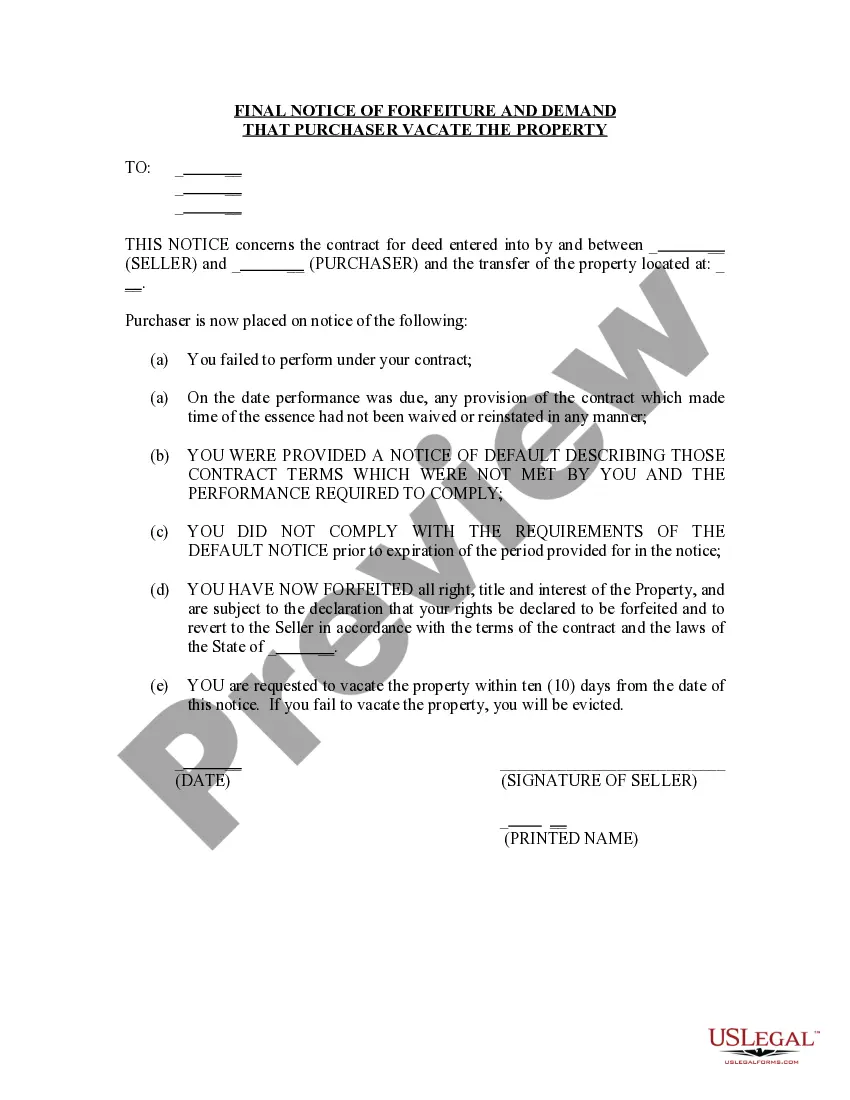
How to fill out Kentucky Final Notice Of Forfeiture And Request To Vacate Property Under Contract For Deed?
Whether for commercial objectives or personal matters, everyone must confront legal circumstances at some point in their lives.
Completing legal documents requires meticulous care, beginning with selecting the correct form template.
Once it is downloaded, you can fill out the document using editing software or print it to complete it by hand. With a vast US Legal Forms catalog available, you will never have to waste time searching for the suitable template across the web. Utilize the library’s user-friendly navigation to find the right template for any circumstance.
- Obtain the template you require using the search bar or catalog navigation.
- Review the form’s details to confirm it corresponds with your situation, jurisdiction, and locality.
- Click on the form’s preview to scrutinize it.
- If it is the wrong document, return to the search feature to locate the Kentucky Property Deed With Life Estate template you need.
- Download the template once it fulfills your requirements.
- If you already possess a US Legal Forms profile, simply click Log in to retrieve previously saved documents in My documents.
- If you have not created an account yet, you can acquire the form by clicking Buy now.
- Select the suitable pricing choice.
- Complete the profile registration form.
- Choose your payment option: either use a credit card or a PayPal account.
- Select the file format you prefer and download the Kentucky Property Deed With Life Estate.
Form popularity
FAQ
Yes, you can create your own life estate deed, but it is advisable to proceed with caution. Using templates from platforms like US Legal Forms can simplify the process and ensure you include all necessary information for a Kentucky property deed with life estate. However, consider consulting with a legal professional to avoid mistakes that could lead to complications in the future. Properly executing and recording the deed is crucial for its effectiveness.
While a Kentucky property deed with life estate can offer benefits, it also has disadvantages. The life tenant cannot sell or mortgage the property without the consent of the remainderman. Additionally, the life tenant is responsible for property taxes and maintenance, which can become burdensome. Furthermore, once a life estate deed is executed, it cannot be easily undone, limiting the life tenant's control over the property.
To get a life estate deed in Kentucky, you should start by drafting the deed itself. This document must specify the life tenant and the remainderman, or those who will inherit the property after the life tenant passes away. You can create this deed using online resources, such as US Legal Forms, which provides templates tailored for Kentucky property deed with life estate. After drafting, you need to sign the deed in front of a notary public and record it with the county clerk's office.
Writing a life estate deed involves drafting a legal document that outlines the rights of the life tenant and the remainderman. It is advisable to include specific language regarding the property, the parties involved, and any conditions or limitations. For those unfamiliar with the process, using a platform like uslegalforms can help simplify the creation of a Kentucky property deed with life estate, ensuring all legal requirements are met.
To record a life estate deed, you must file the document with the county clerk’s office in the county where the property is located. Ensure that the Kentucky property deed with life estate is properly signed and notarized before submission. This step formalizes the life estate arrangement and protects the interests of all parties involved.
Selling a house with a life estate deed can be complex, as the life tenant must typically obtain permission from the remainderman to proceed with the sale. It is essential to consult with a legal professional familiar with Kentucky property deeds with life estate to navigate this process smoothly. Once all parties agree, the property can be sold, but understanding the rights involved is crucial.
A person with a life estate has the right to use and live in the property for their lifetime, but they do not have full ownership rights. They cannot sell or mortgage the property without the consent of the remainderman, who will inherit the property upon their death. This unique arrangement is a key feature of a Kentucky property deed with life estate.
A life estate deed in Kentucky is a legal document that allows an individual to retain ownership of a property for their lifetime while designating another person to inherit the property after their death. This arrangement can provide peace of mind and ensure that the property remains within the family. Understanding the specifics of a Kentucky property deed with life estate is essential for effective estate planning.
Yes, a life estate should be recorded in the county where the property is located. Recording the Kentucky property deed with life estate ensures that the details of ownership are publicly documented, providing legal protection for both the life tenant and the remainderman. This step is crucial for establishing the rights associated with the property.
The step up basis of a life estate deed allows the value of the property to be adjusted to its fair market value at the time of the owner’s death. This means that if the property appreciates in value over time, the beneficiaries can avoid capital gains tax on the increase in value. This is particularly beneficial for heirs inheriting a Kentucky property deed with life estate, as it minimizes their tax burden.