Limited Business
Description
Get your form ready online
Our built-in tools help you complete, sign, share, and store your documents in one place.
Make edits, fill in missing information, and update formatting in US Legal Forms—just like you would in MS Word.
Download a copy, print it, send it by email, or mail it via USPS—whatever works best for your next step.
Sign and collect signatures with our SignNow integration. Send to multiple recipients, set reminders, and more. Go Premium to unlock E-Sign.
If this form requires notarization, complete it online through a secure video call—no need to meet a notary in person or wait for an appointment.
We protect your documents and personal data by following strict security and privacy standards.

Make edits, fill in missing information, and update formatting in US Legal Forms—just like you would in MS Word.

Download a copy, print it, send it by email, or mail it via USPS—whatever works best for your next step.

Sign and collect signatures with our SignNow integration. Send to multiple recipients, set reminders, and more. Go Premium to unlock E-Sign.

If this form requires notarization, complete it online through a secure video call—no need to meet a notary in person or wait for an appointment.

We protect your documents and personal data by following strict security and privacy standards.
Looking for another form?

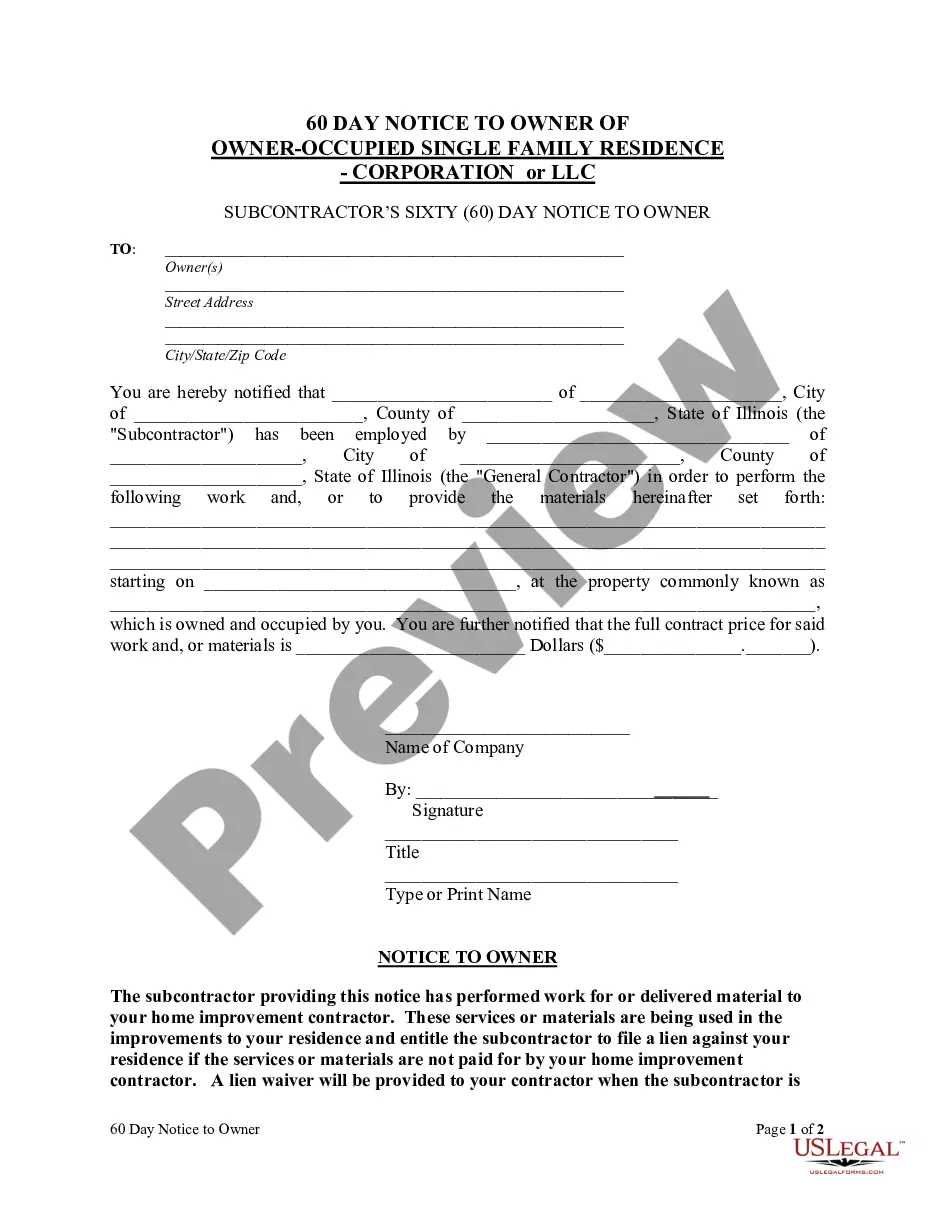
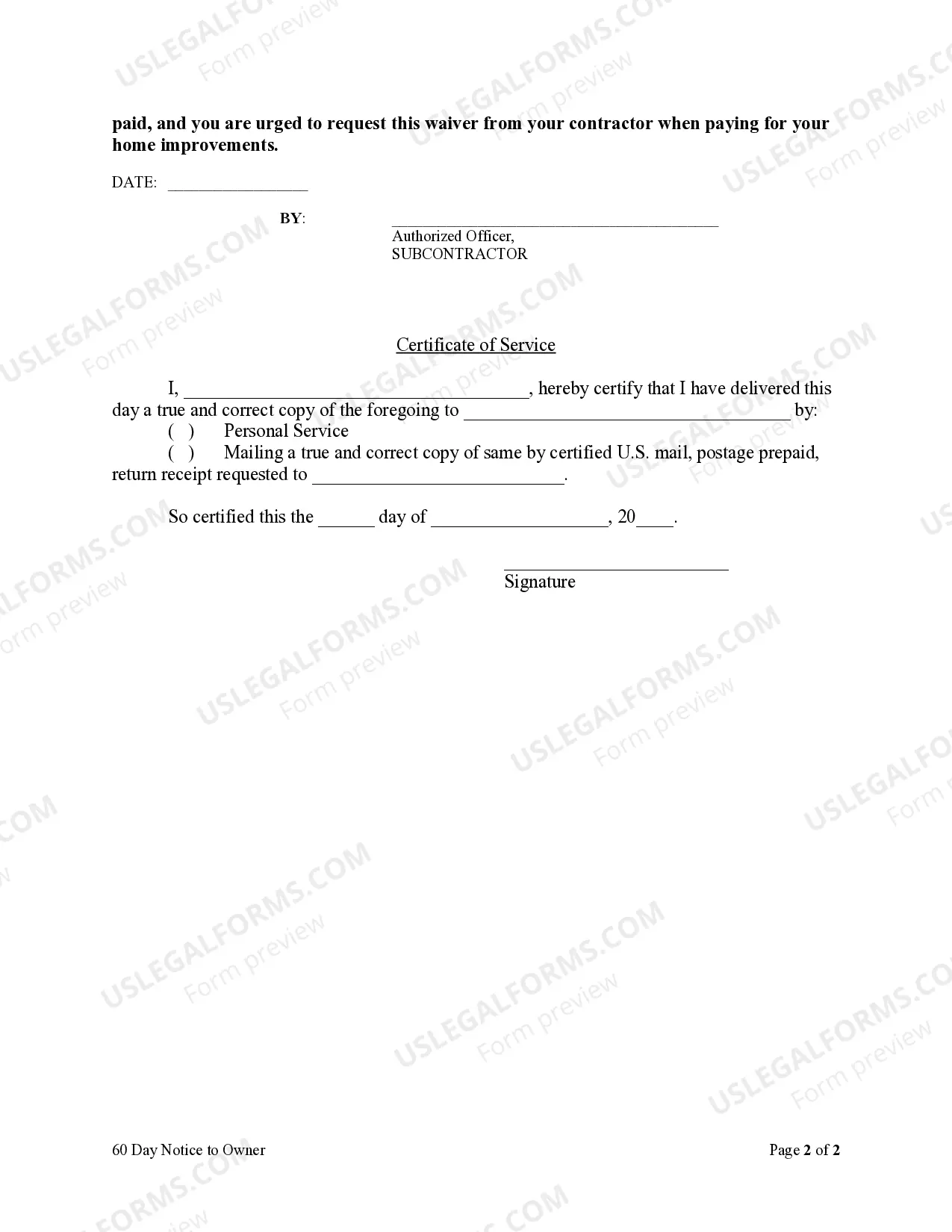
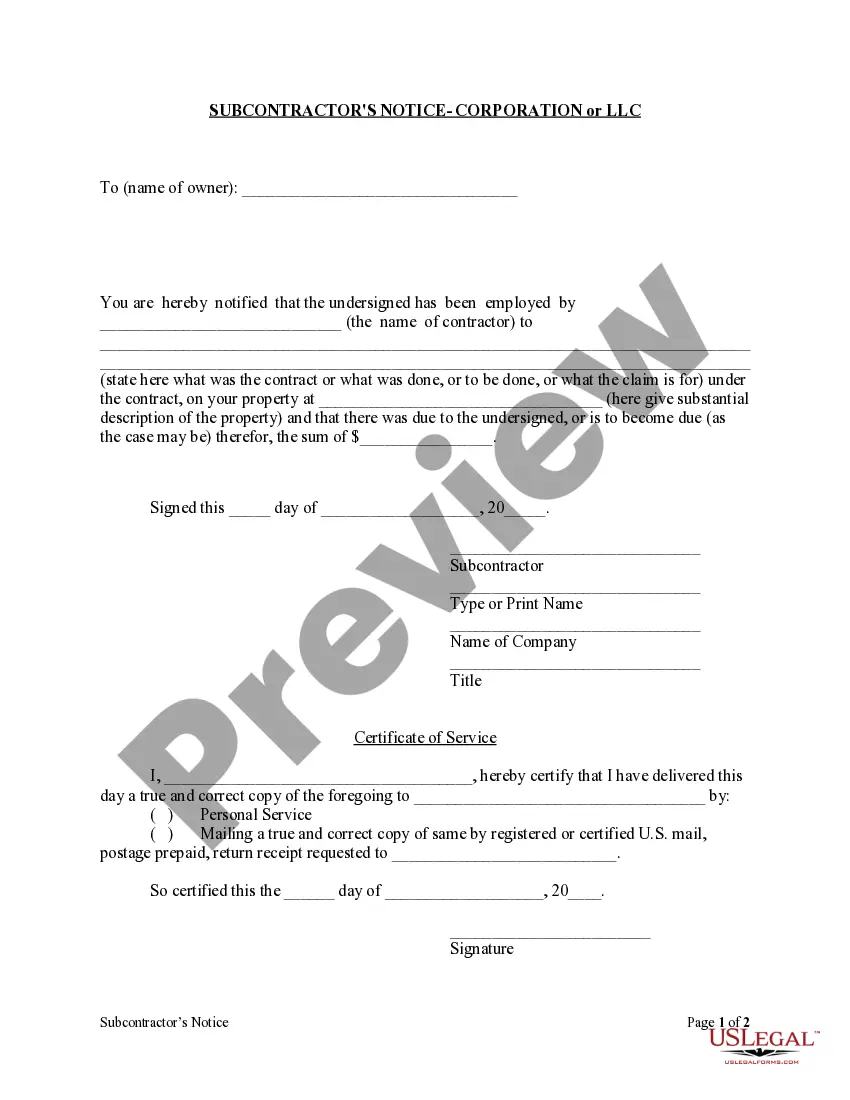
How to fill out Illinois Subcontractor's 60 Day Notice To Owner - Owner Occupied Residence - Mechanic Liens - Corporation Or LLC?
- Log into your existing US Legal Forms account to access your library. Ensure your subscription remains valid to avoid any interruptions.
- If this is your first time, begin by browsing the extensive form library. Use the Preview mode to confirm that the selected form aligns with your specific needs.
- If the desired form isn't quite right, conduct a search using the Search tab to find the most suitable document.
- Once you've found the correct form, click on the 'Buy Now' button and select a subscription plan that fits your requirements. You will need to register to proceed.
- Complete your purchase by entering your payment details through credit card or PayPal.
- After payment, you can download the form directly to your device for completion. Your form will also be accessible under the 'My Forms' section anytime you need it.
Once you've followed these steps, you'll have your limited business documentation ready in no time. With US Legal Forms, rest assured that your legal documents will be both comprehensive and compliant.
Ready to get started? Visit US Legal Forms today and explore your options for seamless legal document preparation!
Form popularity
FAQ
Yes, you can use 'Limited' instead of 'LLC,' but it is essential to understand the implications. The term 'Limited' typically suggests that your business is incorporated, potentially offering different tax and operational structures. Therefore, while you may prefer one designation over the other, ensure it accurately reflects your business structure and complies with state laws. If you need clarification, consulting with a service like US Legal Forms can clarify these options for your limited business.
You become a limited company primarily through registration with your state’s authorities, meeting specific legal requirements. This includes drafting articles of incorporation, establishing a unique business name, and adhering to necessary filing procedures. By organizing your business in this manner, you enjoy the benefits of limited liability, which protects your personal assets from business risks. Platforms like US Legal Forms can assist you in successfully navigating these steps to set up your limited business.
A limited company is characterized by its liability status, where the owners’ personal assets are protected from business debts. To qualify as a limited company, it needs to be registered with the appropriate state authorities and must follow specific compliance rules. Moreover, having share capital and operating under a formal business structure further cements its status. For those creating a limited business, these criteria are essential.
You can determine if you are operating as a limited company by checking your business registration documents. If your business name includes 'Limited' or 'Ltd,' you are most likely a limited company. Additionally, your business should be registered with the state and adhere to specific regulations. If you’re unsure, consider using a platform like US Legal Forms for guidance on legal classifications for your limited business.
A limited company and an LLC (Limited Liability Company) both provide limited liability protection to their owners, but they differ in structure. A limited company is often a corporation, which can issue shares and has more stringent regulatory requirements. On the other hand, an LLC combines the features of a corporation and a partnership, allowing for more flexible management and taxation options. Understanding these distinctions can help you choose the right structure for your limited business.
A limited partnership allows for one or more general partners to manage the business while limiting the liability of limited partners. This can be an advantage if you want to attract investors who prefer limited risk. Alternatively, an LLC provides more overall flexibility in operations and management, so considering your goals is vital when deciding on the right limited business structure.
Although a private limited company and an LLC share similarities, they are not the same. A private limited company refers to a specific legal structure commonly used in countries like the UK, while an LLC is specific to the US. Both offer limited liability to owners, but they operate under different legal frameworks and regulations.
Choosing between LTD and LLC depends on your specific needs. An LLC offers flexibility in management and tax options, while LTD, or limited company, is a term used more commonly outside the US. If you are looking for a limited business structure in the US, an LLC often provides more straightforward benefits for small business owners.
While 'limited' and 'LLC' serve similar purposes in protecting owners, they are not interchangeable. An LLC, or Limited Liability Company, is a specific business structure recognized in the US. Conversely, 'limited' can refer to various entities, such as limited partnerships or limited companies, which may have different legal implications.
A limited business typically refers to a business structure that limits the owner's liability. For instance, a Limited Liability Company (LLC) combines the benefits of a corporation and a sole proprietorship. An example of a limited business is a small tech startup that registers as an LLC to protect its owners from personal liability related to business debts.