Quitclaim Deed Idaho With Life Estate

Description
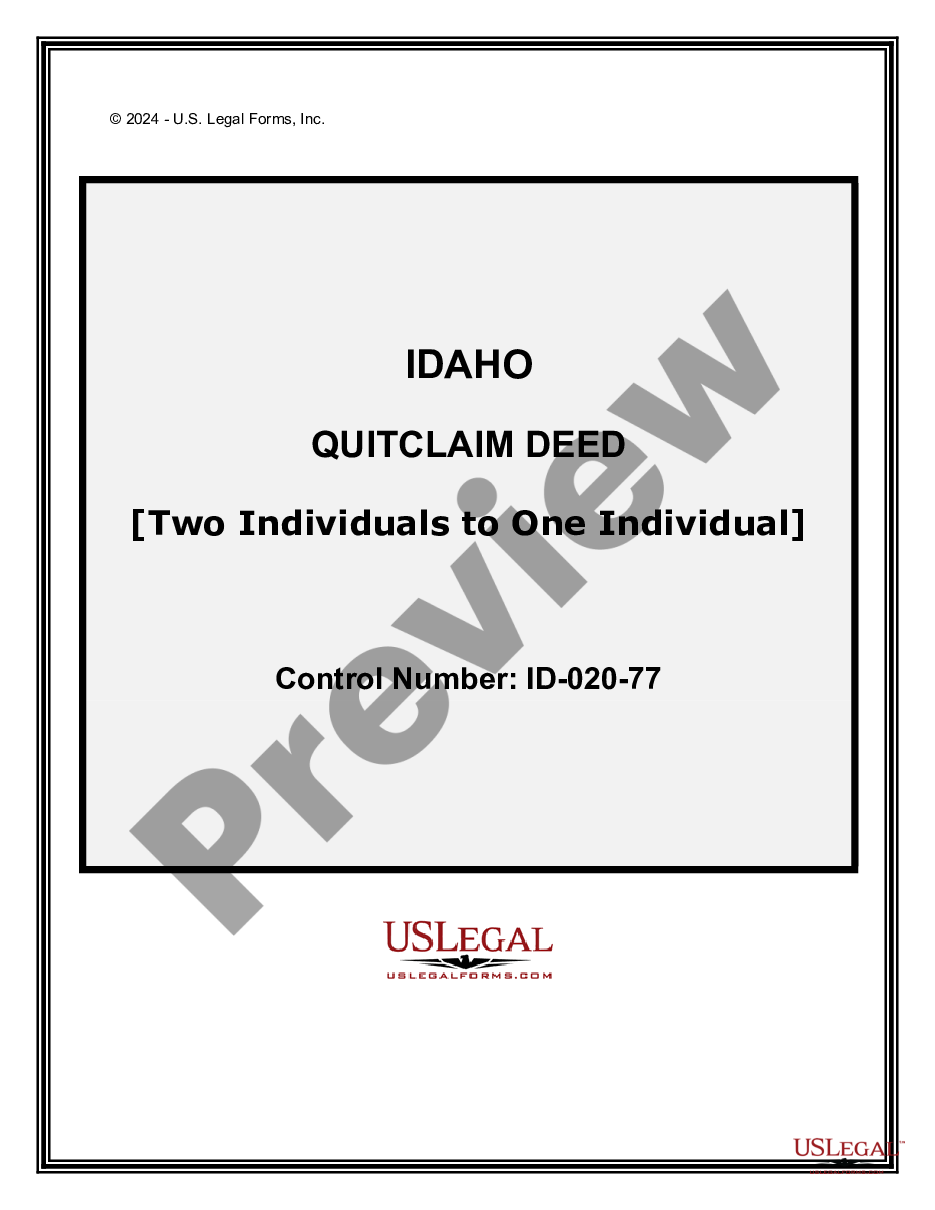
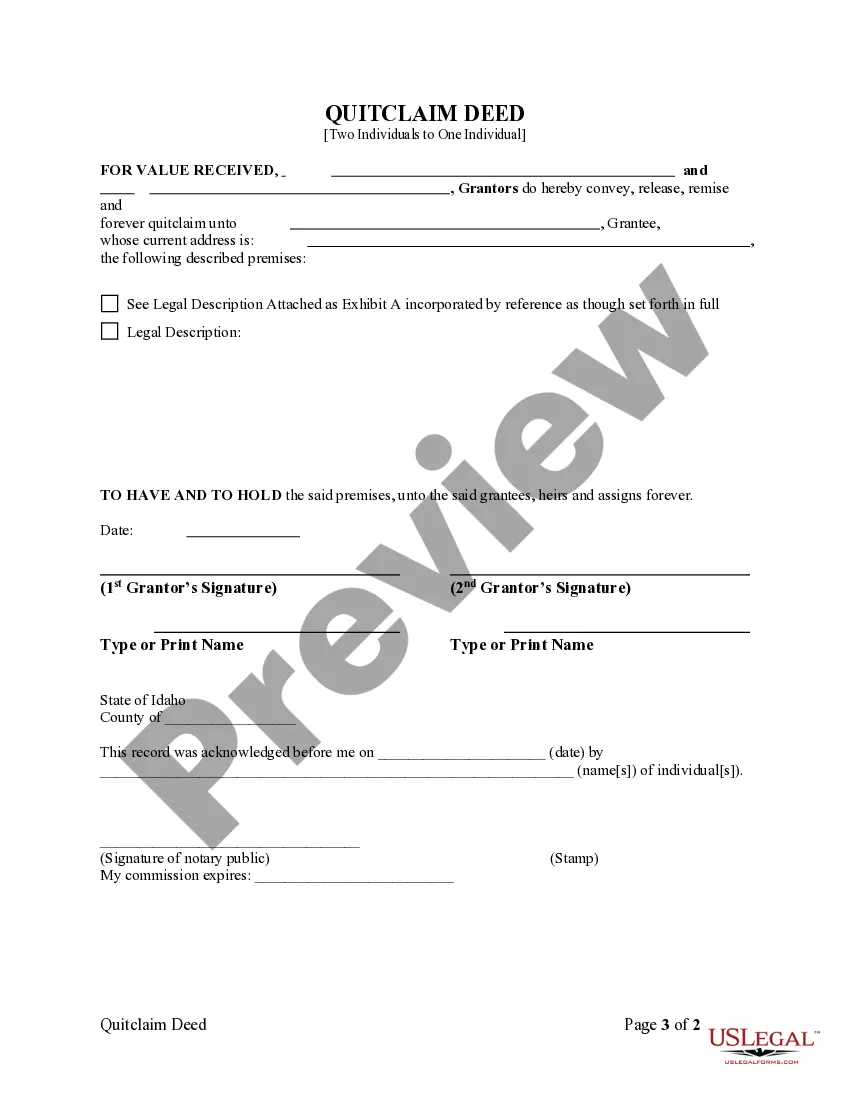

Get your form ready online
Our built-in tools help you complete, sign, share, and store your documents in one place.
Make edits, fill in missing information, and update formatting in US Legal Forms—just like you would in MS Word.
Download a copy, print it, send it by email, or mail it via USPS—whatever works best for your next step.
Sign and collect signatures with our SignNow integration. Send to multiple recipients, set reminders, and more. Go Premium to unlock E-Sign.
If this form requires notarization, complete it online through a secure video call—no need to meet a notary in person or wait for an appointment.
We protect your documents and personal data by following strict security and privacy standards.

Make edits, fill in missing information, and update formatting in US Legal Forms—just like you would in MS Word.

Download a copy, print it, send it by email, or mail it via USPS—whatever works best for your next step.

Sign and collect signatures with our SignNow integration. Send to multiple recipients, set reminders, and more. Go Premium to unlock E-Sign.

If this form requires notarization, complete it online through a secure video call—no need to meet a notary in person or wait for an appointment.

We protect your documents and personal data by following strict security and privacy standards.
Looking for another form?
How to fill out Idaho Quitclaim Deed - Two Individuals To One Individual?
Well-prepared official paperwork is a crucial safeguard against issues and legal disputes, but acquiring it without the help of an attorney can be time-consuming.
Whether you require a current Quitclaim Deed Idaho With Life Estate or other documents for employment, family, or commercial purposes, US Legal Forms is here to assist.
The process is even more straightforward for current users of the US Legal Forms library. If your subscription is active, simply Log In to your account and click the Download button next to the selected file. Additionally, you can retrieve the Quitclaim Deed Idaho With Life Estate at any time since all documents ever obtained on the platform are accessible within the My documents section of your profile. Save time and resources on creating formal documents. Experience US Legal Forms today!
- Verify that the form fits your situation and location by reviewing the description and preview.
- If necessary, search for another sample using the Search bar located in the page header.
- Once you find the appropriate template, click on Buy Now.
- Select the pricing plan, sign into your account, or create a new one.
- Choose your preferred payment method to purchase the subscription plan (using a credit card or PayPal).
- Select PDF or DOCX file format for your Quitclaim Deed Idaho With Life Estate.
- Click Download, then print the document to complete it or upload it to an online editor.
Form popularity
FAQ
A quitclaim deed in Idaho allows an individual to transfer their ownership interest in a property to another party without guaranteeing that the title is clear. This means that the recipient may receive whatever interest the grantor holds, which can be helpful in various situations, including family transfers or estate planning. For those considering this deed along with a life estate, understanding the implications on property rights is crucial.
In divorce situations, quitclaim deeds are often used to transfer property interests between spouses. This type of deed allows one spouse to relinquish their claim to the property, making it easier to clarify ownership. If you're contemplating a quitclaim deed in Idaho with life estate during divorce, it’s wise to seek legal advice to understand your options and protect your interests.
Yes, Idaho allows for transfer on death deeds, which allow you to designate beneficiaries who will receive your property after your death. This type of deed helps avoid probate, making the process simpler and more efficient. If you have questions about how it interacts with a quitclaim deed in Idaho with life estate, consider consulting a professional for tailored advice.
In Idaho, if you are married but your name is not on the deed, you may still have certain rights to the property. This situation often stems from community property laws, which recognize that both spouses often have an equal interest in shared assets. It’s also important to know that a quitclaim deed in Idaho with life estate can be used to formally transfer interests in property, ensuring both spouses’ rights are protected.
Removing someone from a life estate deed is not straightforward, as it requires careful consideration of ownership rights. Generally, the grantor maintains control as long as they are alive and can only relinquish the life estate with a mutual agreement. It is vital to consult with a legal expert or use platforms like US Legal Forms to navigate the complexities of altering a quitclaim deed in Idaho with a life estate.
A quitclaim deed with a life estate is a legal document that transfers ownership of property while reserving the right for the grantor to live on the property for the rest of their life. This means the grantee receives ownership, but the grantor retains a life interest, allowing them to use the property without financial obligations. Understanding this type of deed is crucial, especially when planning property transfers in Idaho, as it balances rights and responsibilities effectively.
Filling out a quitclaim deed in Idaho involves several steps. Begin by entering the names of the grantor and grantee, followed by a description of the property, including its legal description. Ensure that you indicate if it includes a life estate, to clarify ownership rights. For added assurance and to avoid mistakes, consider using US Legal Forms to guide you through the process of creating a valid quitclaim deed in Idaho.
To write a life estate deed, you start by identifying the property and the parties involved. Clearly state the grantor, who creates the deed, and the grantee, who receives the life estate. You must include a clause that specifies the life estate's duration, usually the lifetime of the grantee. Using a reputable legal service like US Legal Forms can simplify this process, especially when dealing with a quitclaim deed in Idaho with a life estate.
A life estate in Idaho allows a person to use the property for their lifetime, after which ownership transfers to another individual. This provides the life tenant rights to occupy and benefit from the property during their life. It also helps in estate planning and can reduce taxes, but it limits the life tenant's ability to sell the property without consent. Understanding these details can guide effective estate decisions.
In Idaho, a spouse may give up their rights to property by signing a quitclaim deed, yet nuances exist. If the property was acquired during the marriage, the spouse may still hold certain rights. However, the specifics can differ based on individual circumstances. It's advisable to discuss your situation with a legal professional to fully understand your rights.