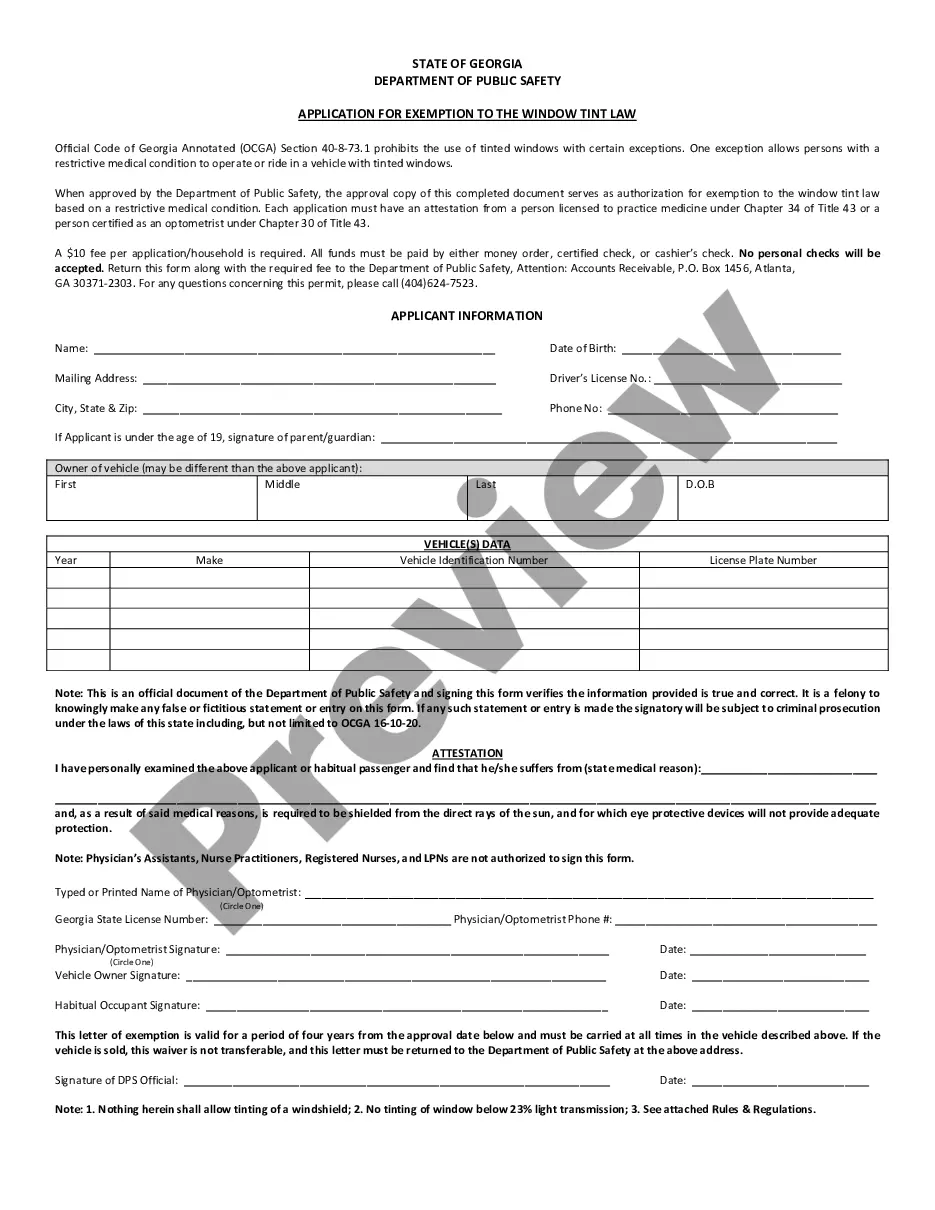
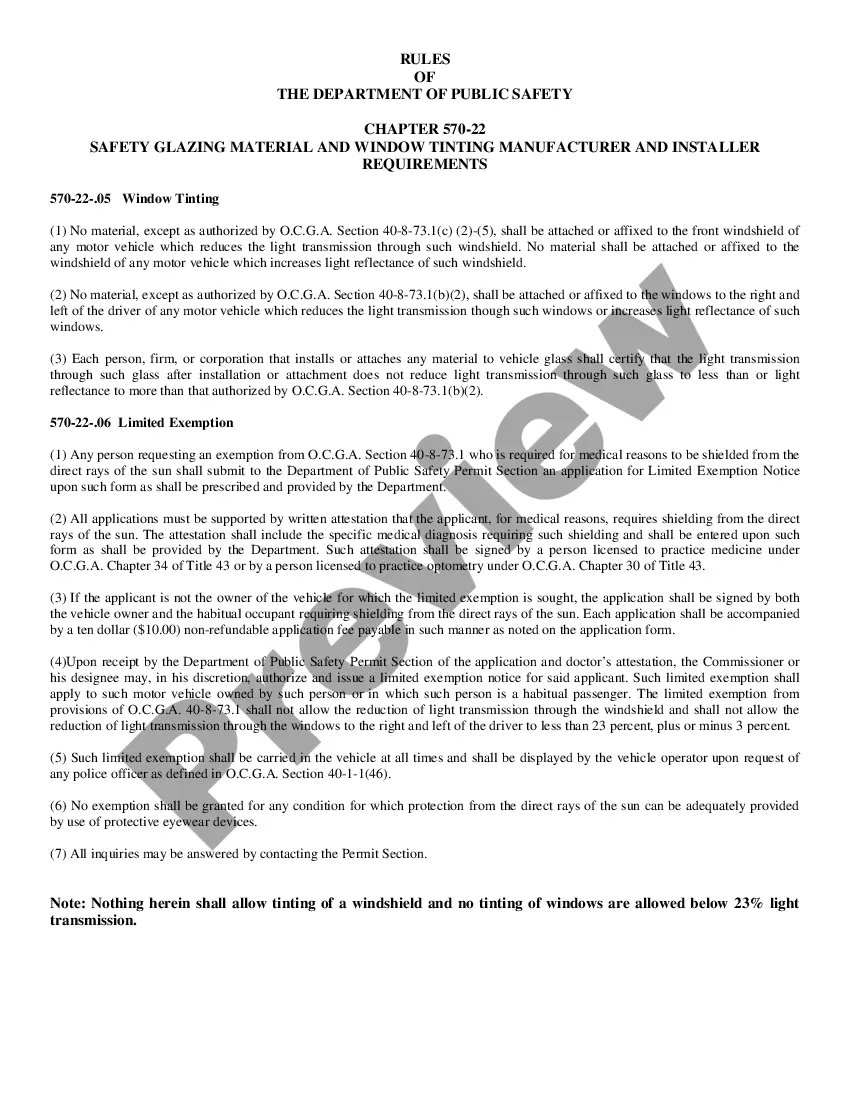
Tint Permit Georgia Forestry Commission
Description
Get your form ready online
Our built-in tools help you complete, sign, share, and store your documents in one place.
Make edits, fill in missing information, and update formatting in US Legal Forms—just like you would in MS Word.
Download a copy, print it, send it by email, or mail it via USPS—whatever works best for your next step.
Sign and collect signatures with our SignNow integration. Send to multiple recipients, set reminders, and more. Go Premium to unlock E-Sign.
If this form requires notarization, complete it online through a secure video call—no need to meet a notary in person or wait for an appointment.
We protect your documents and personal data by following strict security and privacy standards.

Make edits, fill in missing information, and update formatting in US Legal Forms—just like you would in MS Word.

Download a copy, print it, send it by email, or mail it via USPS—whatever works best for your next step.

Sign and collect signatures with our SignNow integration. Send to multiple recipients, set reminders, and more. Go Premium to unlock E-Sign.

If this form requires notarization, complete it online through a secure video call—no need to meet a notary in person or wait for an appointment.

We protect your documents and personal data by following strict security and privacy standards.
Looking for another form?






How to fill out Georgia Application For Exemption To The Window Tint Law?
Securing a reliable source for obtaining the most up-to-date and pertinent legal templates is half the battle of navigating bureaucracy. Locating the appropriate legal documents requires precision and meticulousness, which is why it is essential to source Tint Permit Georgia Forestry Commission samples exclusively from credible providers, such as US Legal Forms. An incorrect form will squander your time and prolong your current situation. With US Legal Forms, you have minimal concerns. You can access and verify all the details regarding the document’s applicability and significance for your circumstances and within your state or locality.
Follow these steps to complete your Tint Permit Georgia Forestry Commission.
Once you have the form on your device, you can modify it using the editor or print it and fill it out manually. Eliminate the hassle that comes with your legal documentation. Explore the extensive US Legal Forms catalog where you can find legal templates, assess their relevance to your situation, and download them instantly.
- Utilize the catalog navigation or search option to locate your template.
- Examine the form’s details to confirm it meets the criteria of your state and locality.
- Review the form preview, if available, to verify that the template aligns with what you are seeking.
- Return to the search if the Tint Permit Georgia Forestry Commission does not meet your requirements.
- If you are confident in the form’s applicability, download it.
- If you are a registered user, click Log in to verify your identity and access your selected templates in My documents.
- If you do not have an account yet, click Buy now to acquire the form.
- Choose the pricing option that suits your needs.
- Proceed to the registration to complete your purchase.
- Finalize your transaction by selecting a payment method (credit card or PayPal).
- Select the document format for downloading the Tint Permit Georgia Forestry Commission.
Form popularity
FAQ
In the state of Georgia, non-reflective tint is allowed on the top 6 inches of your windshield. Front side windows must allow more than 32% of the light in. Back-side windows can be tinted to any level of darkness or more than 32% depending on your vehicle type. The same goes for your rear windows.
What Conditions Typically Qualify for Medical Window Tints Systemic Lupus Erythematosus. Systemic lupus erythematosus is an autoimmune disease where patients suffer from marked photosensitivity. ... Cockayne Syndrome. ... Bloom Syndrome. ... Solar Urticaria. ... Erythropoietic Protoporphyria. ... Albinism. ... Xeroderma Pigmentosum.
If you get pulled over, chances are the officer will test your window tinting using a special tool. If the amount of light allowed into your vehicle is lower than the legal limit, you're likely to receive a ticket. G?eorgia laws do allow for a 3% transmission tolerance.
Gather What You'll Need Application for Exemption to the Window Tint Law. Information about the vehicle, such as year, make, vehicle identification number, and license plate number. A written and signed attestation from a physician or optometrist. Method of payment (money order, certified check, or cashier's check)
Even if you're driving with a legal amount of tint on your vehicle's windows, an officer could still pull you over on something called 'articulable suspicion.