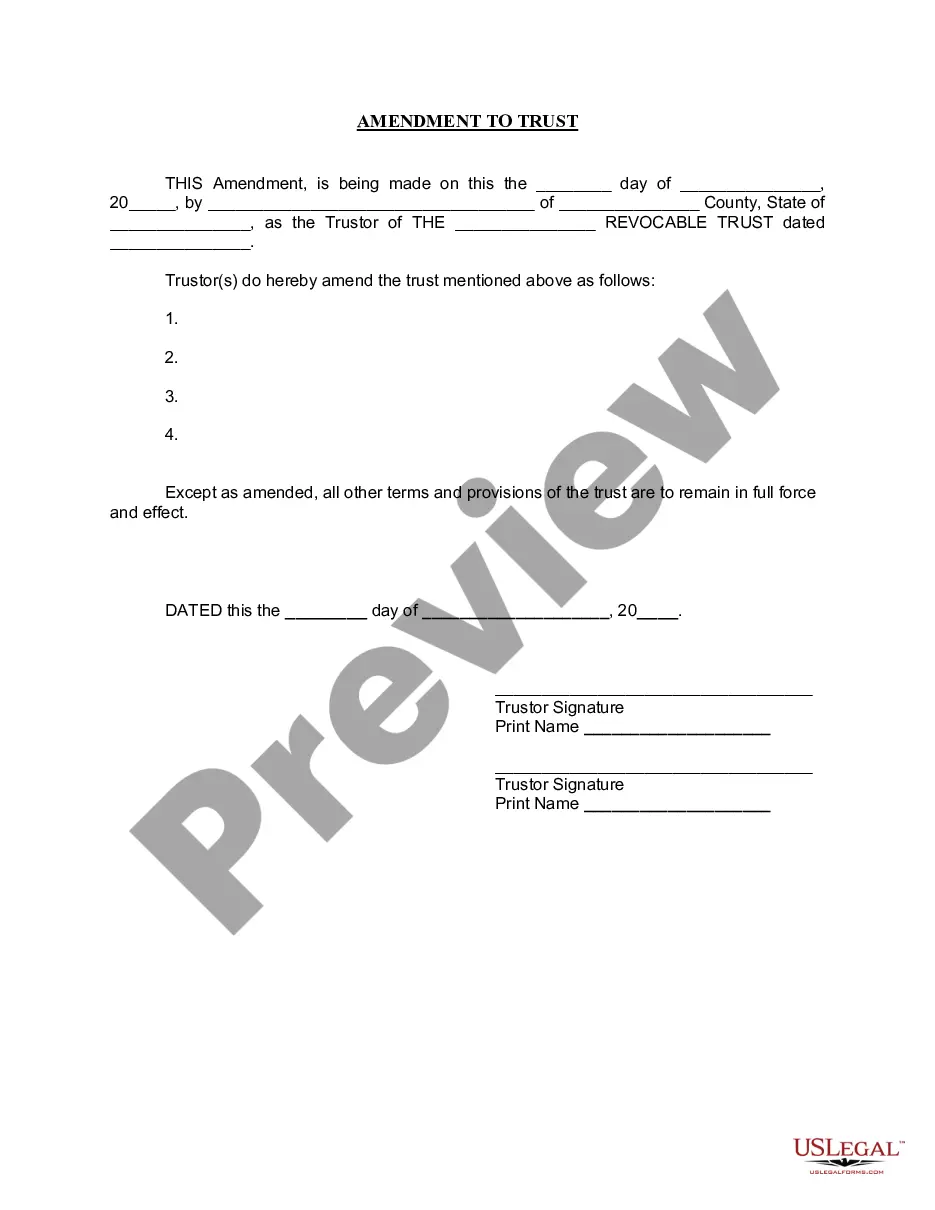
Sample Trust Amendment Form For Revocable Living Trust

Description


Get your form ready online
Our built-in tools help you complete, sign, share, and store your documents in one place.
Make edits, fill in missing information, and update formatting in US Legal Forms—just like you would in MS Word.
Download a copy, print it, send it by email, or mail it via USPS—whatever works best for your next step.
Sign and collect signatures with our SignNow integration. Send to multiple recipients, set reminders, and more. Go Premium to unlock E-Sign.
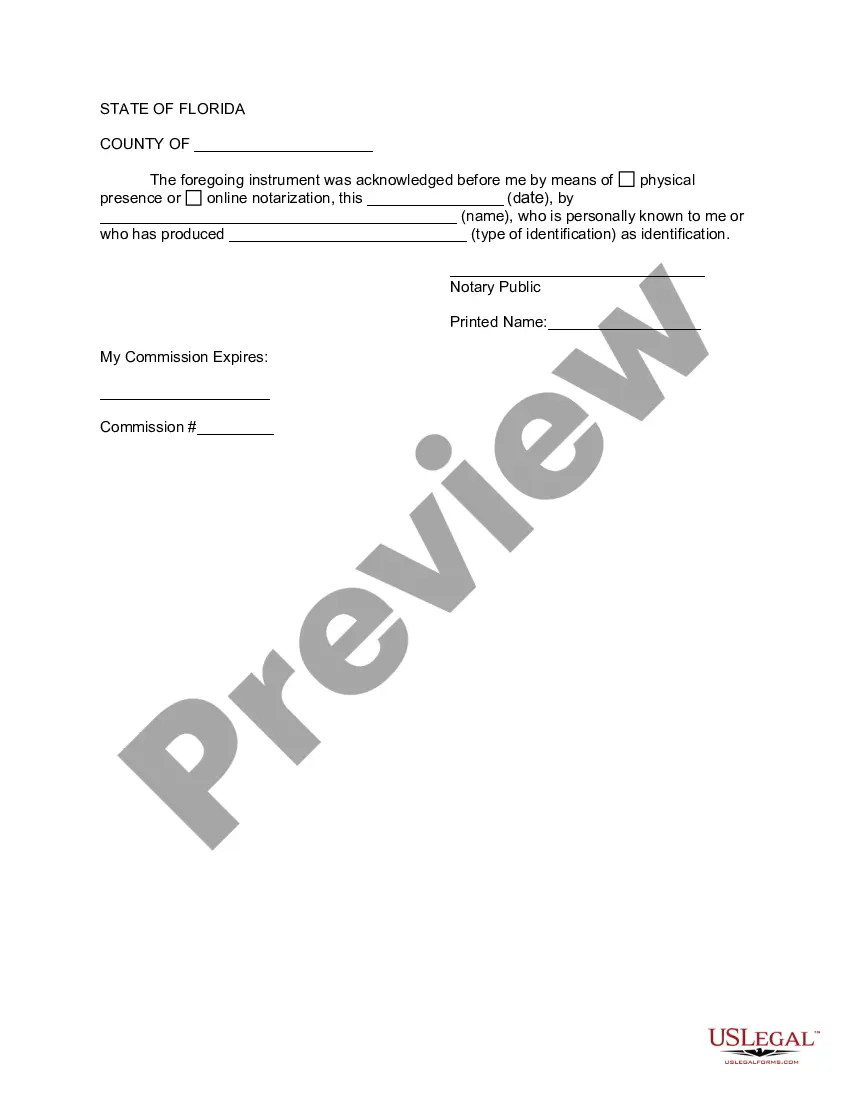
If this form requires notarization, complete it online through a secure video call—no need to meet a notary in person or wait for an appointment.
We protect your documents and personal data by following strict security and privacy standards.

Make edits, fill in missing information, and update formatting in US Legal Forms—just like you would in MS Word.

Download a copy, print it, send it by email, or mail it via USPS—whatever works best for your next step.

Sign and collect signatures with our SignNow integration. Send to multiple recipients, set reminders, and more. Go Premium to unlock E-Sign.

If this form requires notarization, complete it online through a secure video call—no need to meet a notary in person or wait for an appointment.

We protect your documents and personal data by following strict security and privacy standards.
Looking for another form?

How to fill out Florida Amendment To Living Trust?
The Sample Trust Amendment Form For Revocable Living Trust presented on this page is a versatile official template created by experienced attorneys in compliance with federal and local laws.
For over 25 years, US Legal Forms has supplied individuals, businesses, and legal professionals with over 85,000 validated, state-specific documents for various business and personal needs. It’s the quickest, simplest, and most reliable method to acquire the necessary paperwork, as the service assures the utmost level of data protection and anti-malware safeguards.
Select the format you prefer for your Sample Trust Amendment Form For Revocable Living Trust (PDF, Word, RTF) and download the document onto your device. Complete and sign the paperwork by either printing the template to fill it out by hand or using an online multifunctional PDF editor to quickly and accurately fill out and sign your form with a valid signature.
- Search for the document you require and review it.
- Browse through the sample you searched for and view it or examine the form description to confirm it meets your requirements. If it does not, use the search bar to find the suitable one. Click Buy Now when you have located the template you need.
- Choose a subscription plan and create an account.
- Select the pricing option that fits you and sign up for an account. Use PayPal or a credit card to make a swift payment. If you already possess an account, Log In and verify your subscription to continue.
- Obtain the editable template.
Form popularity
FAQ
A revocable trust can be modified while the Grantor is alive. Revising the terms of a trust is known as ?amending? the trust. An amendment is generally appropriate when there are only a few minor changes to make, like rewording a certain paragraph, changing the successor trustee, or modifying beneficiaries.
For example, you might use a trust amendment form to: Update your trustee or successor trustee: If your chosen trustee is no longer willing or able to manage the trust, or you'd like to designate someone else, you can use an amendment form to name another person or organization to manage your trust.
If you've already written a will that includes someone you wish to remove, don't add a codicil (an addition to your will written as a separate document) ? write a new will. It'll stop the document becoming too complicated and open to a challenge. It also means you can more accurately outline your current wishes.
A beneficiary can renounce their interest from the trust and, upon the consent of other beneficiaries, be allowed to exit. A trustee cannot remove a beneficiary from an irrevocable trust. A grantor can remove a beneficiary from a revocable trust by going back to the trust deed codes that allow for the same.
A trust amendment that can be used to modify an existing California revocable trust instrument. This trust amendment allows a client to modify a revocable trust instrument without creating an entirely new trust instrument or restating an existing revocable trust instrument in its entirety.