Will In Trust Vs Living Trust
Description



Get your form ready online
Our built-in tools help you complete, sign, share, and store your documents in one place.
Make edits, fill in missing information, and update formatting in US Legal Forms—just like you would in MS Word.
Download a copy, print it, send it by email, or mail it via USPS—whatever works best for your next step.
Sign and collect signatures with our SignNow integration. Send to multiple recipients, set reminders, and more. Go Premium to unlock E-Sign.
If this form requires notarization, complete it online through a secure video call—no need to meet a notary in person or wait for an appointment.
We protect your documents and personal data by following strict security and privacy standards.

Make edits, fill in missing information, and update formatting in US Legal Forms—just like you would in MS Word.

Download a copy, print it, send it by email, or mail it via USPS—whatever works best for your next step.

Sign and collect signatures with our SignNow integration. Send to multiple recipients, set reminders, and more. Go Premium to unlock E-Sign.

If this form requires notarization, complete it online through a secure video call—no need to meet a notary in person or wait for an appointment.

We protect your documents and personal data by following strict security and privacy standards.
Looking for another form?





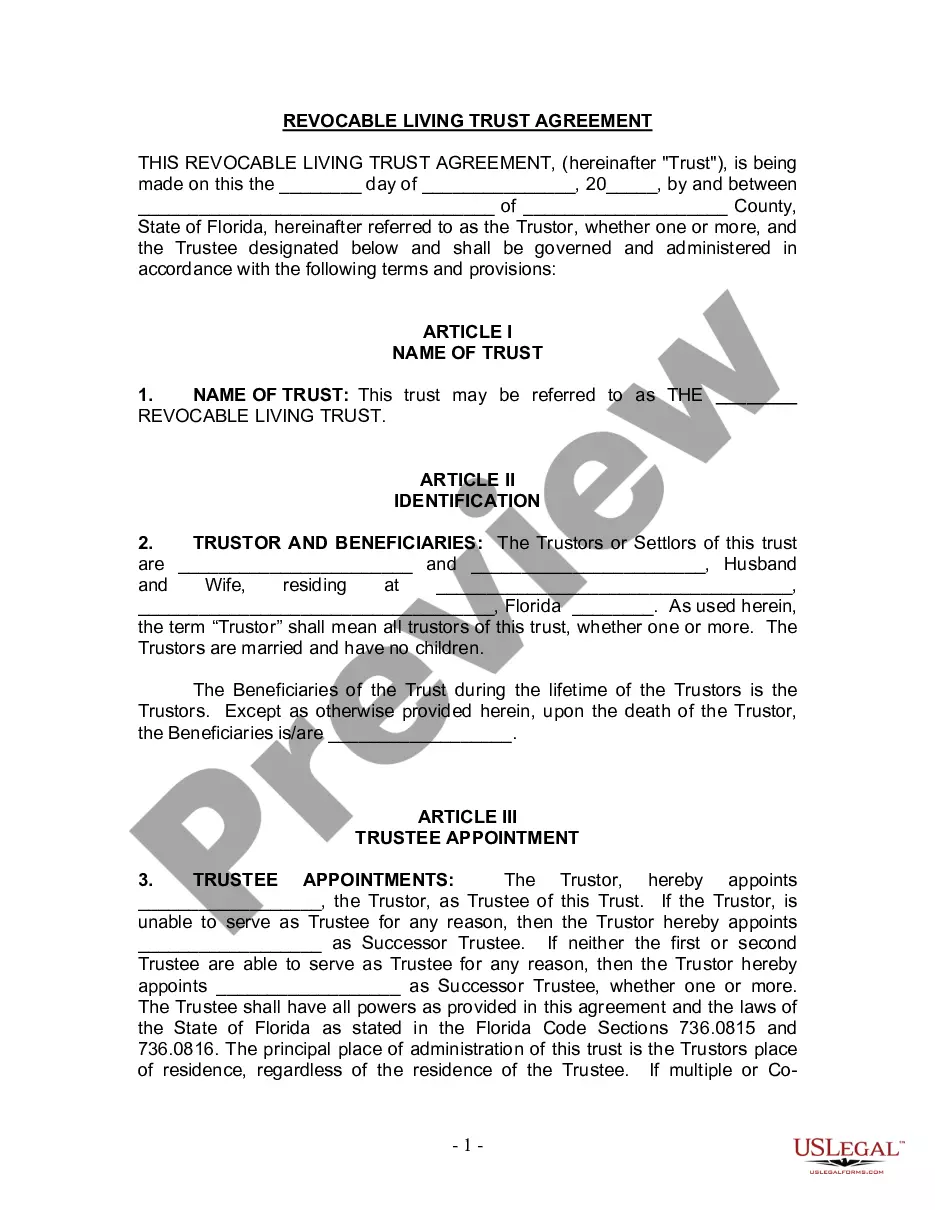
How to fill out Florida Revocable Living Trust For Husband And Wife With No Children?
Dealing with legal paperwork and processes can be a lengthy addition to your schedule.
Will In Trust Vs Living Trust and similar documents often require you to locate them and figure out the best method to complete them proficiently.
Thus, if you are managing financial, legal, or personal affairs, having a comprehensive and accessible online library of forms at your convenience will be immensely helpful.
US Legal Forms is the leading online platform for legal templates, featuring over 85,000 state-specific forms and various resources to help you finalize your documents swiftly.
Simply Log In to your account, search for Will In Trust Vs Living Trust, and download it instantly from the My documents tab. You can also access previously saved forms.
- Explore the collection of pertinent documents available to you with merely a click.
- US Legal Forms provides you with state- and county-specific forms accessible at any time for downloading.
- Protect your document management processes by utilizing a premium service that allows you to prepare any form within minutes without additional or concealed fees.
Form popularity
FAQ
Determining which is better—a will or a trust—depends on your specific needs and circumstances. A will is simpler to create and offers a straightforward method for distributing your assets after your death. However, a living trust can provide more control and privacy while avoiding probate, which is beneficial in discussing the will in trust vs living trust.
A living trust, unlike a will, can keep your assets out of probate proceedings. A trustor names a trustee to manage the assets of the trust indefinitely. Wills name an executor to manage the assets of the probate estate only until probate closes. Trusts tend to be more expensive and more complex to maintain than wills.
Disadvantages of a Living Trust Limitations on transfers. Once you move your assets into a trust, you must follow the trust document's instructions on assignments. ... No tax avoidance. For the most part, you are unable to completely avoid paying taxes on living trusts. ... Increased contesting period.
Like a Will and a testamentary trust, a Living Trust lets you decide specifically what will happen to your property after you die. You can also use a trust to control how your beneficiaries will spend their inheritance (to reduce the risk they may "blow it" on expensive vacations, cars, gambling, etc.).
Assets that should not be used to fund your living trust include: Qualified retirement accounts ? 401ks, IRAs, 403(b)s, qualified annuities. Health saving accounts (HSAs) Medical saving accounts (MSAs) Uniform Transfers to Minors (UTMAs) Uniform Gifts to Minors (UGMAs) Life insurance. Motor vehicles.