Florida Code For Roofing
Description



Get your form ready online
Our built-in tools help you complete, sign, share, and store your documents in one place.
Make edits, fill in missing information, and update formatting in US Legal Forms—just like you would in MS Word.
Download a copy, print it, send it by email, or mail it via USPS—whatever works best for your next step.
Sign and collect signatures with our SignNow integration. Send to multiple recipients, set reminders, and more. Go Premium to unlock E-Sign.
If this form requires notarization, complete it online through a secure video call—no need to meet a notary in person or wait for an appointment.
We protect your documents and personal data by following strict security and privacy standards.

Make edits, fill in missing information, and update formatting in US Legal Forms—just like you would in MS Word.

Download a copy, print it, send it by email, or mail it via USPS—whatever works best for your next step.

Sign and collect signatures with our SignNow integration. Send to multiple recipients, set reminders, and more. Go Premium to unlock E-Sign.

If this form requires notarization, complete it online through a secure video call—no need to meet a notary in person or wait for an appointment.

We protect your documents and personal data by following strict security and privacy standards.
Looking for another form?


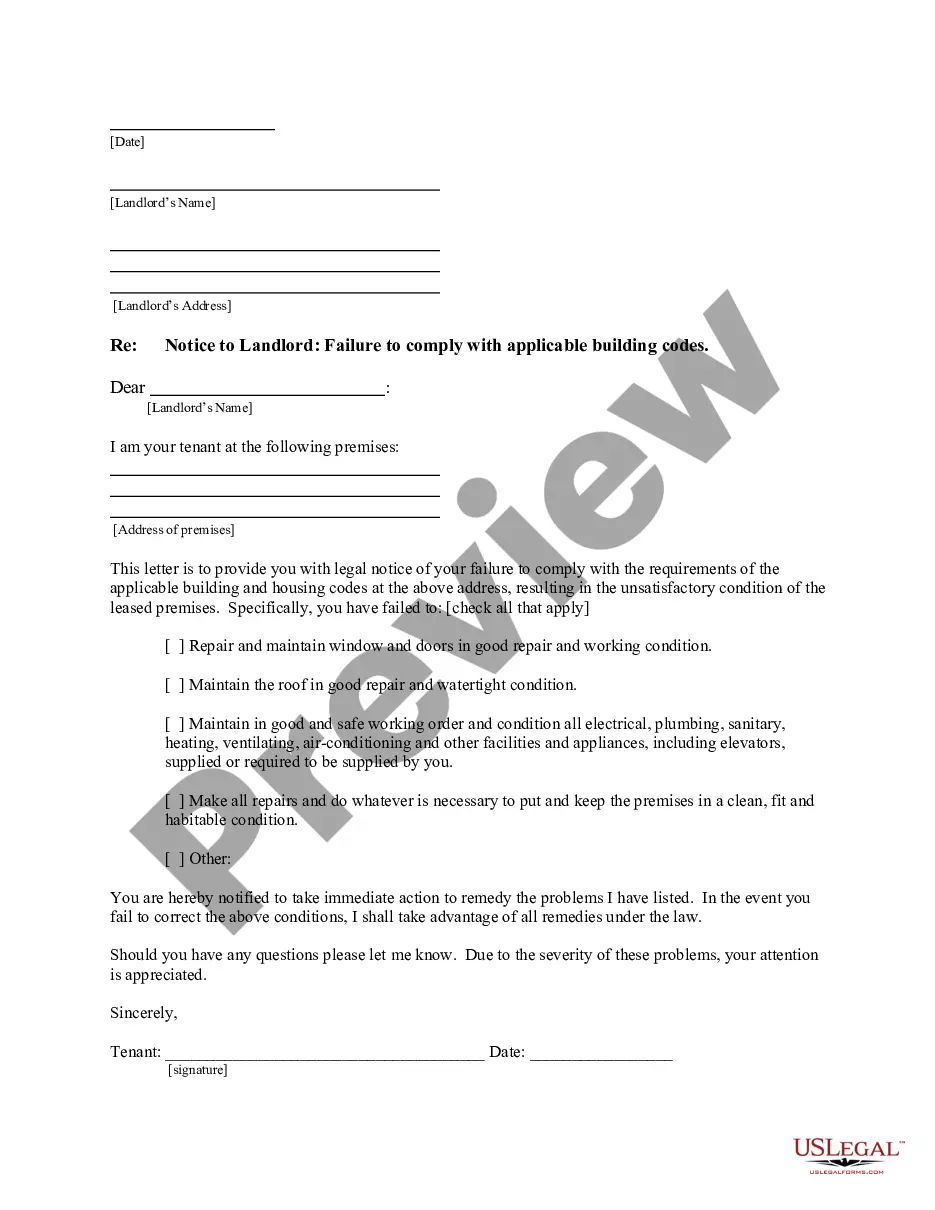
How to fill out Florida Letter From Tenant To Landlord For Failure Of Landlord To Comply With Building Codes Affecting Health And Safety Or Resulting In Untenantable Condition - Demand For Remedy?
Regardless of whether it is for professional reasons or personal concerns, everyone must handle legal issues at some point in their lives.
Completing legal documentation requires meticulous care, starting with selecting the appropriate form template.
Once it is downloaded, you can fill out the form with editing software or print it and complete it manually. With an extensive US Legal Forms collection available, you won't waste time searching for the right template online. Utilize the library’s user-friendly navigation to find the correct form for any scenario.
- Obtain the template you require using the search bar or the catalog browsing.
- Examine the form’s details to ensure it aligns with your circumstances, state, and county.
- Click on the preview of the form to view it.
- If it is not the correct form, return to the search option to find the Florida Code For Roofing template you need.
- Obtain the template if it suits your requirements.
- If you possess a US Legal Forms account, simply click Log in to access previously saved templates in My documents.
- If you do not yet have an account, you can secure the form by clicking Buy now.
- Select the appropriate pricing option.
- Complete the account registration form.
- Choose your payment method: a credit card or PayPal account.
- Select the document format you desire and download the Florida Code For Roofing.
Form popularity
FAQ
In recent years, the Florida code for roofing has introduced several important changes aimed at improving safety and durability. These rules focus on enhanced wind resistance and energy efficiency for roofing materials. Homeowners must ensure their roofing systems comply with these updated standards, especially in storm-prone areas. For guidance through these regulations, you can rely on platforms like US Legal Forms to help you navigate the legal requirements.
The code for roofing in Florida outlines the standards that homeowners, contractors, and builders must follow for roofing projects. This code includes information on material types, design specifications, and inspection procedures. Understanding the Florida code for roofing is crucial to avoid fines and ensure quality work. Platforms like uslegalforms can assist you in navigating these regulations, helping you stay compliant and informed.
The roof rule in Florida refers to specific guidelines designed to ensure safe and effective roofing practices. These rules detail installation methods, material standards, and necessary inspections. Compliance with the Florida code for roofing helps protect homes from potential hazards, increasing their longevity and safety. It's essential to familiarize yourself with these regulations to ensure your roofing project meets legal requirements.
The new roof code in Florida establishes updated requirements for roofing materials, installation practices, and inspections. These regulations ensure that roofs withstand Florida's unique weather conditions, such as hurricanes and severe storms. The Florida code for roofing emphasizes safety and durability, providing homeowners with peace of mind. By staying informed about these updates, you can enhance your property's resilience.
And for roofs that are older than 15 years, insurers would have to allow homeowners to have an inspection on the roof's condition before refusing coverage. If the inspection shows the roof has five or more years of useful life left, the insurance company could not reject coverage simply because of age.?
Here is the text of the Rule: 708.1. 1 Not more than 25 percent of the total roof area or roof section of any existing building or structure shall be repaired, replaced or recovered in any 12-month period unless the entire roofing system or roof section conforms to requirements of this code.
Drip Edge (R 905.2. 8.5) - shall be overlapped a minimum 3? and fastened 4? o.c. The drip edge may be installed under or over the underlayment. If drip edge installed over underlayment there shall be minimum 4? roof cement covering or approved alternate material. Flashing (R 905.2.
Florida Building Code 25% Reroofing Rule Not more than 25 percent of the total roof area or roof section of any existing building or structure shall be repaired, replaced or recovered in any 12-month period unless the entire roofing system or roof section conforms to requirements of this code.
However, on , SB 4-D took effect, which eliminated Florida's 25% Roof Replacement Rule. Now, so long as the rest of the roof is in compliance with the 2007 Florida Building Code, or any subsequent versions of that code, then a full roof replacement is not required.