Notice Given By Landlord
Description


Get your form ready online
Our built-in tools help you complete, sign, share, and store your documents in one place.
Make edits, fill in missing information, and update formatting in US Legal Forms—just like you would in MS Word.
Download a copy, print it, send it by email, or mail it via USPS—whatever works best for your next step.
Sign and collect signatures with our SignNow integration. Send to multiple recipients, set reminders, and more. Go Premium to unlock E-Sign.
If this form requires notarization, complete it online through a secure video call—no need to meet a notary in person or wait for an appointment.
We protect your documents and personal data by following strict security and privacy standards.

Make edits, fill in missing information, and update formatting in US Legal Forms—just like you would in MS Word.

Download a copy, print it, send it by email, or mail it via USPS—whatever works best for your next step.

Sign and collect signatures with our SignNow integration. Send to multiple recipients, set reminders, and more. Go Premium to unlock E-Sign.

If this form requires notarization, complete it online through a secure video call—no need to meet a notary in person or wait for an appointment.

We protect your documents and personal data by following strict security and privacy standards.
Looking for another form?







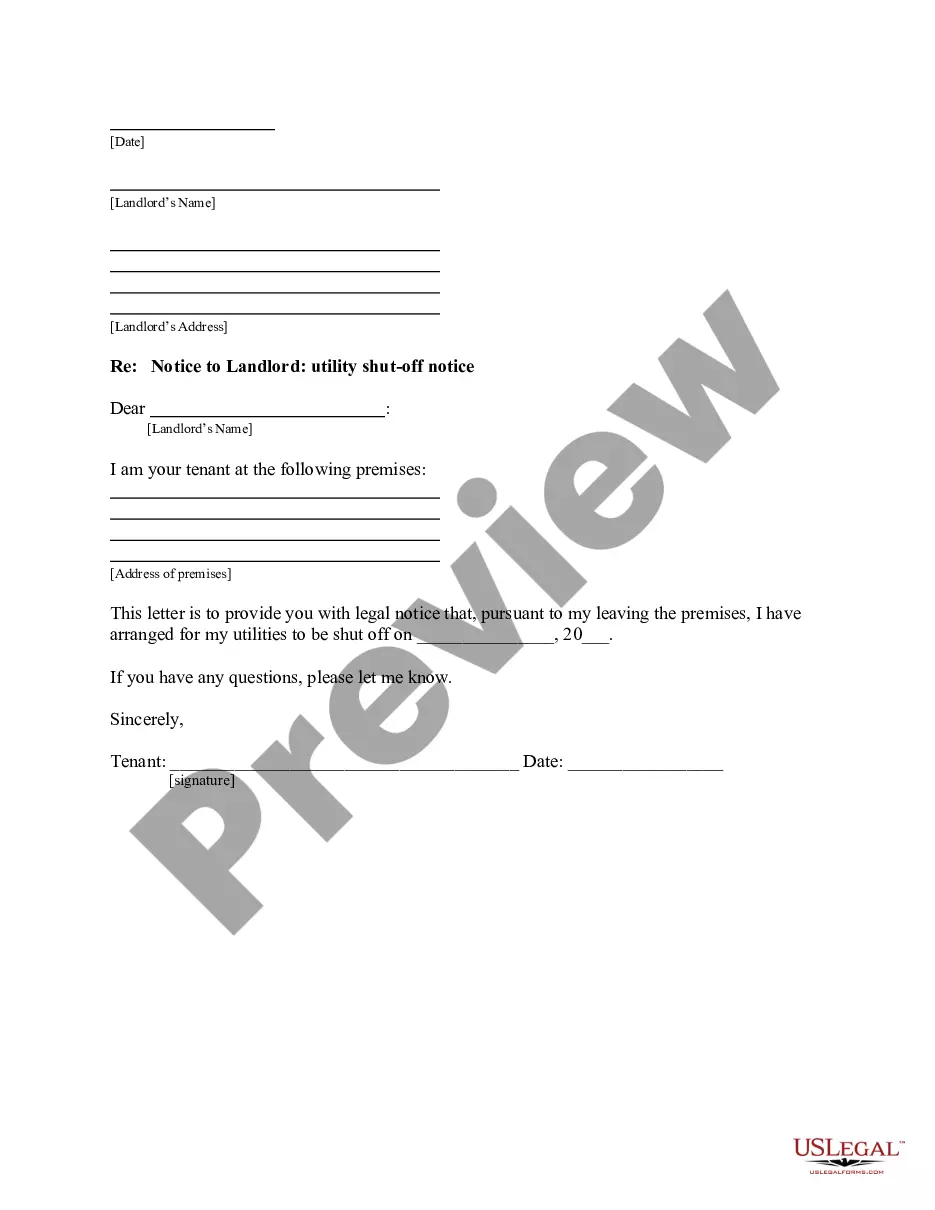
How to fill out Connecticut Letter From Tenant To Landlord - Utility Shut Off Notice To Landlord Due To Tenant Vacating Premises?
- Log into your US Legal Forms account if you are a returning user. Verify your subscription is active; renew if necessary.
- If you're new to our service, begin by previewing the available templates. Ensure you select one that fits your specific legal needs.
- Should you encounter any issues, utilize the search feature to find the correct document tailored to your jurisdiction.
- Proceed to purchase the document by clicking 'Buy Now.' Choose your desired subscription plan and create an account for access to our extensive library.
- Complete the purchase by entering your payment details via credit card or PayPal.
- Download your 'Notice given by landlord' form and save it to your device. Access it anytime via the 'My Forms' section of your profile.
With US Legal Forms, you not only gain access to a vast array of legal documents but also support from legal experts, ensuring your forms are accurate and compliant.
Start your journey to easier legal documentation today with US Legal Forms. Visit our website to explore your options!
Form popularity
FAQ
The 42-14 law in North Carolina addresses the notice requirements for landlords regarding non-payment of rent and lease violations. It mandates that landlords provide a written notice before taking legal action to evict a tenant. The notice given by landlord under this law must state the reason and give an appropriate period for tenant response. Understanding this law can significantly impact how you approach your rental agreement and responsibilities.
In North Carolina, a landlord must provide a tenant with a written notice before initiating an eviction, which typically ranges from 10 to 30 days, depending on the reason. After the notice period, if the tenant has not vacated, the landlord can file for eviction through the courts. Understanding the timeline regarding the notice given by landlord can help you prepare appropriately. Staying informed empowers you during the eviction process.
In North Carolina, landlords cannot evict tenants without following the proper legal process, nor can they enter a rental unit without prior notice. Additionally, they cannot retaliate against tenants for asserting their rights or refuse to make necessary repairs. Knowing what actions are prohibited helps you recognize your rights when dealing with the notice given by landlord. This knowledge equips you to take appropriate actions if faced with wrongful behavior.
Tenants in common in North Carolina share ownership of a property, each holding an individual interest. This means that each tenant has the right to possess the whole property while also having the authority to sell or transfer their share. The notice given by landlord is important in this context, particularly if one tenant wishes to remove another from the property. Understanding these rights can help ensure a smooth co-ownership experience.
As a renter in North Carolina, you have several rights that protect you. This includes the right to a habitable living space and protection against unlawful eviction. The notice given by landlord must comply with state regulations, ensuring you have proper communication regarding any issues. Knowing these rights empowers you to advocate for yourself and navigate your rental situation confidently.
In North Carolina, a landlord must provide a written notice to the tenant, typically giving 10 days for eviction due to non-payment of rent. If the eviction is for other reasons, such as lease violations, the period may vary. Always ensure the notice given by landlord is clear and follows state guidelines to avoid legal complications. Familiarizing yourself with these rules can help you understand your rights better.
Not giving notice to your landlord can result in several risk factors. You may be charged for an additional month’s rent or lose your entitlement to the security deposit. Furthermore, your landlord could take legal action. Thus, understanding the importance of notice given by landlord can safeguard you from unnecessary disputes and expenses.
If you don't inform your landlord that you're moving out, you might continue to incur charges for rent and utilities. Additionally, failing to provide the proper notice given by landlord can lead to complications, such as losing your security deposit. It's advisable to communicate your plans promptly to avoid any unwanted financial burdens. Ensuring mutual agreement is key to a smooth transition.
In Texas, you can terminate your lease early under certain conditions, such as a breach of contract by the landlord or if you are a victim of domestic violence. Additionally, you must provide the notice given by landlord as per the terms of your lease. If you are uncertain about your options, consulting legal resources might be beneficial. Platforms like US Legal Forms can help you navigate the legalities effectively.
Yes, in Ohio, a landlord must generally provide a 30-day notice to terminate the lease. This rule helps protect tenants by ensuring they have adequate time to find new housing. Be sure to verify any local laws, as requirements can vary. Understanding the notice given by landlord is essential to your rights as a tenant.