Limited Companies
Description
Get your form ready online
Our built-in tools help you complete, sign, share, and store your documents in one place.
Make edits, fill in missing information, and update formatting in US Legal Forms—just like you would in MS Word.
Download a copy, print it, send it by email, or mail it via USPS—whatever works best for your next step.
Sign and collect signatures with our SignNow integration. Send to multiple recipients, set reminders, and more. Go Premium to unlock E-Sign.
If this form requires notarization, complete it online through a secure video call—no need to meet a notary in person or wait for an appointment.
We protect your documents and personal data by following strict security and privacy standards.

Make edits, fill in missing information, and update formatting in US Legal Forms—just like you would in MS Word.

Download a copy, print it, send it by email, or mail it via USPS—whatever works best for your next step.

Sign and collect signatures with our SignNow integration. Send to multiple recipients, set reminders, and more. Go Premium to unlock E-Sign.

If this form requires notarization, complete it online through a secure video call—no need to meet a notary in person or wait for an appointment.

We protect your documents and personal data by following strict security and privacy standards.
Looking for another form?


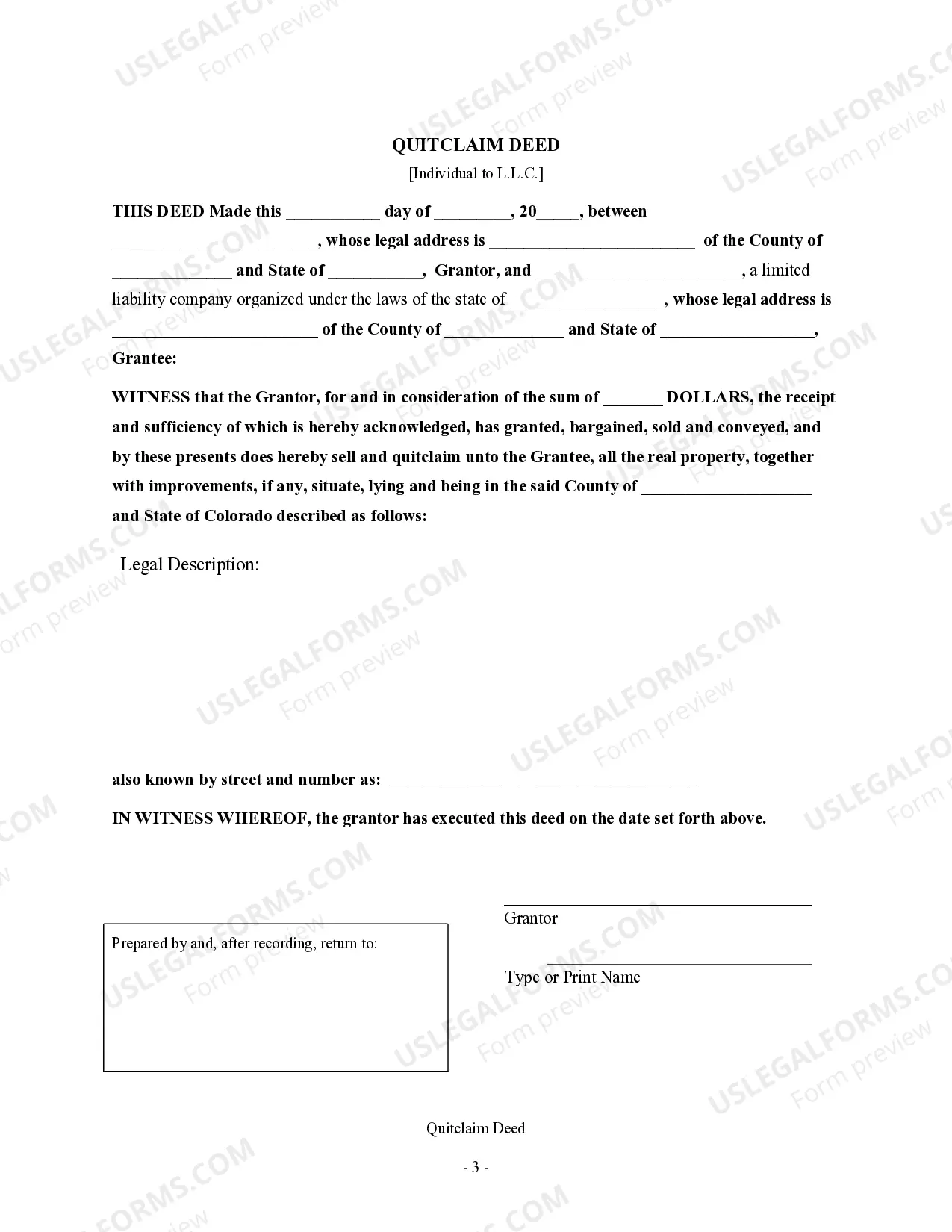
How to fill out Colorado Quitclaim Deed - Individual To Limited Liability Company?
- If you're a returning user, log in to your account to download the required form template. Ensure your subscription remains active or renew it if necessary.
- For first-time users, start by reviewing the Preview mode and form description to confirm you've selected the appropriate form that aligns with your local jurisdiction's requirements.
- If the current template does not meet your needs, use the Search tab at the top to locate the correct document.
- Once you've found the desired form, click on the Buy Now button and select your preferred subscription plan. You will need to create an account to access our extensive legal resources.
- Complete your purchase by entering your credit card information or by utilizing your PayPal account for a more convenient transaction.
- Finally, download your form and save it to your device, allowing you to access it anytime from the My Forms section of your profile.
In conclusion, US Legal Forms provides a user-friendly platform boasting a vast library of over 85,000 customizable legal forms, empowering you to quickly and accurately prepare necessary documents for your limited company.
Don't hesitate—start simplifying your legal processes today with US Legal Forms!
Form popularity
FAQ
known example of a limited liability company is Amazon LLC before it transitioned to a corporation. This structure allowed Amazon to grow its operations while shielding its owners from personal liability. Many startups begin as LLCs for this very reason. By starting as a limited liability company, entrepreneurs can protect their personal assets as they innovate and expand.
An LLC, or Limited Liability Company, is a specific type of limited company that provides flexibility in management and tax structure. While both LLCs and other limited companies protect owners from personal liability, LLCs can be taxed as either corporations or partnerships, giving owners more control over their tax situation. Additionally, LLCs often have fewer restrictions regarding ownership and operations. Understanding these distinctions will help you make an informed decision for your business.
Being a limited company means that the owners have limited liability for the company's debts and obligations. This legal structure protects personal assets in case the business faces financial trouble. Such a designation often leads to increased credibility with clients and suppliers while providing potential tax advantages. In essence, limited companies offer many strategic benefits for business owners.
One popular example of a limited company is Microsoft Corporation. As a public limited company, it allows shareholders to buy or sell shares on the stock market. This provides Microsoft with the ability to raise substantial funds for growth and operations while ensuring limited liability for its shareholders. It exemplifies how limited companies can thrive in competitive industries.
A limited company is a type of business entity that combines the benefits of a corporation with the protections offered to its owners. These businesses can operate in various sectors, from technology to retail. By choosing the limited company structure, owners can safeguard their personal assets and often enjoy tax benefits. Overall, limited companies provide an effective way to manage financial risk.
Yes, Apple Inc. is a public limited company. Its shares are publicly traded and available on various stock exchanges. As a public limited company, Apple's shareholders enjoy limited liability, meaning they are not personally responsible for the company's debts beyond their investment. This structure enables companies like Apple to raise significant capital from the public.
Limited companies refer to business entities where the liability of the owners is limited to their investment in the business. This structure protects personal assets from business debts. Common types of limited companies include private limited companies (Ltd) and public limited companies (PLC). Such a setup allows individuals to run a business with reduced financial risk.
To determine if your LLC is classified as an S or C Corp, review the choice made when you formed your business. This classification affects how your company is taxed and the benefits it can receive. Many entrepreneurs find it helpful to consult resources or services that explain these distinctions clearly. The US Legal Forms platform can guide you through the classification and its implications for your LLC.
A limited company typically needs to file an annual return, financial statements, and tax returns. Additionally, depending on the state, there might be specific documents for compliance or changes in business structure. Staying organized with these filings is crucial for your limited company's standing. US Legal Forms can assist you in understanding and preparing the necessary documentation.
Determining whether your LLC is classified as an S Corp, C Corp, or partnership depends on the tax structure you chose during formation. Generally, an LLC can elect to be taxed as a corporation or retain its default status as a partnership. Understanding these classifications can help you optimize your tax strategy. For detailed guidance, consider using US Legal Forms to assess your options.