Employee Agree Period With Termination
Description
Get your form ready online
Our built-in tools help you complete, sign, share, and store your documents in one place.
Make edits, fill in missing information, and update formatting in US Legal Forms—just like you would in MS Word.
Download a copy, print it, send it by email, or mail it via USPS—whatever works best for your next step.
Sign and collect signatures with our SignNow integration. Send to multiple recipients, set reminders, and more. Go Premium to unlock E-Sign.
If this form requires notarization, complete it online through a secure video call—no need to meet a notary in person or wait for an appointment.
We protect your documents and personal data by following strict security and privacy standards.

Make edits, fill in missing information, and update formatting in US Legal Forms—just like you would in MS Word.

Download a copy, print it, send it by email, or mail it via USPS—whatever works best for your next step.

Sign and collect signatures with our SignNow integration. Send to multiple recipients, set reminders, and more. Go Premium to unlock E-Sign.

If this form requires notarization, complete it online through a secure video call—no need to meet a notary in person or wait for an appointment.

We protect your documents and personal data by following strict security and privacy standards.
Looking for another form?





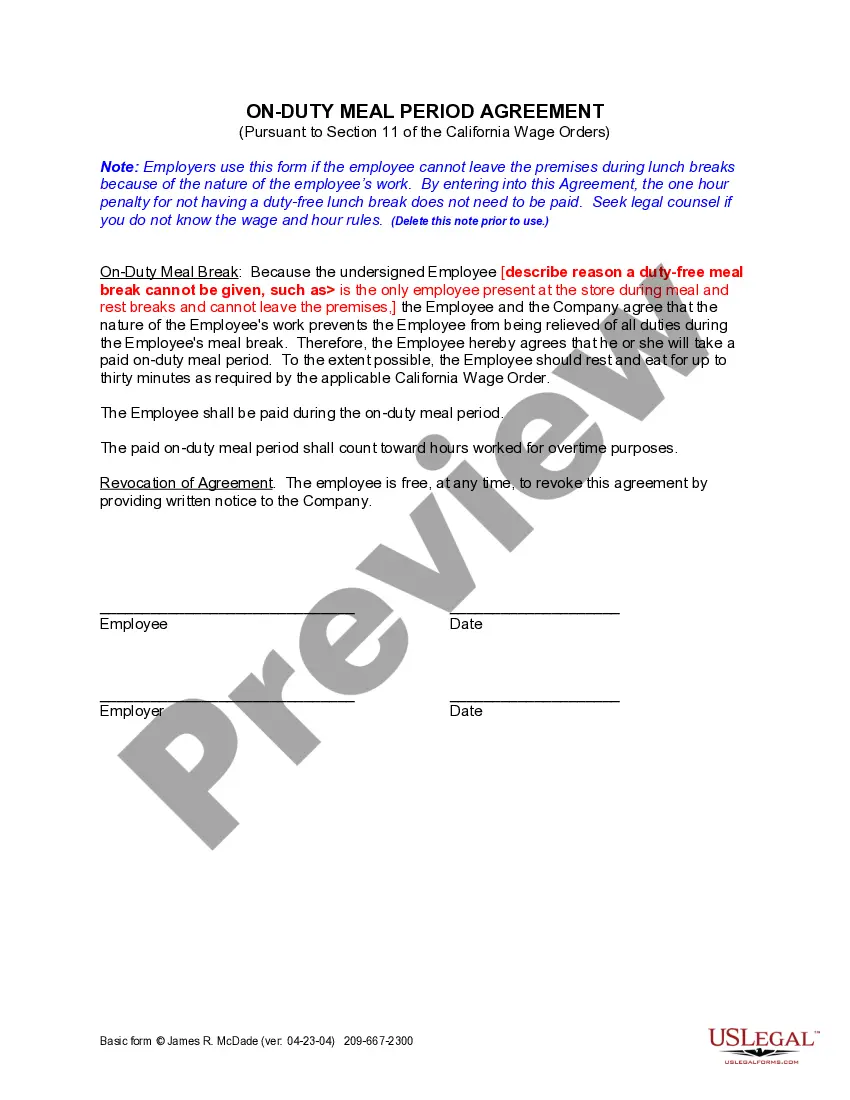
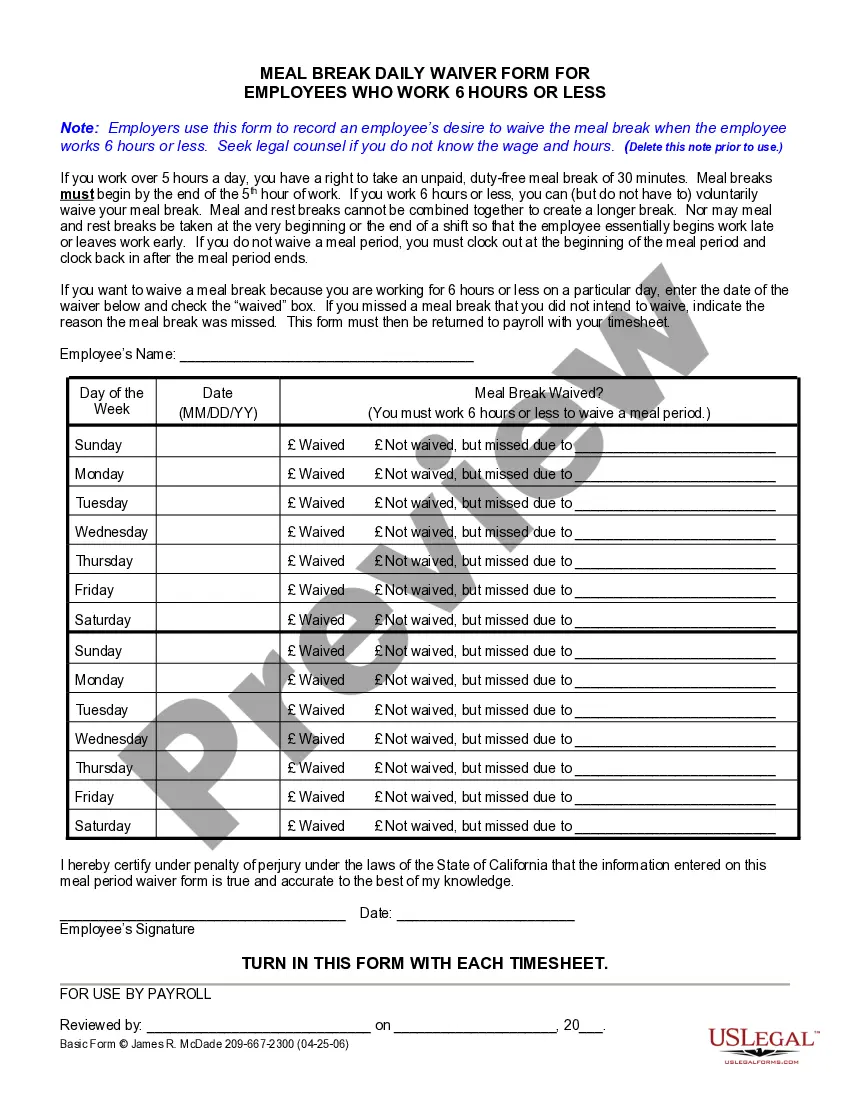
How to fill out California On Duty Meal Period Agreement?
- If you are an existing user, log in to your account and download the relevant form template by clicking the Download button. Ensure your subscription is up to date, and renew it if necessary.
- For first-time users, start by browsing the template collection. Check the Preview mode and form description to ensure it meets your specific needs and aligns with local jurisdiction requirements.
- If you need a different template, utilize the Search feature to find one that suits your criteria. This will help you ensure you have the correct documentation.
- Proceed to purchase the document by clicking the Buy Now button. Choose the subscription plan that fits your needs and register for an account to access the legal library.
- Complete your purchase by entering your payment details through credit card or PayPal for a seamless transaction.
- Finally, download your form and save it on your device. You can also access it later in the My Forms section of your profile.
US Legal Forms empowers individuals and attorneys to swiftly execute legal documents through a comprehensive library of forms, making the process of managing employee agreements efficient.
Unlock the potential of precise legal documentation. Start your journey with US Legal Forms today!
Form popularity
FAQ
An example of termination by agreement is when an employee and employer mutually decide to end the employment relationship, often through discussion and negotiation. This can occur due to various reasons, such as personal circumstances or business needs. Utilizing a formal agreement formalizes this understanding and clarifies the employee agree period with termination, protecting both parties.
Yes, an employer can terminate an employee during a probation period. This phase is typically designed for evaluating a new hire's performance and fit within the company. If issues arise, and an employee does not meet expectations, it’s vital to manage the employee agree period with termination consistently and professionally.
The purpose of a termination agreement is to provide clarity and mutual understanding regarding the end of an employment relationship. This document can detail any obligations that must be fulfilled by either side, such as confidentiality or non-compete clauses. Moreover, a well-drafted termination agreement can help ensure a smoother employee agree period with termination, benefiting both the employer and the employee.
A termination agreement is a legal document that outlines the terms under which an employee's contract will be ended. It serves to protect both the employer and employee by clearly stating the conditions of the termination, including severance payments, return of company property, and confidentiality clauses. Utilizing a termination agreement can facilitate a smoother employee agree period with termination by avoiding potential disputes.
There are three basic types of termination: voluntary, involuntary, and mutual. Voluntary termination occurs when an employee chooses to leave the job, while involuntary termination happens when the employer decides to end the employment. Mutual termination arises when both parties agree to end the employment relationship. Understanding these types can clarify your employee agree period with termination.
Choosing the right words during a termination is essential for conveying respect and professionalism. Make sure to mention the employee agreement period with termination for clarity. Use phrases like 'we must part ways' instead of harsher terms. It’s important to maintain a calm and reassuring tone to help the employee process the news.
Documenting a termination meeting is crucial for record-keeping and compliance. Start by noting the date, time, and location of the meeting, as well as who was present. Include details about the discussion topics, especially your references to the employee agreement period with termination. This documentation can be invaluable for addressing any future disputes or inquiries.
When discussing termination, use clear and compassionate language. It's important to mention the employee agreement period with termination to provide context. Phrases like 'We have decided to end your employment' convey the message firmly yet kindly. Ensure that the language used reflects company values and shows respect for the individual.
Politeness is key during the termination process, as it helps preserve dignity. Start the conversation by expressing appreciation for the employee's contributions and then explain the decision in relation to the employee agreement period with termination. Allow the employee to share their thoughts without interruption. Lastly, offer assistance during their transition to show empathy.
structured script is vital when terminating an employee, as it helps to maintain professionalism. Begin by stating the purpose of the meeting, then explain the decision clearly while referencing the employee agreement period with termination. Address any questions the employee might have. Finally, offer support resources, such as outplacement services, to assist in their transition.