Declaration Of Trust Vs Trust Agreement

Description

Get your form ready online
Our built-in tools help you complete, sign, share, and store your documents in one place.
Make edits, fill in missing information, and update formatting in US Legal Forms—just like you would in MS Word.
Download a copy, print it, send it by email, or mail it via USPS—whatever works best for your next step.
Sign and collect signatures with our SignNow integration. Send to multiple recipients, set reminders, and more. Go Premium to unlock E-Sign.
If this form requires notarization, complete it online through a secure video call—no need to meet a notary in person or wait for an appointment.
We protect your documents and personal data by following strict security and privacy standards.

Make edits, fill in missing information, and update formatting in US Legal Forms—just like you would in MS Word.

Download a copy, print it, send it by email, or mail it via USPS—whatever works best for your next step.

Sign and collect signatures with our SignNow integration. Send to multiple recipients, set reminders, and more. Go Premium to unlock E-Sign.

If this form requires notarization, complete it online through a secure video call—no need to meet a notary in person or wait for an appointment.

We protect your documents and personal data by following strict security and privacy standards.
Looking for another form?
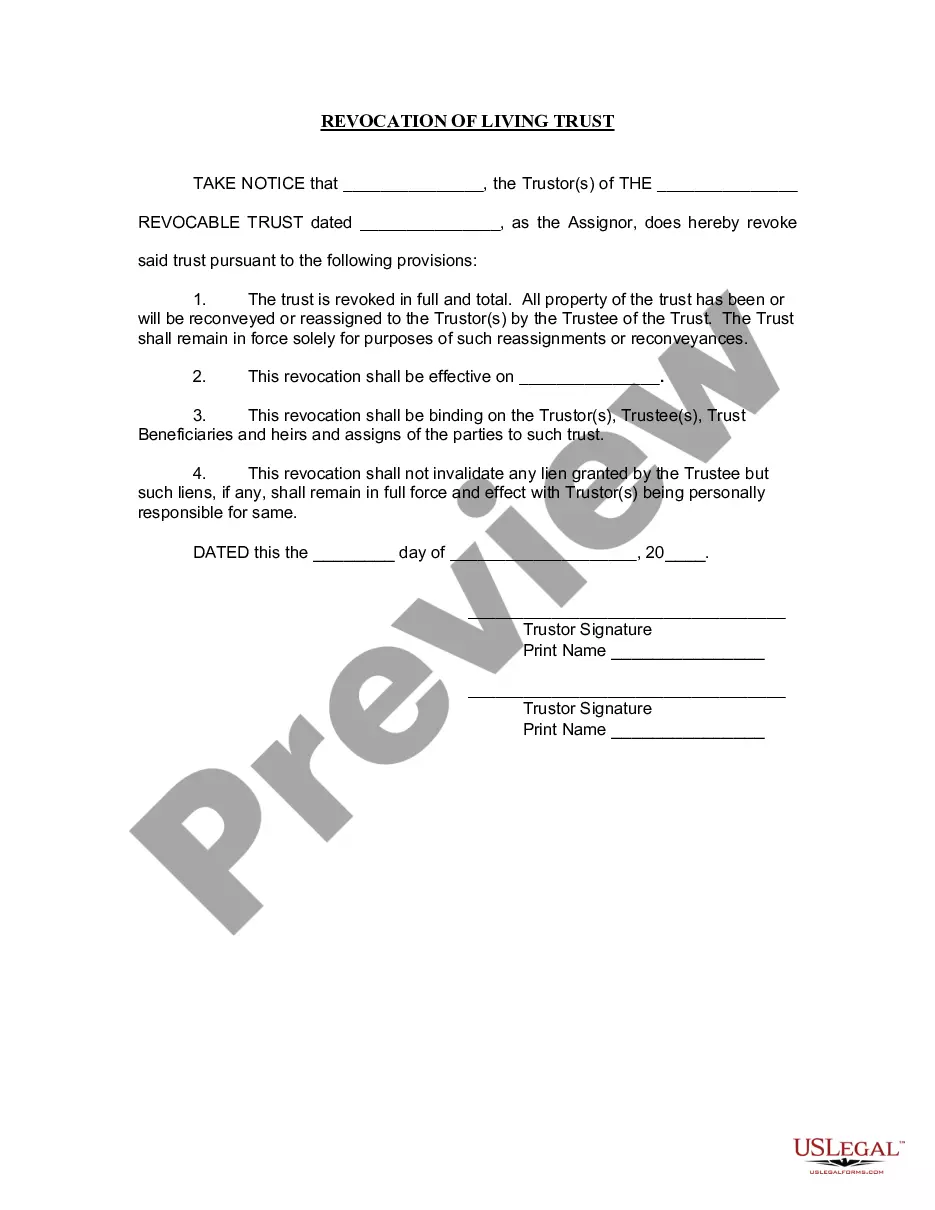
How to fill out California Revocation Of Living Trust?
Acquiring legal documents that comply with federal and local laws is crucial, and the internet provides a multitude of options to choose from.
However, why squander time searching for the appropriate Declaration Of Trust Vs Trust Agreement example online when the US Legal Forms digital library conveniently consolidates such documents in one location.
US Legal Forms is the premier online legal repository featuring over 85,000 editable forms crafted by attorneys for any business or personal circumstance. They are straightforward to navigate with all documents organized by state and intended usage.
Explore additional samples using the search feature at the top of the page if necessary. Once you find the correct form, click Buy Now and select a subscription plan. Set up an account or Log In and make a payment via PayPal or credit card. Choose the format for your Declaration Of Trust Vs Trust Agreement and download it. All documents you access through US Legal Forms are reusable. To re-download and complete previously acquired forms, navigate to the My documents section in your profile. Enjoy the most comprehensive and user-friendly legal document service!
- Our experts stay informed on legislative changes, so you can be confident that your documentation is current and compliant when securing a Declaration Of Trust Vs Trust Agreement from our site.
- Obtaining a Declaration Of Trust Vs Trust Agreement is straightforward and swift for both existing and new users.
- If you already possess an account with an active subscription, Log In and download the template you need in your preferred format.
- If you are new to our platform, follow the instructions below.
- Review the template using the Preview feature or through the text description to ensure it fits your requirements.
Form popularity
FAQ
A Declaration of Trust is a legal document that declares who owns an asset or property and who will benefit from it. On the other hand, a Trust Agreement is an agreement between two parties where one party agrees to hold assets for another party's benefit.
Under agreement means that the terms of the trust are stated explicitly in a written document, whereas under trust means that the circumstances surrounding the transfer of assets suggest that a trust was intended but there was no written agreement.
Alternatives to using a deed of trust Alternatively, if there are four or fewer beneficial owners then you could use an agreement under hand (a normal agreement that does not have to be witnessed) called a tenants in common agreement. As far as ownership is concerned, this has the same effect as a declaration of trust.
Declaration of trust is the document used to establish the primary details of a trust. While some states allow oral declarations, many states require a written declaration of trust outlining the essential pieces of the trust in order for it to be legally recognized.
The document or statement also contains details of the trust's purpose, its beneficiaries, and how it will be managed by the trustee. The declaration of trust is sometimes referred to as a nominee declaration.