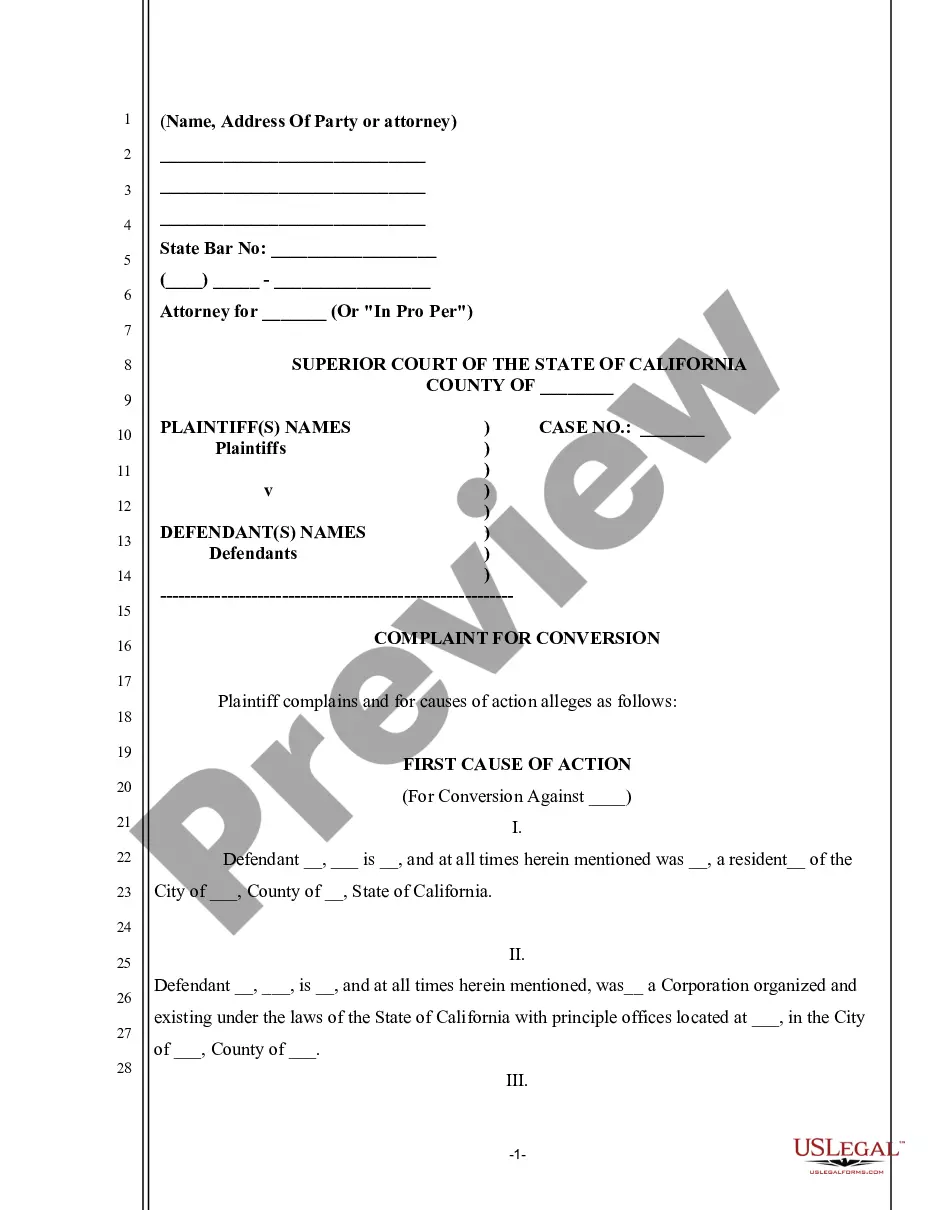
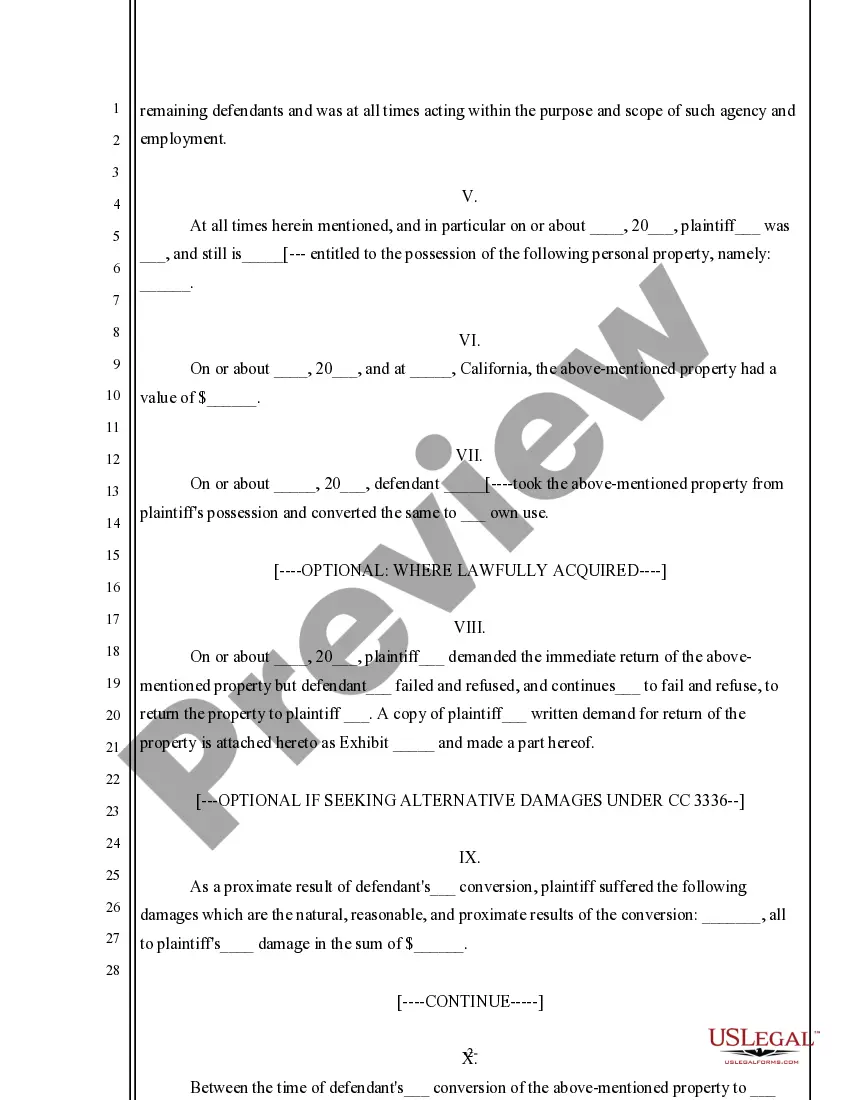
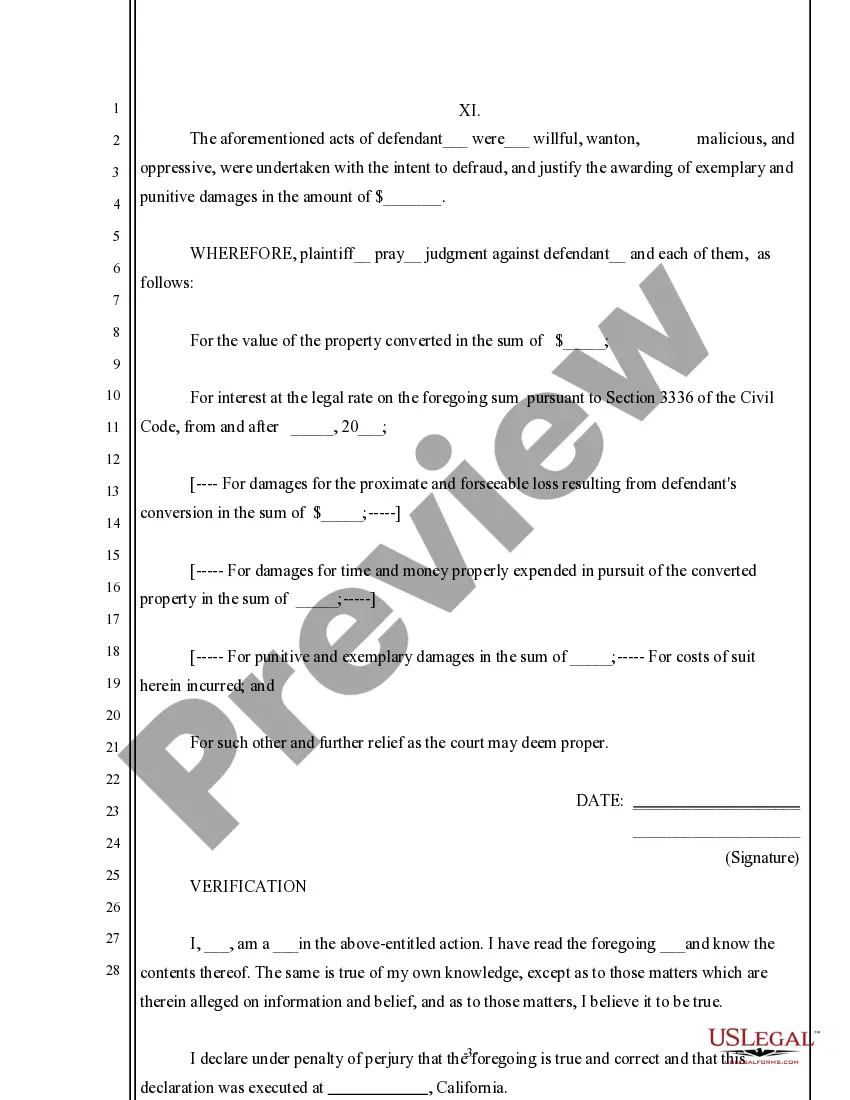
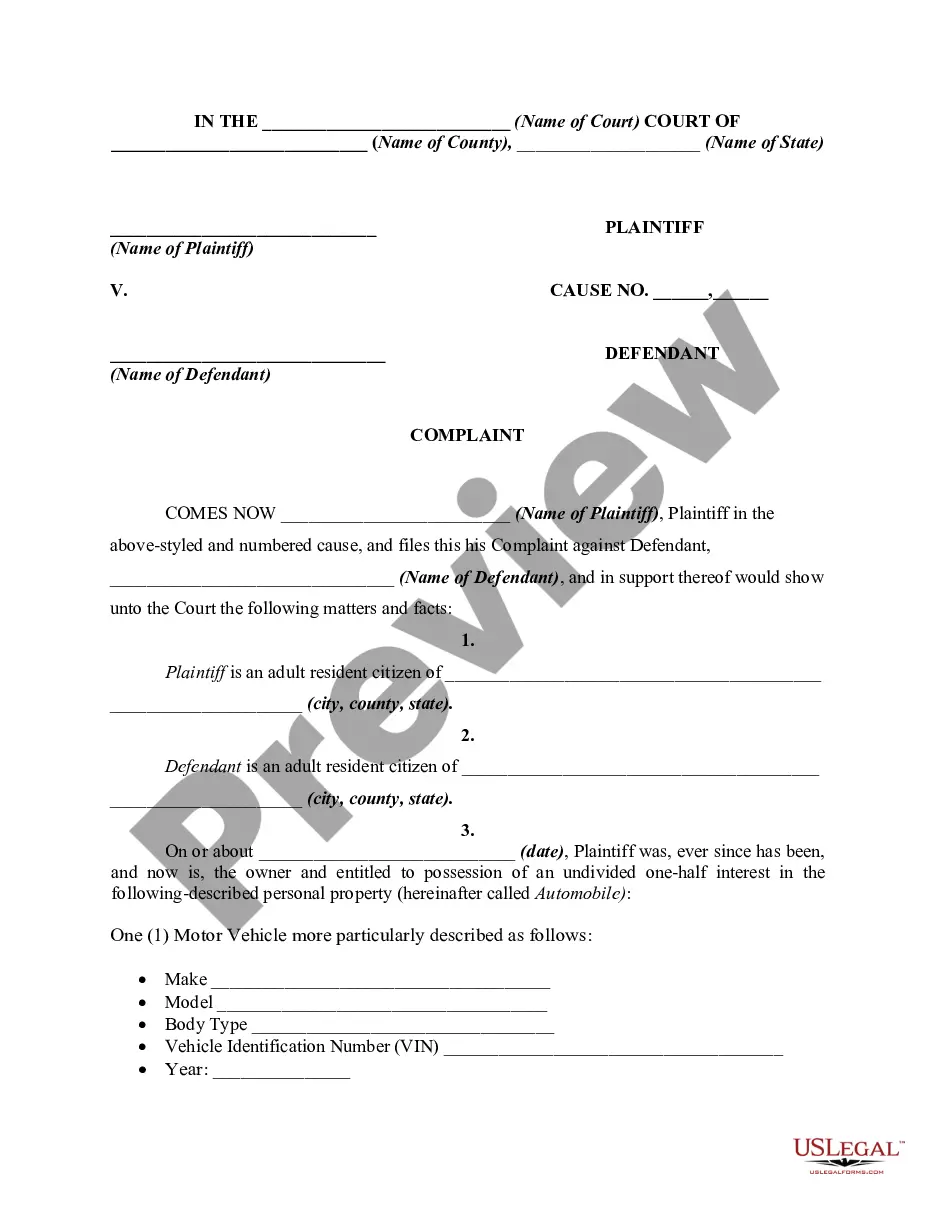
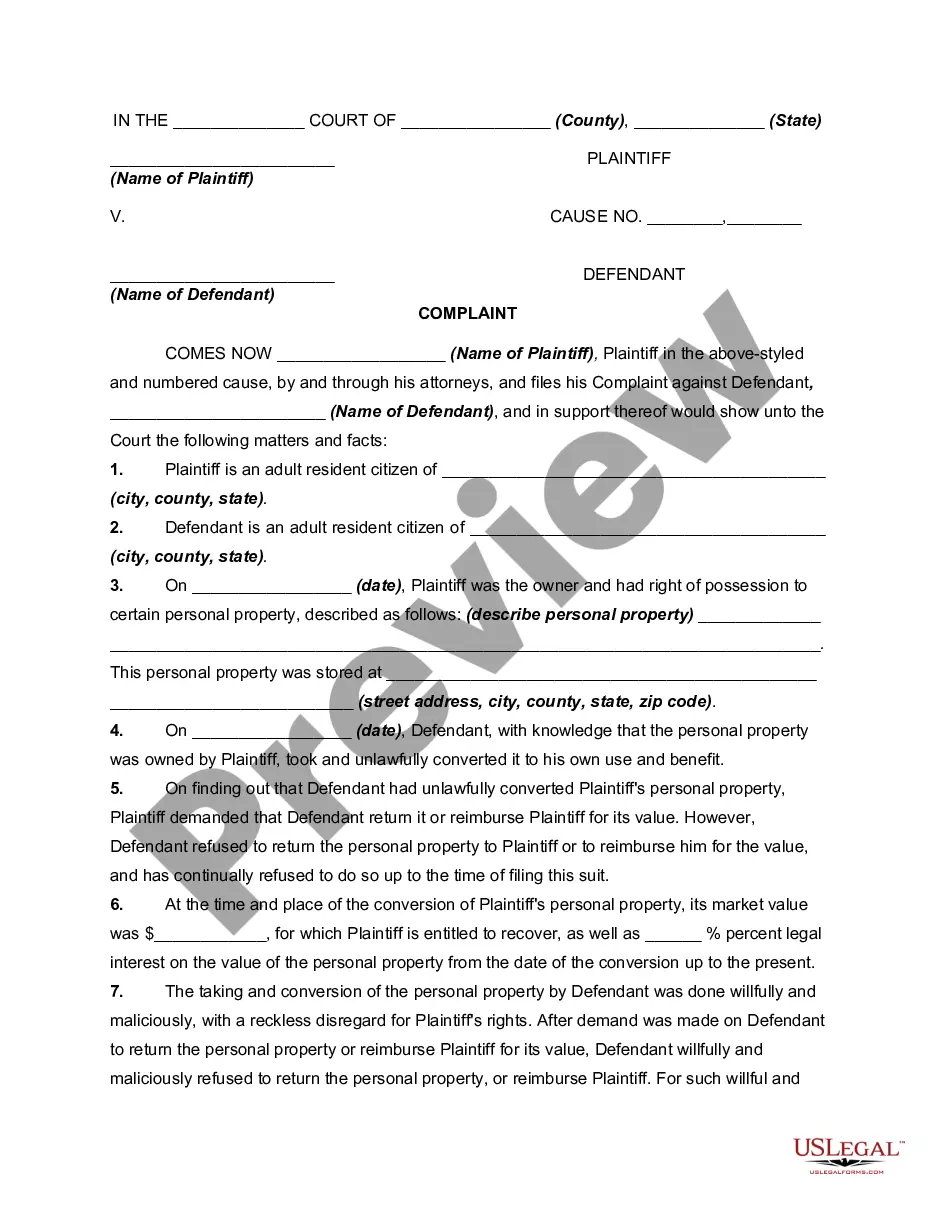
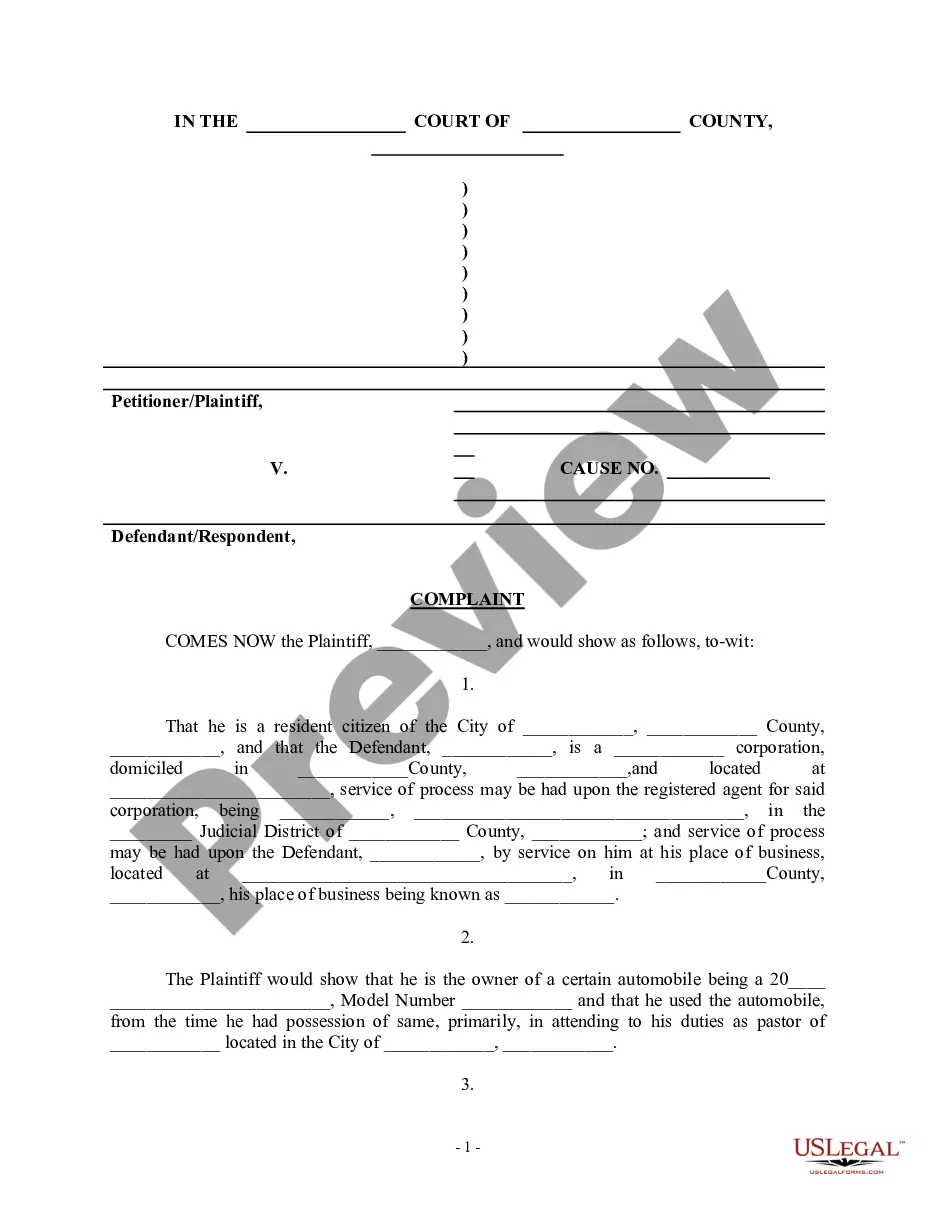
Complaint For Conversion California Formaldehyde Phase 2
Description
Get your form ready online
Our built-in tools help you complete, sign, share, and store your documents in one place.
Make edits, fill in missing information, and update formatting in US Legal Forms—just like you would in MS Word.
Download a copy, print it, send it by email, or mail it via USPS—whatever works best for your next step.
Sign and collect signatures with our SignNow integration. Send to multiple recipients, set reminders, and more. Go Premium to unlock E-Sign.
If this form requires notarization, complete it online through a secure video call—no need to meet a notary in person or wait for an appointment.
We protect your documents and personal data by following strict security and privacy standards.

Make edits, fill in missing information, and update formatting in US Legal Forms—just like you would in MS Word.

Download a copy, print it, send it by email, or mail it via USPS—whatever works best for your next step.

Sign and collect signatures with our SignNow integration. Send to multiple recipients, set reminders, and more. Go Premium to unlock E-Sign.

If this form requires notarization, complete it online through a secure video call—no need to meet a notary in person or wait for an appointment.

We protect your documents and personal data by following strict security and privacy standards.
Looking for another form?
How to fill out California Complaint For Conversion Of Personal Property?
Managing legal documents and procedures can be a lengthy addition to your entire day.
Complaint For Conversion California Formaldehyde Phase 2 and similar forms typically necessitate you to search for them and comprehend how you can complete them accurately.
Thus, whether you are dealing with financial, legal, or personal issues, utilizing a comprehensive and efficient online catalog of forms when needed will greatly assist you.
US Legal Forms is the leading online platform for legal templates, providing over 85,000 state-specific documents and an array of tools to help you fill out your papers effortlessly.
Is it your first time using US Legal Forms? Register and set up your account in just a few minutes, and you will gain access to the form catalog and Complaint For Conversion California Formaldehyde Phase 2. Then, follow the steps outlined below to complete your form.
- Browse the collection of pertinent documents available with just one click.
- US Legal Forms offers state- and county-specific documents available at any moment for downloading.
- Safeguard your document management processes by employing a premium service that allows you to create any form in a few minutes without any extra or hidden charges.
- Simply Log In to your account, search for Complaint For Conversion California Formaldehyde Phase 2, and obtain it instantly from the My documents section.
- You can also retrieve previously saved forms.
Form popularity
FAQ
When toys are labeled as 'compliant for formaldehyde,' it signifies that they conform to strict safety regulations concerning emissions. Such compliance ensures that the toys do not release harmful levels of formaldehyde, protecting children from potential health risks. By adhering to the Complaint for conversion California formaldehyde phase 2 standards, manufacturers demonstrate their dedication to safeguarding children's health and promoting safe play environments.
When a product is labeled 'compliant for formaldehyde,' it indicates that it meets specific regulations set forth by agencies such as CARB for formaldehyde emissions. In California, this compliance aligns with the guidelines under the Complaint for conversion California formaldehyde phase 2 regulations. This means that the product has undergone testing and adheres to safe limits for emissions, providing reassurance for consumers concerned about indoor air quality.
Filing Fees General Civil (Limit of $25,000.00)FeeClaims up to $600.00$35.00Claims from $600.01 to $1750.00$55.00Claims from $1750.01 to $10,000.00$75.00Claims from $10,000.01 to $25,000.00$160.001 more row
File the Motion with the court. File all four copies of your motion with the court in person or by first-class mail. If you mail your motion to the court, include a postage-paid and self-addressed envelope with your motion so that the court can return copies.
Public Access. Generally, unless access to a file is restricted by statute, court rule or an order pursuant to MCR 8.119(I), any person may inspect pleadings and other papers in a court clerk's office and may obtain copies as provided in MCR 8.119(J).
A ?proof of service? shows the court that a document was served as required by law. WHO TO SERVE - Michigan Court Rule (MCR) 5.125 identifies Interested Persons ? those required to be served ? for many different types of probate proceedings, including guardianships, conservatorships, estates and trusts.
Certified copies made with an ink stamp can be obtained via mail, fax, or email. The fee for certified documents is $11.00 plus $0.50 per page. Requests for certified copies must be made by filling out a Copy Request Form and submitting it to the court with payment.
Federal case files are maintained electronically and are available through the internet-based Public Access to Court Electronic Records (PACER) service. PACER allows anyone with an account to search and locate appellate, district, and bankruptcy court case and docket information. Register for a PACER account.
Official transcripts of courtroom proceedings must be ordered from the Court Reporter. Copies of official transcripts already on file with the court are available through the Court Reporter or through the PACER Service Center. A transcript to be delivered within thirty (30) calendar days after receipt of an order.
Public court records can be viewed online at . Requests for copies of a public record must be submitted on a File / Copy Request Form (PDF).