Increase Rent Rate Formula
Description

Get your form ready online
Our built-in tools help you complete, sign, share, and store your documents in one place.
Make edits, fill in missing information, and update formatting in US Legal Forms—just like you would in MS Word.
Download a copy, print it, send it by email, or mail it via USPS—whatever works best for your next step.
Sign and collect signatures with our SignNow integration. Send to multiple recipients, set reminders, and more. Go Premium to unlock E-Sign.
If this form requires notarization, complete it online through a secure video call—no need to meet a notary in person or wait for an appointment.
We protect your documents and personal data by following strict security and privacy standards.

Make edits, fill in missing information, and update formatting in US Legal Forms—just like you would in MS Word.

Download a copy, print it, send it by email, or mail it via USPS—whatever works best for your next step.

Sign and collect signatures with our SignNow integration. Send to multiple recipients, set reminders, and more. Go Premium to unlock E-Sign.

If this form requires notarization, complete it online through a secure video call—no need to meet a notary in person or wait for an appointment.

We protect your documents and personal data by following strict security and privacy standards.
Looking for another form?








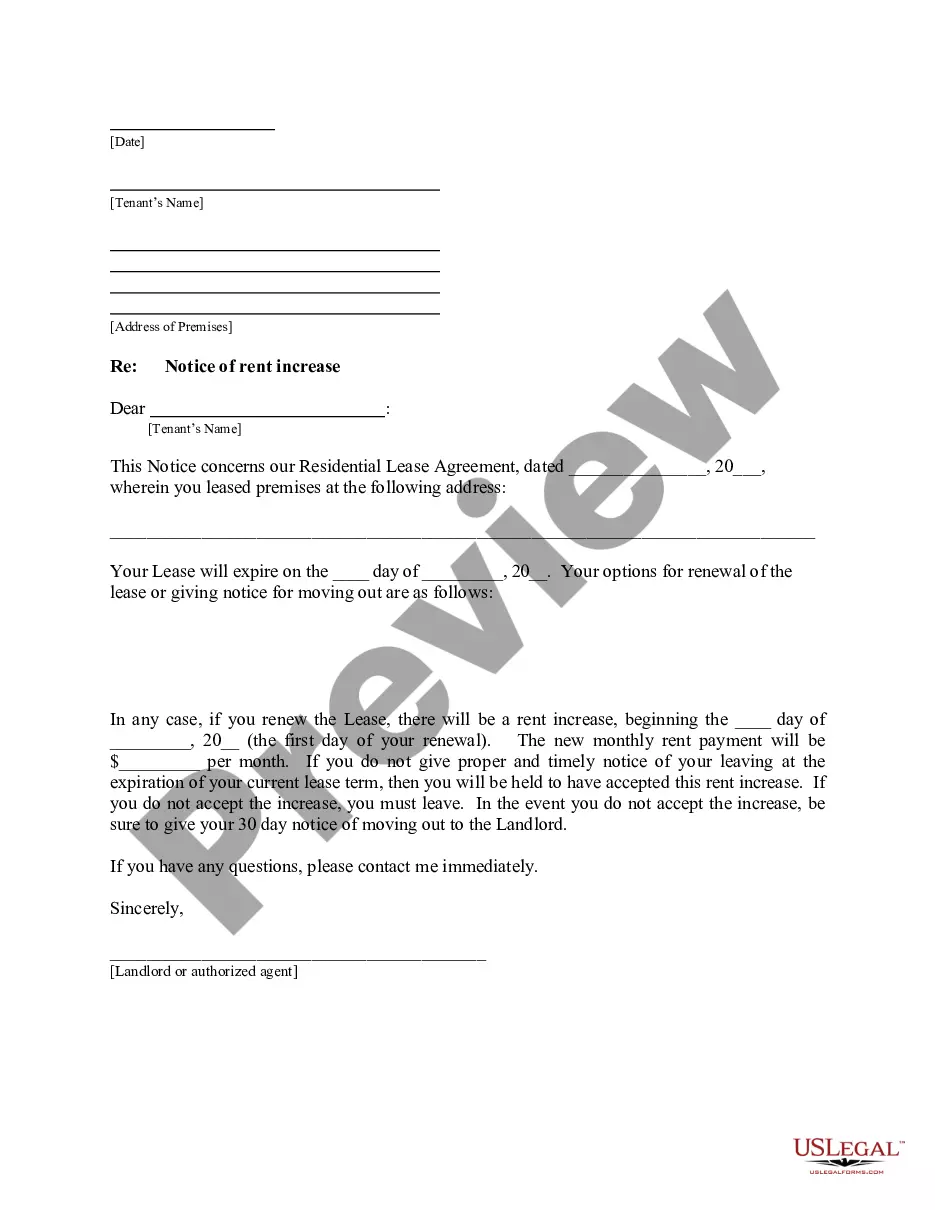
How to fill out California Letter From Landlord To Tenant About Intent To Increase Rent And Effective Date Of Rental Increase?
Whether for commercial reasons or personal matters, everyone must confront legal circumstances at some stage in their lives.
Completing legal documentation requires meticulous focus, starting with selecting the appropriate form template.
With a vast US Legal Forms catalog available, you do not need to waste time searching for the right template across the internet. Utilize the library’s simple navigation to locate the suitable template for any circumstance.
- Obtain the template you require through the search box or catalog browsing.
- Review the form’s details to ensure it aligns with your situation, jurisdiction, and county.
- Click on the form’s preview to review it.
- If it’s the incorrect form, return to the search feature to find the Increase Rent Rate Formula example you need.
- Download the template if it satisfies your criteria.
- If you already possess a US Legal Forms account, simply click Log in to access previously saved templates in My documents.
- If you do not have an account yet, you can download the form by clicking Buy now.
- Choose the correct pricing option.
- Fill out the account registration form.
- Select your payment method: you can utilize a credit card or PayPal account.
- Choose the file format you prefer and download the Increase Rent Rate Formula.
- Once it is saved, you can complete the form using editing software or print it and finish it by hand.
Form popularity
FAQ
To calculate the CPI increase for rent, first obtain the CPI figures for the relevant months. Next, subtract the earlier CPI from the later CPI, then divide by the earlier CPI, and multiply by 100 to get the percentage increase. This approach provides a clear picture of how inflation affects your rent, enabling you to apply an appropriate increase rent rate formula confidently, which can be supported with templates from US Legal Forms.
The maximum a landlord can increase the rent often depends on local laws and regulations. Many states have rent control laws that limit how much rent can rise within a specific period. To understand your exact limits, it's wise to review your local statutes and consider the increase rent rate formula that aligns with those laws. Using resources like US Legal Forms can simplify this process for landlords and tenants alike.
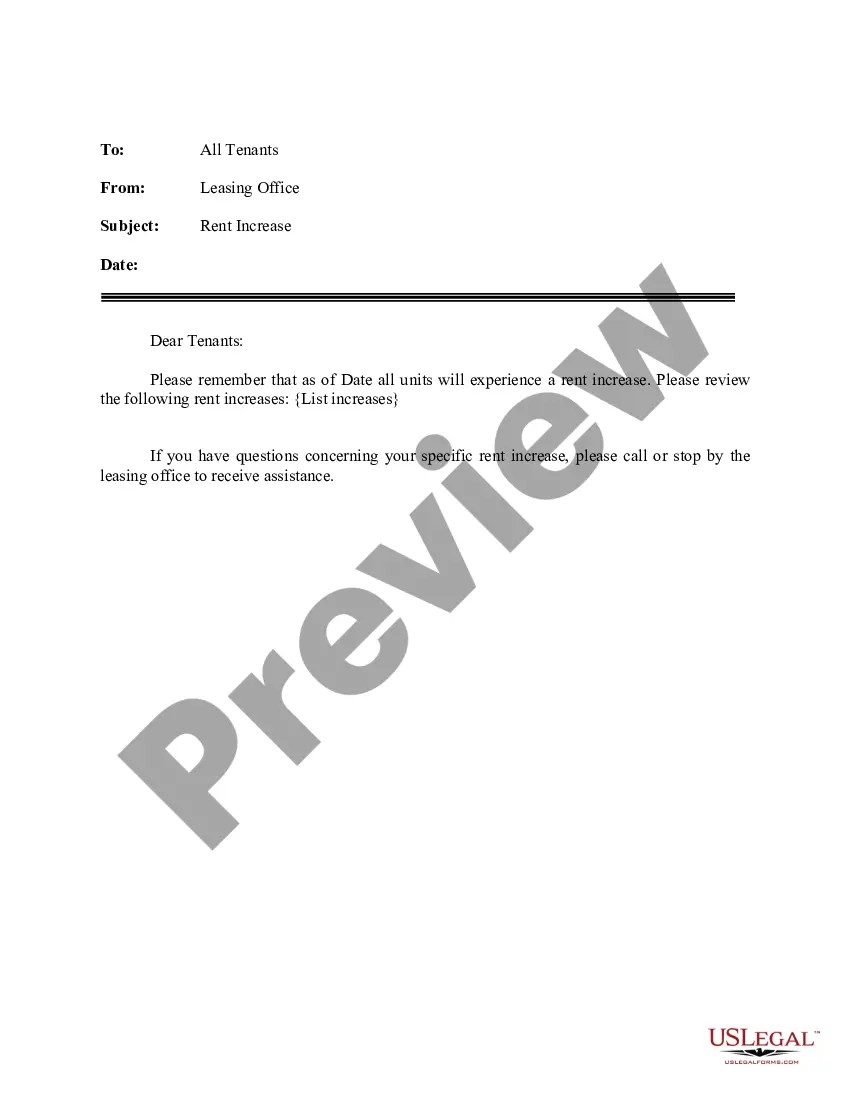
When writing a rent increase notice, clearly state the current rent amount and the new rent amount you propose. Include the effective date of the increase and reference any applicable contracts or laws that allow for the adjustment. Using the increase rent rate formula can help you justify the change, offering a detailed explanation of how you arrived at the new amount, which promotes transparency and fosters good relationships with tenants.
In California, landlords can legally raise rent by a limited percentage set by state regulations. As a rule of thumb, this is typically capped at 5 percent plus the rate of inflation or 10 percent, whichever is lower. Familiarizing yourself with these regulations helps ensure that you apply the increase rent rate formula correctly and understand your rights as a tenant.
The average rent increase in California often aligns with inflation rates and can vary significantly between cities. Generally, it ranges from 3 to 8 percent annually. Keeping track of these trends provides valuable insight into how the increase rent rate formula typically functions in the state.
Certain tenants in California may be exempt from rent increases under specific conditions. For example, properties built within the last 15 years or single-family homes owned by individuals may not be subject to rent control laws. Understanding exemptions helps tenants navigate the increase rent rate formula effectively.
California law dictates specific limits on how much landlords can increase rent each year. Generally, the increase cannot exceed 5 percent plus the local rate of inflation, or 10 percent, whichever is lower. This law emphasizes the importance of understanding the increase rent rate formula to remain compliant.
Landlords must comply with local laws when increasing rent. The maximum allowed varies by state and city, often dictated by legislation or rent control ordinances. Knowing the applicable laws helps landlords apply the increase rent rate formula correctly without exceeding legal limits.
To find the percentage increase in rent, start by taking the difference between the new rent and the old rent. Next, divide this difference by the old rent. Finally, multiply by 100 to convert it into a percentage. This process exemplifies the increase rent rate formula effectively.
To calculate a 2.5 percent increase, first, determine the current rent amount. Multiply this amount by 0.025 to find the increase. Finally, add this increase to the current rent. This straightforward method helps you understand how the increase rent rate formula works in practice.