Wisconsin Stipulation Regarding Claim Against the Estate
What is this form?
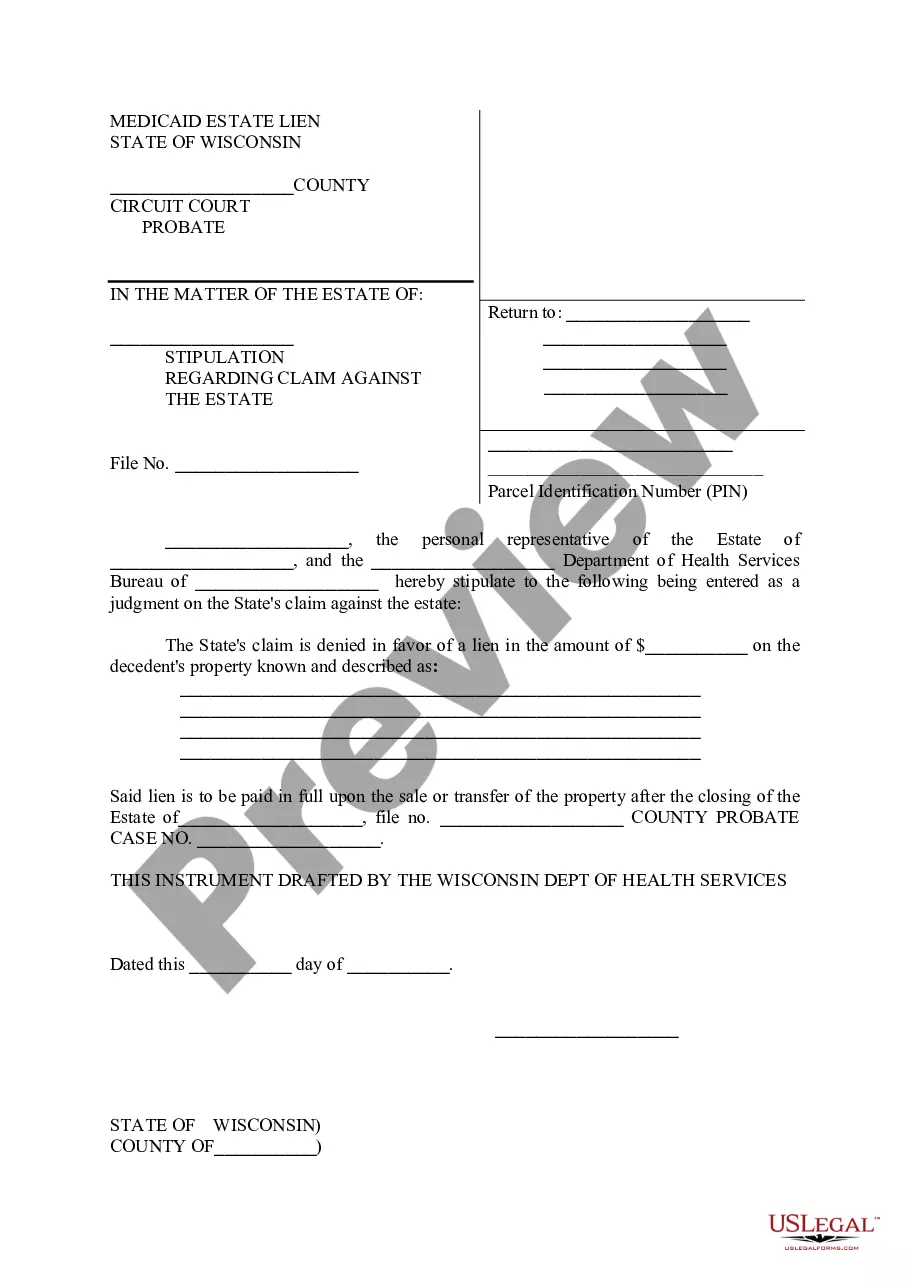
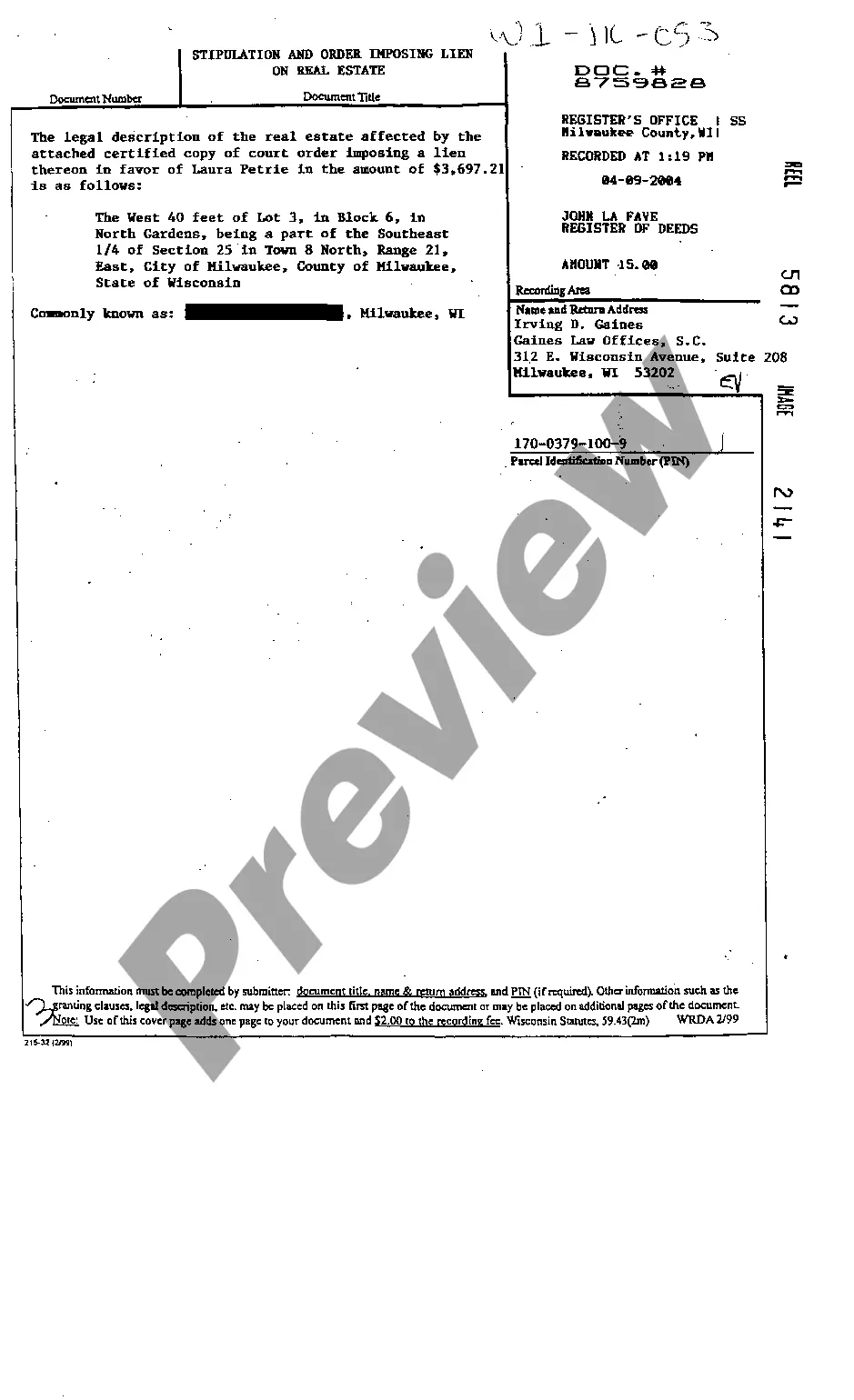
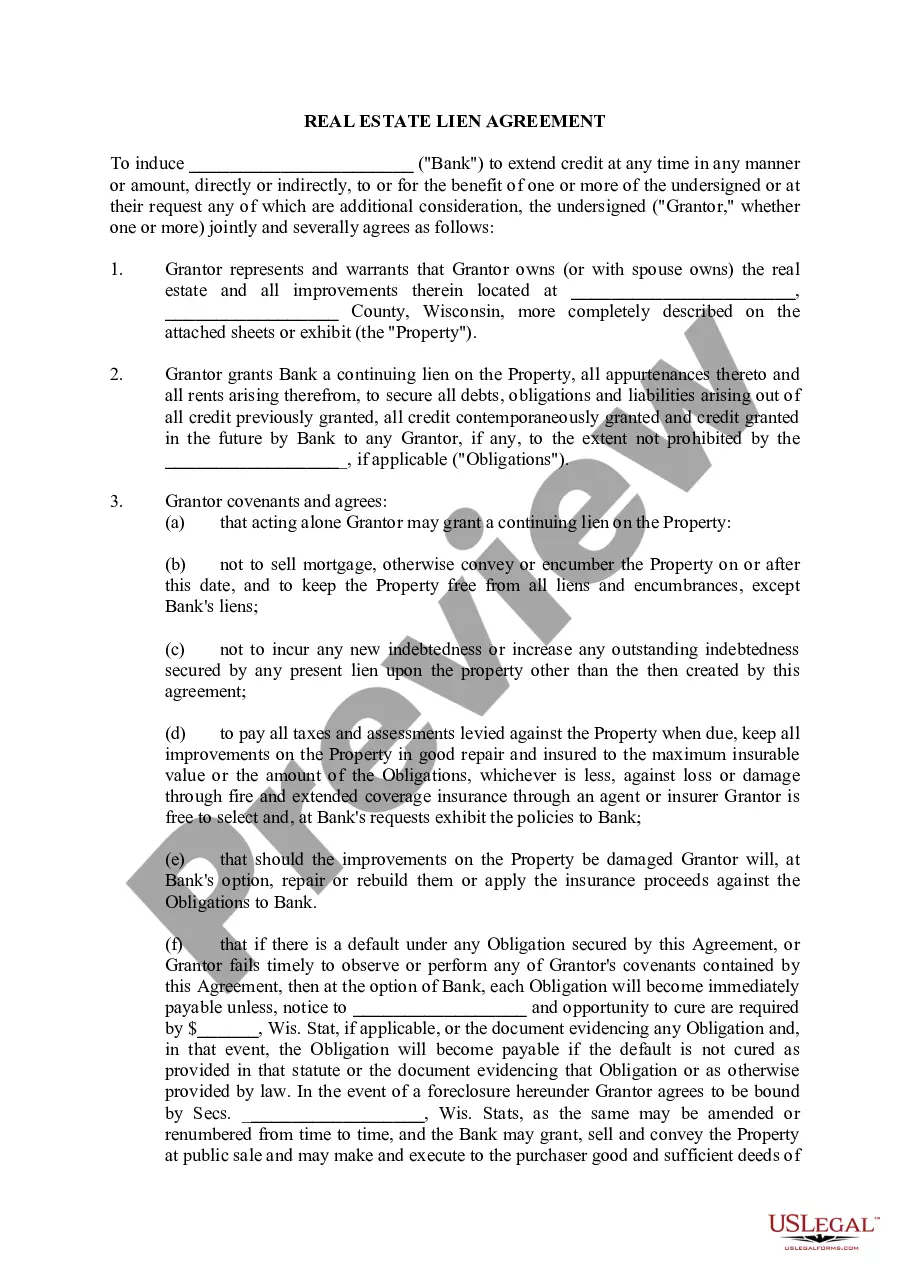
The Stipulation Regarding Claim Against the Estate is a legal document detailing an agreement between the personal representative of an estate and the State regarding the denial of claims against the estate. This stipulation sets a specific lien amount on the decedent's property, which will be paid upon the propertyâs sale or transfer. This form is distinct from general claims as it formalizes the denial of the state's claim while securing a lien on the property.
Key parts of this document
- Identification of the parties involved: the personal representative and the Stateâs Department of Health Services.
- A description of the claim being denied and the amount of the lien agreed upon.
- Details of the decedent's property subject to the lien, including its description and Parcel Identification Number (PIN).
- Provisions for the payment of the lien upon sale or transfer of the property.
- Signature lines for the personal representative and notarization details.

Common use cases
This form is used when there is a claim made by the State against an estate that the personal representative disputes. It is appropriate when an agreement has been reached to deny the state's claim and establish a lien on specific estate property, ensuring a clear resolution before the estate is settled.
Who needs this form
This form is intended for:
- Personal representatives of an estate dealing with state claims.
- Beneficiaries of an estate who need clarity on claims against the estate.
- Legal representatives managing estate matters related to Medicaid estate liens.
Instructions for completing this form
- Identify the parties involved by filling in the personal representative's name and the Stateâs Department of Health Services.
- Enter the name of the decedent and the file number associated with the estate.
- Specify the Parcel Identification Number (PIN) and describe the property subject to the lien.
- State the agreed lien amount to be placed on the property.
- Have the personal representative and a notary public sign and date the stipulation.
Notarization guidance
Yes, this form must be notarized to be legally valid. Us Legal Forms offers integrated online notarization, available 24/7, allowing you to complete this process securely through a video call without needing to travel to a notary's office.
Get your form ready online
Our built-in tools help you complete, sign, share, and store your documents in one place.
Make edits, fill in missing information, and update formatting in US Legal Forms—just like you would in MS Word.
Download a copy, print it, send it by email, or mail it via USPS—whatever works best for your next step.
Sign and collect signatures with our SignNow integration. Send to multiple recipients, set reminders, and more. Go Premium to unlock E-Sign.
If this form requires notarization, complete it online through a secure video call—no need to meet a notary in person or wait for an appointment.
We protect your documents and personal data by following strict security and privacy standards.

Make edits, fill in missing information, and update formatting in US Legal Forms—just like you would in MS Word.

Download a copy, print it, send it by email, or mail it via USPS—whatever works best for your next step.

Sign and collect signatures with our SignNow integration. Send to multiple recipients, set reminders, and more. Go Premium to unlock E-Sign.

If this form requires notarization, complete it online through a secure video call—no need to meet a notary in person or wait for an appointment.

We protect your documents and personal data by following strict security and privacy standards.
Common mistakes to avoid
- Failing to accurately describe the property can lead to legal complications.
- Not specifying an accurate lien amount may cause disputes later.
- Omitting necessary signatures may invalidate the form.
Why use this form online
- Convenience of downloading the form instantly without needing to visit a legal office.
- Editability allows users to customize the form to fit their specific needs before printing.
- Reliable access to attorney-drafted templates ensures compliance with current legal standards.
Looking for another form?
Form popularity
FAQ
Probate can take two years, even longer, for a large or contested estate. But the process may last up to six months even for a small, uncomplicated estate.
Electronically filed cases are subject to a fee of $20 per case per party. See page 4. CSS = court support services surcharge, 814.85: $51 for claims $10,000 or less, $169 for claims over $10,000, $68 for claims other than money judgments.
Godoy. After someone dies, anyone who thinks they are owed money or property by the deceased can file a claim against the estate. Estate claims range from many different types of debts, such as mortgages, credit card debt, loans, unpaid wages, or breach of contract.
A Financial Disclosure Statement is a document in which the party completing it should report all of his or her income, assets, debts and expenses. Spouses rely on the information reported in order to arrive at a fair division of assets and debts and income.
Find the Correct Probate Court. The probate court handles issues involving a deceased person's estate, along with potential disputes regarding outstanding debts, issues with heirs, etc. Confirm the Debt. Complete the Claim Form. File the Claim Form.
Go to the courthouse. The small claims court clerk will supply you with the necessary forms (a summons and a complaint form) to begin your action. List your name as the plaintiff. You are the person filing the lawsuit.
Although Wisconsin law requires that probate be completed within 18 months, a court may choose to grant an extension. On average, probate in Wisconsin takes no less than six months. The probate process must allow time for creditors to be notified, file required income tax returns, and resolve any disputes.
How do I file a claim against an estate? A standard claim form (PR-1819) can be obtained online from Wisconsin Courts. The completed form, along with the statutory $3 filing fee, must be filed with the Register in Probate prior to the expiration of the claims date.