Surface Pits
What this document covers
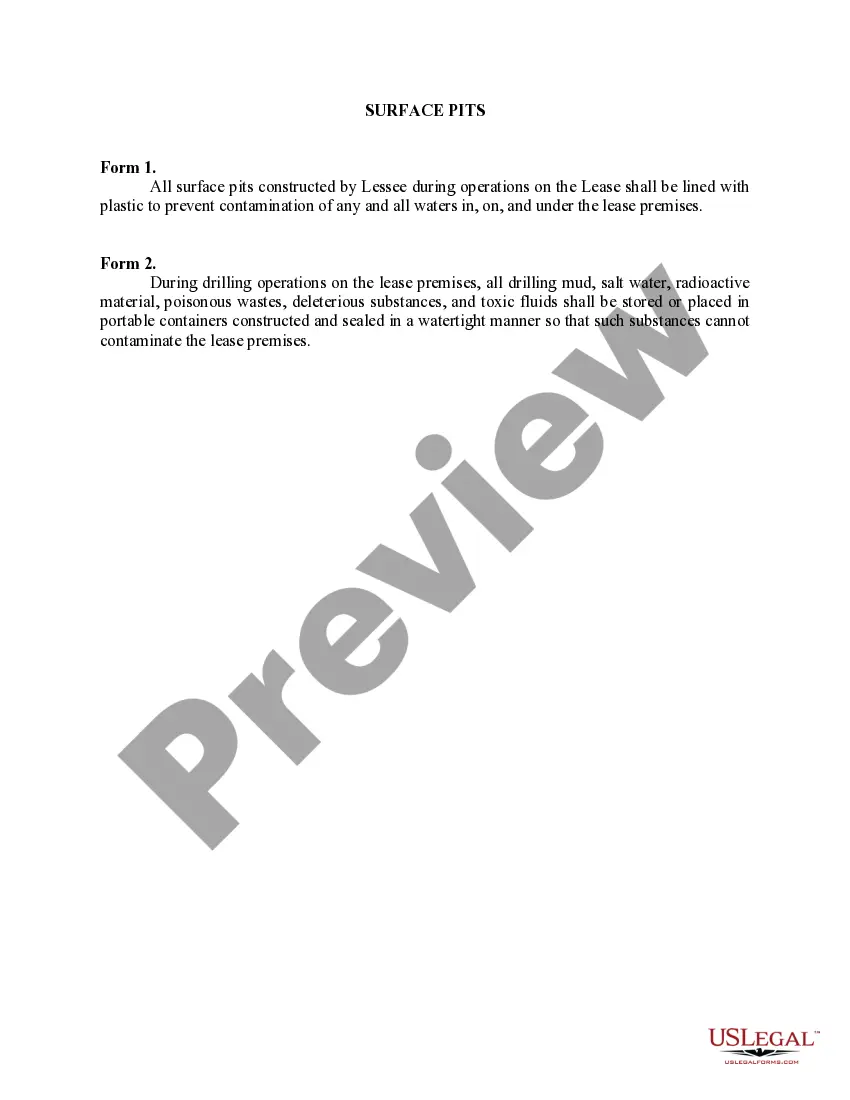
The Surface Pits form is a lease rider used in oil and gas leases to specify additional provisions related to surface pits. This form protects the lease premises by ensuring proper containment of potentially harmful substances during drilling operations, which may not be adequately addressed in standard lease agreements. By using this form, lessors can place limitations on the lessee's rights concerning surface pits, thereby safeguarding water quality and the environment in the designated lease area.
Form components explained
- Requirement for lining all surface pits with plastic to prevent water contamination.
- Mandatory use of watertight portable containers for storing hazardous materials during drilling.
- Specific guidelines for managing toxic substances to protect the lease premises.
Situations where this form applies
This form should be used in lease transactions where additional protections regarding environmental safety are necessary. If you are a lessor concerned about the impact of drilling operations on your land and water resources, using the Surface Pits form will help set clear expectations and responsibilities for the lessee.
Who can use this document
- Landowners who are leasing their property for oil and gas exploration.
- Leasers who want to include specific terms protecting their property from contamination.
- Attorneys representing either lessors or lessees in oil and gas lease negotiations.
Completing this form step by step
- Identify the lessor and lessee, providing their full names and contact information.
- Specify the location and boundaries of the lease premises.
- Outline the terms regarding the construction of surface pits and containment of hazardous materials.
- Include any additional provisions or limitations you deem necessary for environmental protection.
- Review the completed form for accuracy before signing.
Notarization guidance
This form does not typically require notarization to be legally valid. However, some jurisdictions or document types may still require it. US Legal Forms provides secure online notarization powered by Notarize, available 24/7 for added convenience.
Get your form ready online
Our built-in tools help you complete, sign, share, and store your documents in one place.
Make edits, fill in missing information, and update formatting in US Legal Forms—just like you would in MS Word.
Download a copy, print it, send it by email, or mail it via USPS—whatever works best for your next step.
Sign and collect signatures with our SignNow integration. Send to multiple recipients, set reminders, and more. Go Premium to unlock E-Sign.
If this form requires notarization, complete it online through a secure video call—no need to meet a notary in person or wait for an appointment.
We protect your documents and personal data by following strict security and privacy standards.

Make edits, fill in missing information, and update formatting in US Legal Forms—just like you would in MS Word.

Download a copy, print it, send it by email, or mail it via USPS—whatever works best for your next step.

Sign and collect signatures with our SignNow integration. Send to multiple recipients, set reminders, and more. Go Premium to unlock E-Sign.

If this form requires notarization, complete it online through a secure video call—no need to meet a notary in person or wait for an appointment.

We protect your documents and personal data by following strict security and privacy standards.
Mistakes to watch out for
- Failing to clearly define the boundaries of the lease premises.
- Neglecting to specify all hazardous materials that need to be contained properly.
- Not reviewing local regulations that may affect the lease terms.
Advantages of online completion
- Easy access to professionally drafted legal forms, ensuring compliance with industry standards.
- Ability to customize the form to meet specific environmental concerns and legal requirements.
- Instant download and convenience of completing forms at any time.
Summary of main points
- The Surface Pits lease rider helps protect lessors from environmental risks in oil and gas leases.
- It is vital to list specific provisions regarding surface pit construction and substance storage.
- This form is adaptable to various jurisdictions, providing flexibility in legal compliance.
Looking for another form?




Form popularity
FAQ
Pitting corrosion occurs when the cathode (damaged coating) is large and the anode (exposed metal) is small. Typically the surface protection layer or film becomes the cathode when it is damaged and cracked. A small area of metal is then exposed and becomes the anodic.
Pitting corrosion is a form of localized corrosion, which produces attacks in the form of spots or pits. Pitting corrosion may occur in stainless steels in neutral or acid solutions containing halides, primarily chlorides (Cl-), such as seawater.
1 : the action or process of forming pits (as in acned skin, a tooth, or a dental restoration) 2 : the formation of a depression or indentation in living tissue that is produced by pressure with a finger or blunt instrument and disappears only slowly following release of the pressure in some forms of edema.
Pitting Corrosion is the localized corrosion of a metal surface confined to a point or small area, that takes the form of cavities.The resulting pits can become wide and shallow or narrow and deep which can rapidly perforate the wall thickness of a metal.
Pitting corrosion is a localized form of corrosion by which cavities or "holes" are produced in the material. Pitting is considered to be more dangerous than uniform corrosion damage because it is more difficult to detect, predict and design against. Corrosion products often cover the pits.
Another viable method for repairing pitting corrosion is the use of cold-applied epoxy materials. These 100% solids, paste-grade materials have been on the market since the 1960s and have been continuously improved to withstand greater temperatures and pressure levels as well as various in-service conditions.
What Causes Pitting Corrosion? Pitting corrosion occurs when the cathode (damaged coating) is large and the anode (exposed metal) is small. Typically the surface protection layer or film becomes the cathode when it is damaged and cracked. A small area of metal is then exposed and becomes the anodic.
Adjective. If the surface of something is pitted, it is covered with a lot of small, shallow holes. Everywhere building facades are pitted with shell and bullet holes. Synonyms: scarred, marked, rough, scratched More Synonyms of pitted.