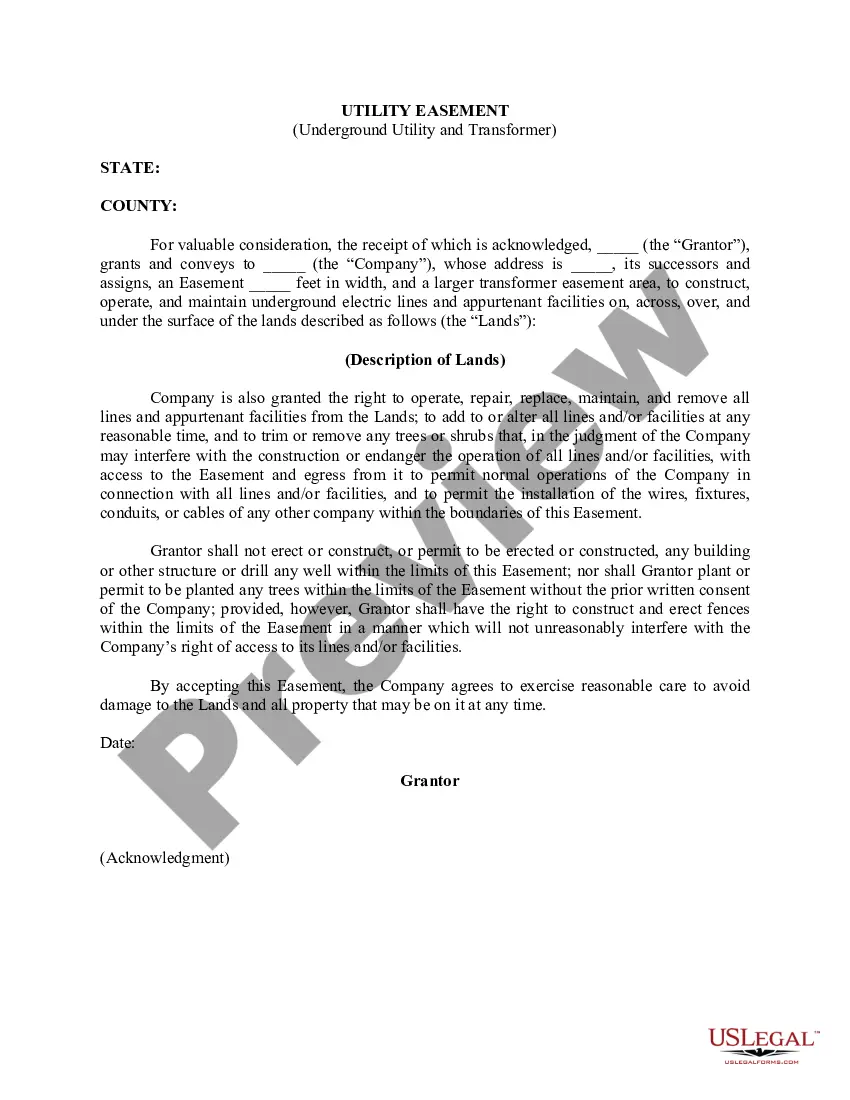
Utility Easement (Underground Utility and Transformer)
Understanding this form
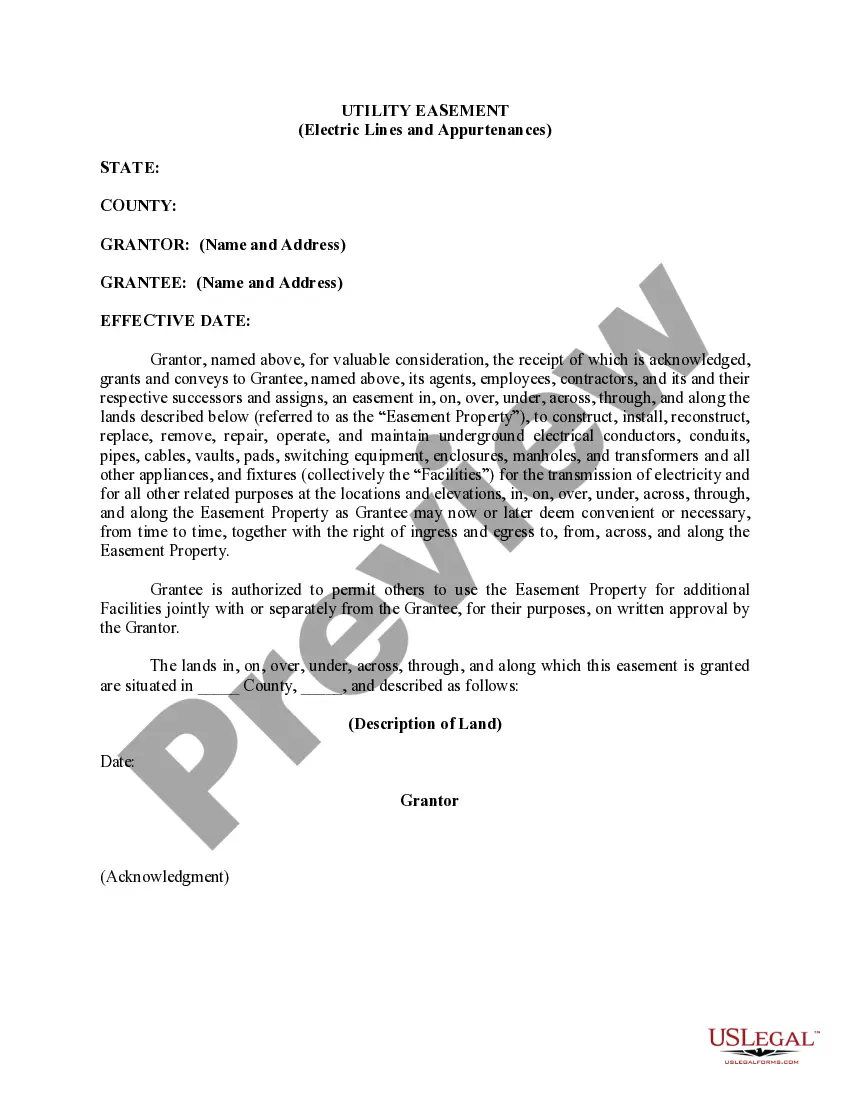
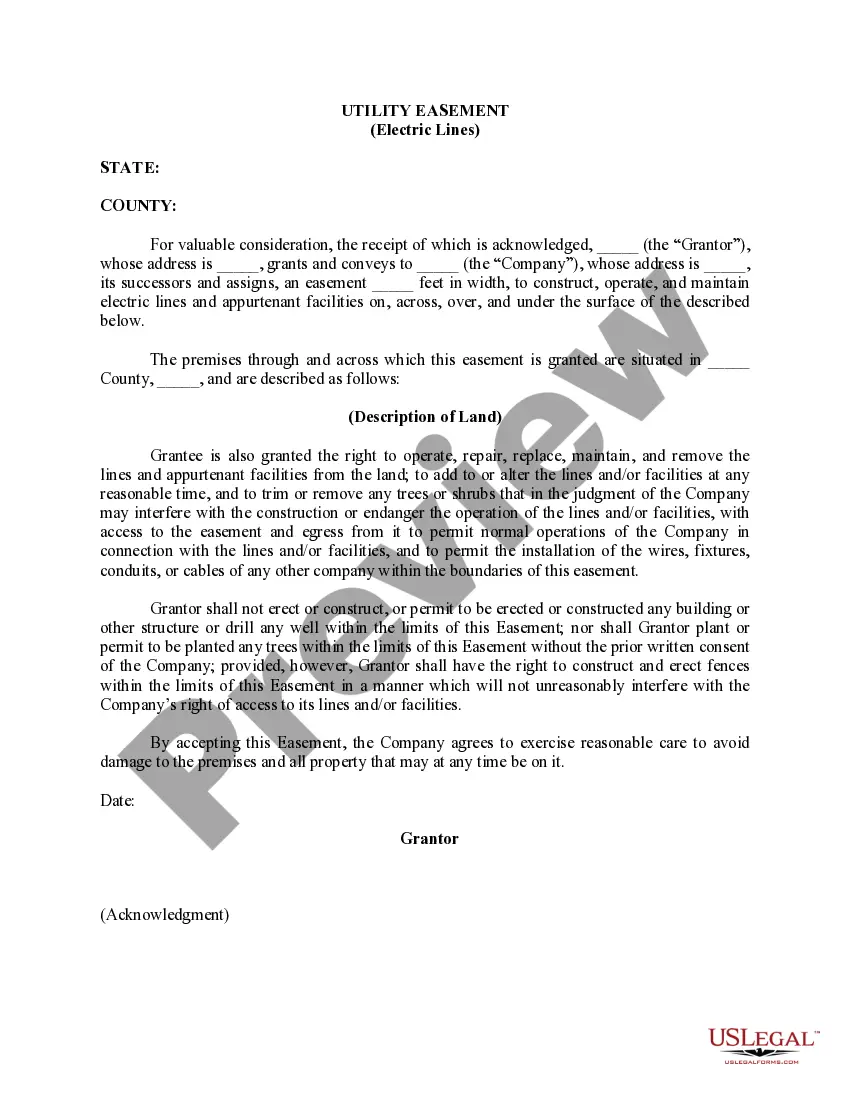
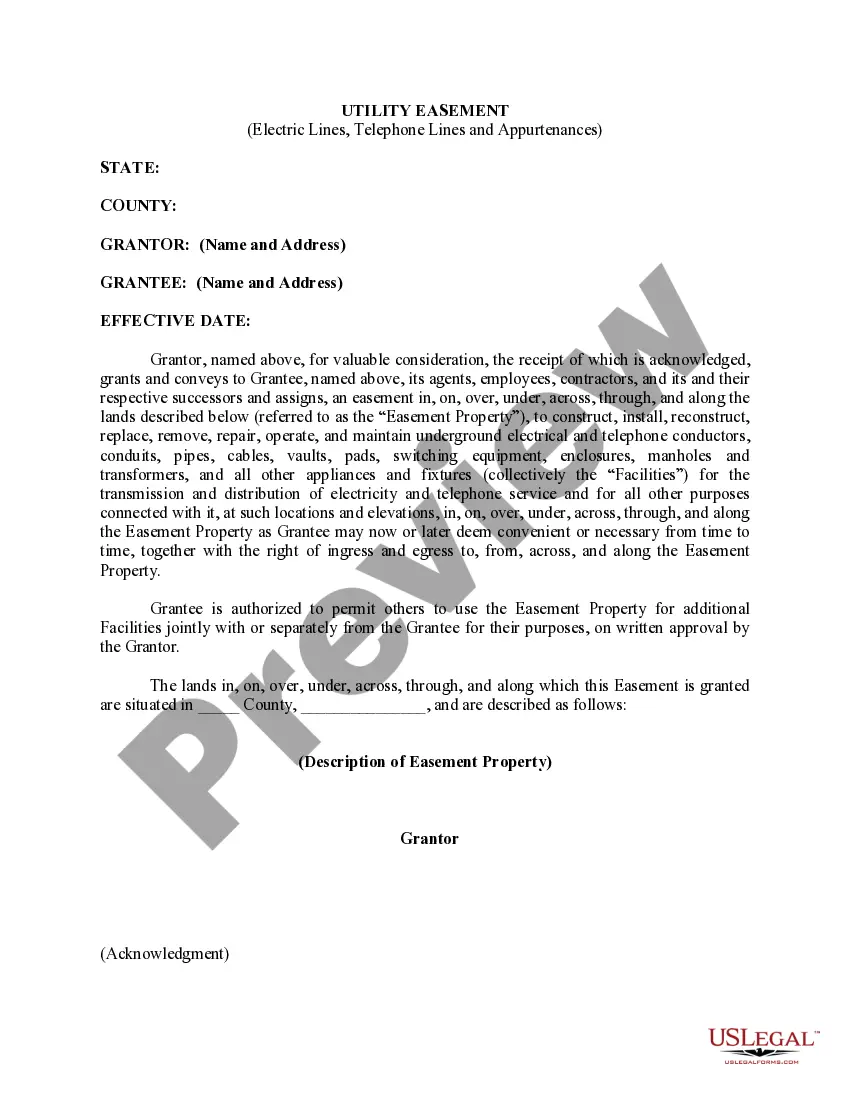
The Utility Easement (Underground Utility and Transformer) form is a legal document that grants an easement for the installation and maintenance of underground electric lines and transformer facilities. This form is essential for property owners who need to allow utility companies access to their property to ensure reliable energy services while safeguarding their property rights. Unlike other easement forms, this document specifically pertains to underground utilities and transformers, making it essential for those dealing with electric service installations.
What’s included in this form
- Identification of the grantor (property owner) and the company receiving the easement.
- Description of the easement area, including dimensions and location.
- Rights granted to the utility company, including maintenance, repair, and installation of facilities.
- Restrictions placed on the grantor regarding construction and planting within the easement area.
- Legal acknowledgment of compensation, typically One Dollar and other valuable considerations.
- Signatures and date for validation.
When to use this form
This form should be used when a property owner needs to grant a utility company the right to install and maintain underground electric lines and transformers on their land. Common scenarios include new construction, upgrades to existing electrical infrastructure, or where utility services need to cross private land to connect to other areas.
Who should use this form
- Property owners who need to grant an easement for underground electrical work.
- Utility companies seeking legal permission to install and maintain their equipment on private property.
- Attorneys preparing easement agreements for clients involved in utility installations.
How to prepare this document
- Identify the parties involved: provide names and contact information for the grantor and the utility company.
- Specify the property details: include a description of the easement area, including boundaries and dimensions.
- Detail the rights being granted: clearly outline the rights the utility company has, such as maintenance and access to the easement.
- Include any restrictions on the grantor: specify what cannot be done in the easement area, like erecting buildings or planting trees.
- Sign and date the document: ensure all parties sign the form and include the date of agreement to make it legally binding.
Does this document require notarization?
Notarization is required for this form to take effect. Our online notarization service, powered by Notarize, lets you verify and sign documents remotely through an encrypted video session, available 24/7.
Get your form ready online
Our built-in tools help you complete, sign, share, and store your documents in one place.
Make edits, fill in missing information, and update formatting in US Legal Forms—just like you would in MS Word.
Download a copy, print it, send it by email, or mail it via USPS—whatever works best for your next step.
Sign and collect signatures with our SignNow integration. Send to multiple recipients, set reminders, and more. Go Premium to unlock E-Sign.
If this form requires notarization, complete it online through a secure video call—no need to meet a notary in person or wait for an appointment.
We protect your documents and personal data by following strict security and privacy standards.

Make edits, fill in missing information, and update formatting in US Legal Forms—just like you would in MS Word.

Download a copy, print it, send it by email, or mail it via USPS—whatever works best for your next step.

Sign and collect signatures with our SignNow integration. Send to multiple recipients, set reminders, and more. Go Premium to unlock E-Sign.

If this form requires notarization, complete it online through a secure video call—no need to meet a notary in person or wait for an appointment.

We protect your documents and personal data by following strict security and privacy standards.
Common mistakes
- Failing to specify the exact dimensions of the easement area.
- Not clearly outlining the rights granted to the utility company.
- Omitting signatures from all relevant parties.
- Neglecting to date the form, which can affect its validity.
Why complete this form online
- Convenience of downloading and filling out the form at any time.
- Easy editing capabilities to customize the form for specific needs.
- Access to legally sound templates drafted by licensed attorneys.
- Avoiding delays that can occur with traditional filing methods.
Looking for another form?

Form popularity
FAQ
An easement in gross is personal to the party that receives the benefit of easement. An example of an easement in gross is an easement to a utility company to run a power line across a burdened piece of property. The utility company is the benefited party and there isn't necessarily a benefited parcel of land.
An appurtenant easement is an easement that runs with the land meaning it is meant to be binding on successive owners of the dominant and servient tenements.In contrast, an easement in gross is a personal easement that necessarily does not run with the land.
Express Grant by Instrument. An express grant by written instrument is the most common source of an easement. Implied. The owner of a large tract of land splits up the land with one or more parcels that do not abut a public highway or road. Necessity. Dedication.
When termed as a utility easement, it means a utility company's right to access and control the portion of another person's land that is located near utility facilities and structures (i.e. utility poles, transformers, overhead or underground electrical lines).
The bottom line is that developers and builders who are presented with utility company easement forms should not just sign them, but think about the kinds of issues they can present. It is easier to negotiate these concessions up front before the lines go in, than to ask the utility company to amend its easement later.
Easements can be created in a variety of ways. They can be created by an express grant, by implication, by necessity, and by adverse possession.
An easement can decrease the value of a real estate, increase the value of the real estate or it can have no impact on the value of the real estate at all. The most important fact is that each property and situation should be evaluated on individual basis, taking into account all the circumstances.