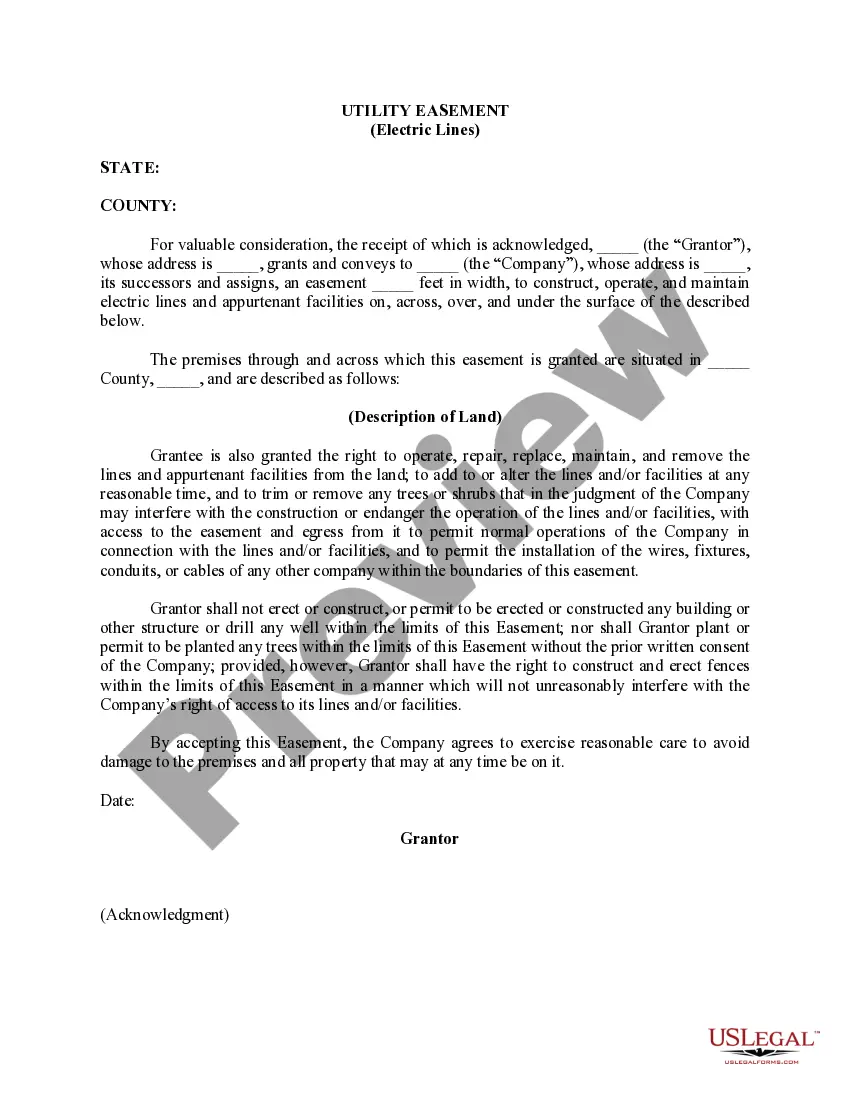
Utility Easement (Electric Lines)
What is this form?
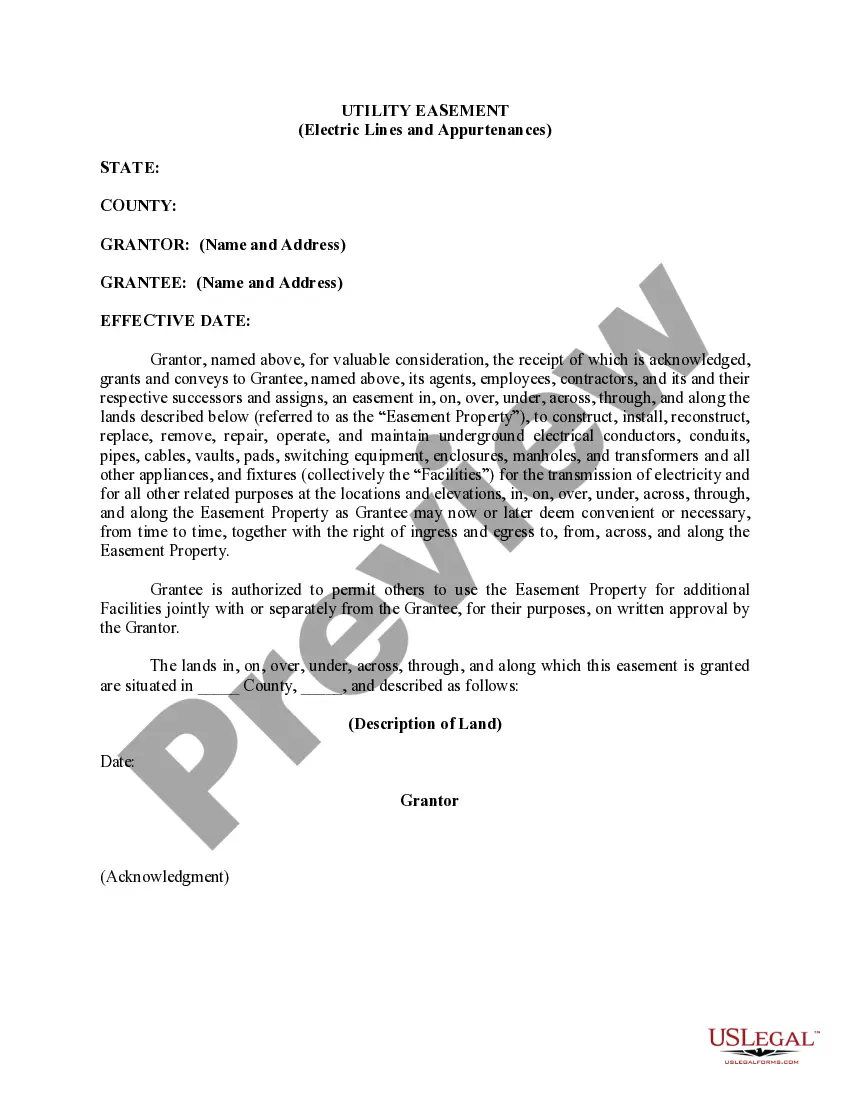
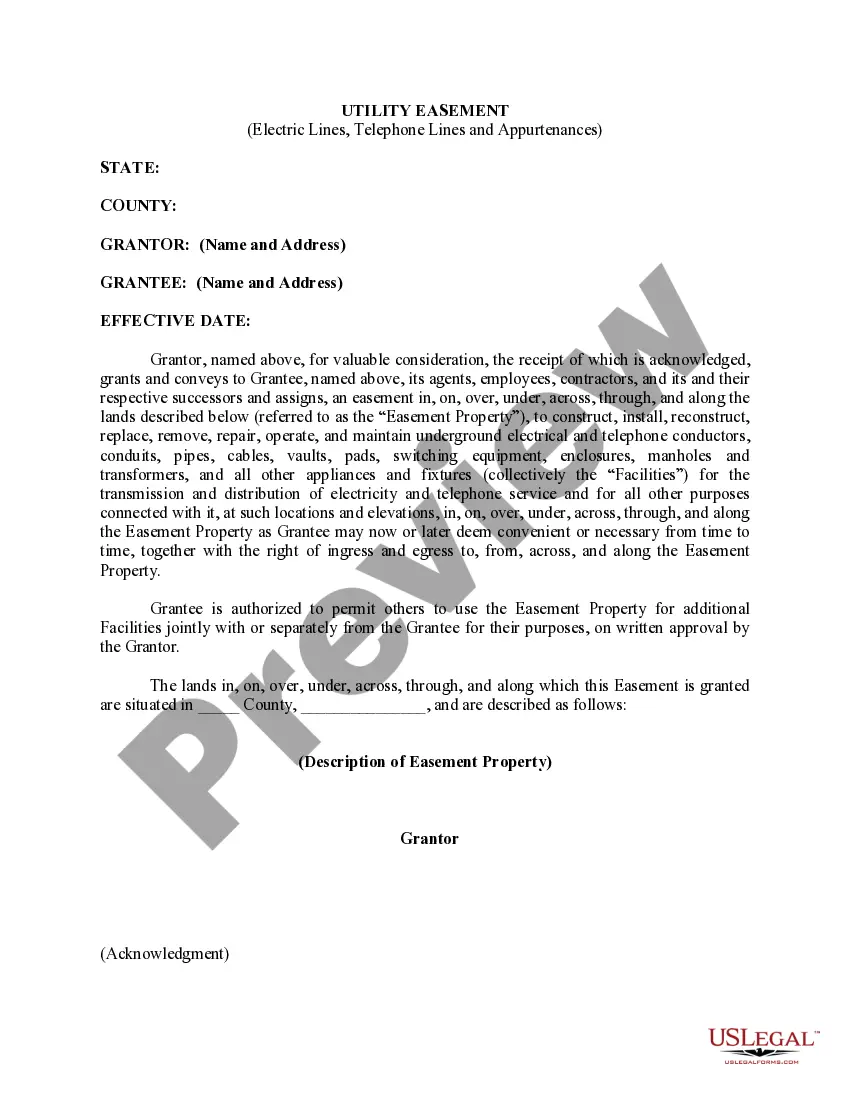
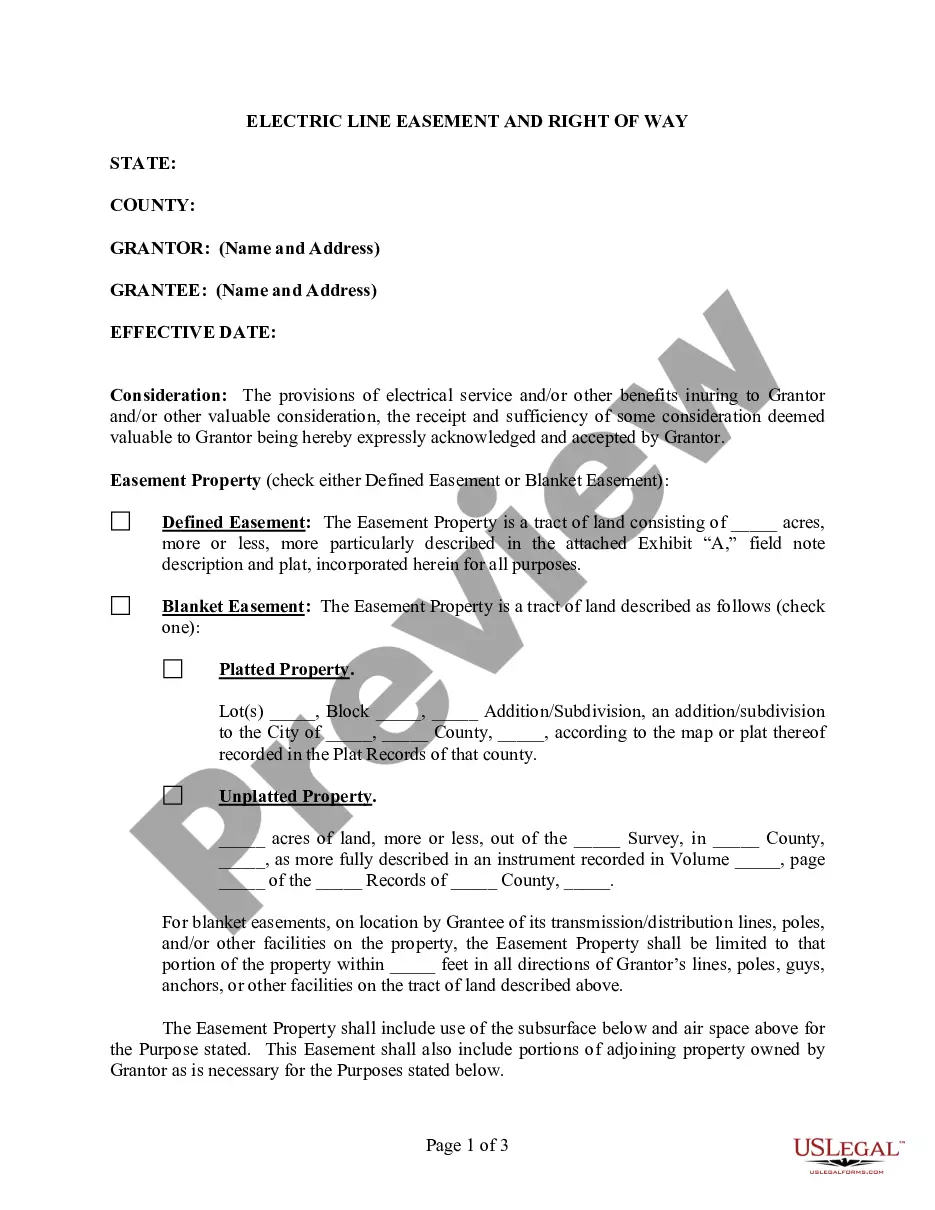
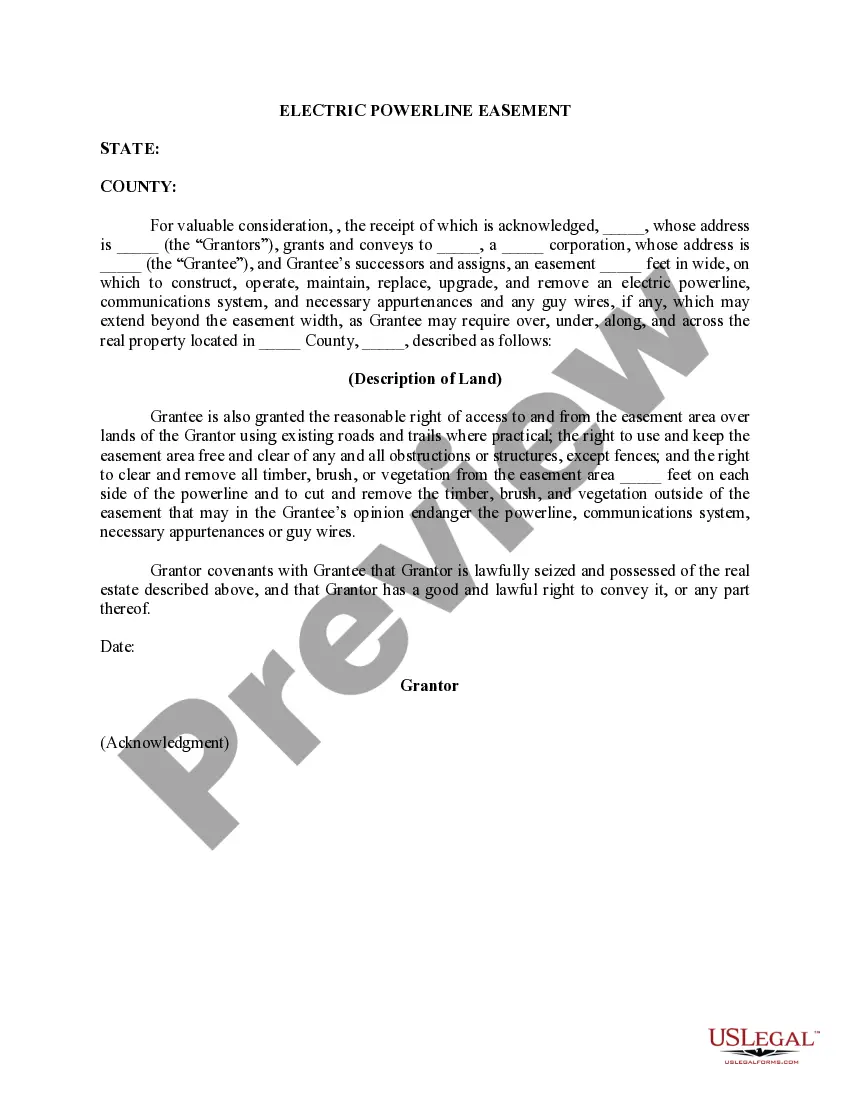
A Utility Easement for Electric Lines is a legal document that grants a company the right to use a specified portion of your property for the construction, operation, and maintenance of electric lines. Unlike other easements, this form specifically addresses the needs associated with electric utilities and ensures both parties understand their rights and responsibilities. It enables utility companies to manage and maintain essential infrastructure while protecting the interests of property owners.
What’s included in this form
- Grantor and Company identification fields.
- Specifications of the easement width and dimensions.
- Rights granted to the Company for operation, maintenance, and repairs.
- Restrictions on the Grantor regarding construction and planting in the easement area.
- Conditions for trimming trees or shrubs that interfere with electric line operations.
Common use cases
This form should be used when a property owner (Grantor) needs to grant permission to a utility company (Company) to establish electric lines on their property. Typical scenarios include new developments or renovations requiring electric service access, or when existing electric lines need to be properly documented for legal clarity, ensuring both the utility company and the property owner understand their respective roles and obligations.
Who can use this document
- Property owners who wish to allow utility companies to install electric lines on their land.
- Utility companies needing legal documentation for necessary easements.
- Legal representatives handling property transactions that involve easements for electric utilities.
Completing this form step by step
- Identify the parties involved: Fill in the names of the Grantor and the Company.
- Specify the property: Enter the location and description of the premises on which the easement will be granted.
- Define the easement width: Indicate the width of the easement being granted.
- Outline rights and restrictions: Make sure the terms regarding access, maintenance, and construction are clear.
- Include the date and Grantor's signature to finalize the document.
Does this form need to be notarized?
This form needs to be notarized to ensure legal validity. US Legal Forms provides secure online notarization powered by Notarize, allowing you to complete the process through a verified video call, available anytime.
Get your form ready online
Our built-in tools help you complete, sign, share, and store your documents in one place.
Make edits, fill in missing information, and update formatting in US Legal Forms—just like you would in MS Word.
Download a copy, print it, send it by email, or mail it via USPS—whatever works best for your next step.
Sign and collect signatures with our SignNow integration. Send to multiple recipients, set reminders, and more. Go Premium to unlock E-Sign.
If this form requires notarization, complete it online through a secure video call—no need to meet a notary in person or wait for an appointment.
We protect your documents and personal data by following strict security and privacy standards.

Make edits, fill in missing information, and update formatting in US Legal Forms—just like you would in MS Word.

Download a copy, print it, send it by email, or mail it via USPS—whatever works best for your next step.

Sign and collect signatures with our SignNow integration. Send to multiple recipients, set reminders, and more. Go Premium to unlock E-Sign.

If this form requires notarization, complete it online through a secure video call—no need to meet a notary in person or wait for an appointment.

We protect your documents and personal data by following strict security and privacy standards.
Avoid these common issues
- Failing to provide an accurate description of the property.
- Not specifying the easement width correctly.
- Overlooking any state-specific requirements or regulations.
- Not obtaining the necessary signatures before finalizing the form.
Benefits of using this form online
- Convenience: Easily access and download the form from anywhere.
- Editability: Customize the document to fit your specific situation without hassle.
- Reliability: Forms are prepared by licensed attorneys, ensuring compliance with legal standards.
Quick recap
- This Utility Easement form is vital for establishing rights over land for electric utility access.
- Proper completion of the form is crucial to avoid legal disputes between property owners and utility companies.
- Using an online platform for completion provides convenience and ensures access to up-to-date legal language.
Looking for another form?


Form popularity
FAQ
Express Grant by Instrument. An express grant by written instrument is the most common source of an easement. Implied. The owner of a large tract of land splits up the land with one or more parcels that do not abut a public highway or road. Necessity. Dedication.
Types of Easements An easement may be classified as either an easement appurtenant or an easement in gross. Easement Appurtenant. An easement appurtenant is an easement that benefits one parcel of land, known as the dominant tenement, to the detriment of another parcel of land, known as the servient tenement.
When termed as a utility easement, it means a utility company's right to access and control the portion of another person's land that is located near utility facilities and structures (i.e. utility poles, transformers, overhead or underground electrical lines).
The bottom line is that developers and builders who are presented with utility company easement forms should not just sign them, but think about the kinds of issues they can present. It is easier to negotiate these concessions up front before the lines go in, than to ask the utility company to amend its easement later.
An easement is a right which the owner or occupier of certain land possesses, as such, for the beneficial enjoyment of that land, to do and continue to do something, or to prevent and continue to prevent something being done, in or upon, or in respect of certain other land not his own. Kinds/ Types of Easement -
An easement held by an electricity provider allows it to erect and maintain electric power equipment on your land. The easement gives the electric power company the right to use a property for this specific purpose only.
Utility easements are one of the most common types of easements for private property, which generally allow public utility companies access to the property for the purpose of installing, repairing and maintaining utility lines.
An easement in gross is personal to the party that receives the benefit of easement. An example of an easement in gross is an easement to a utility company to run a power line across a burdened piece of property. The utility company is the benefited party and there isn't necessarily a benefited parcel of land.