USLegal Guide to Surrogacy - Surrogate
Understanding this form
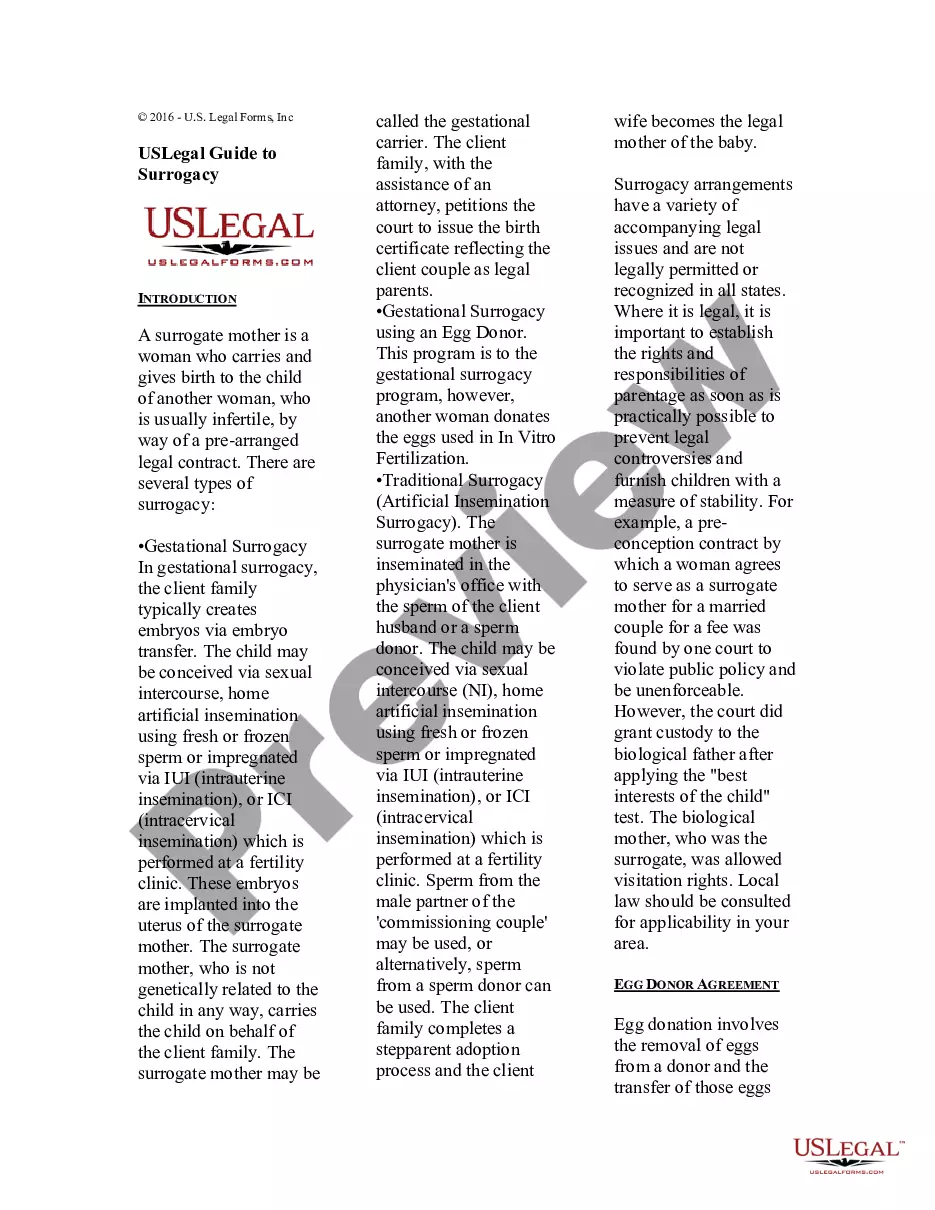
The USLegal Guide to Surrogacy - Surrogate provides a comprehensive overview of surrogacy in the U.S. It outlines the different types of surrogacy, including gestational and traditional, and explains key agreements involved in the process. Unlike other forms, this guide also includes links to state-specific laws, making it a valuable resource for those navigating the surrogacy journey.
Form components explained
- Definition and overview of surrogacy types: gestational and traditional.
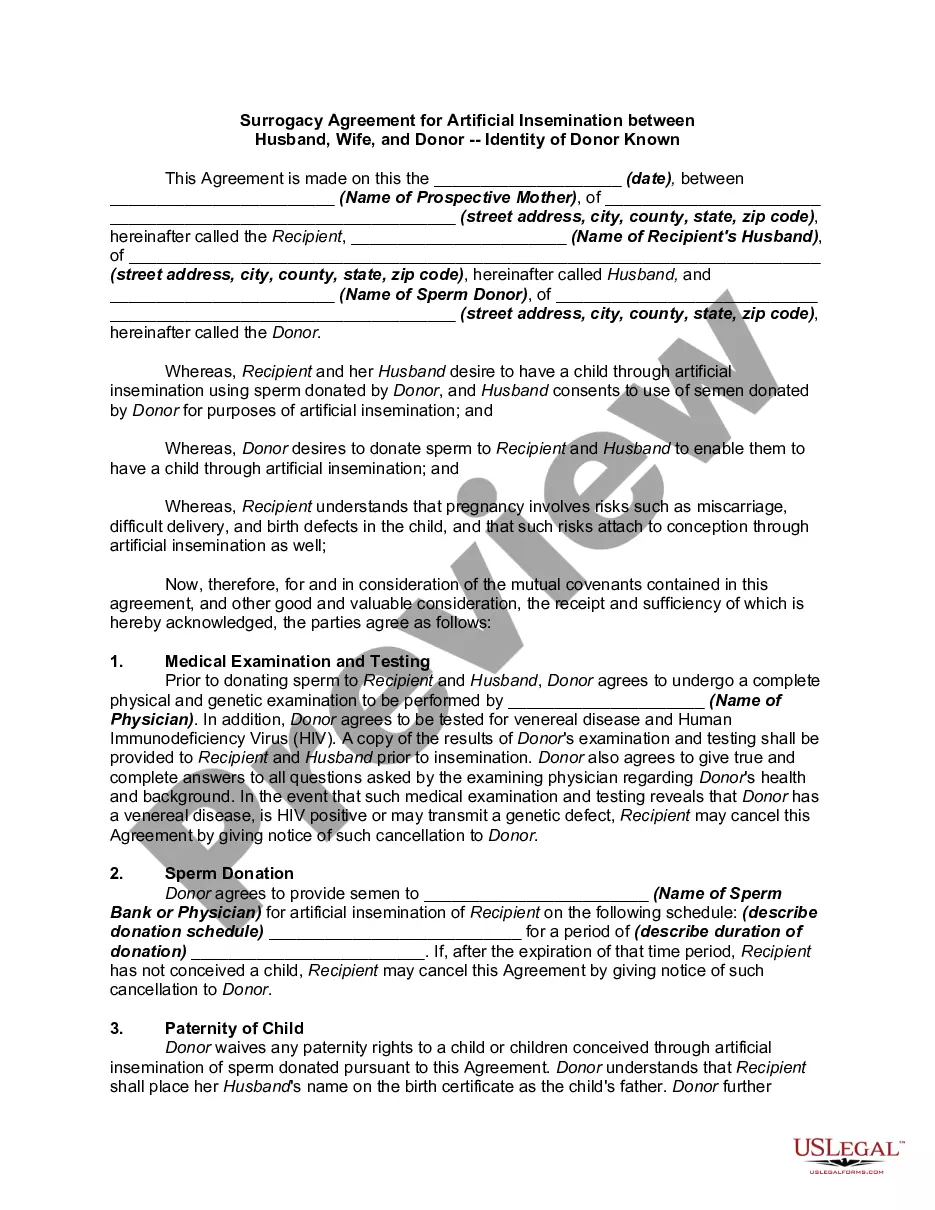
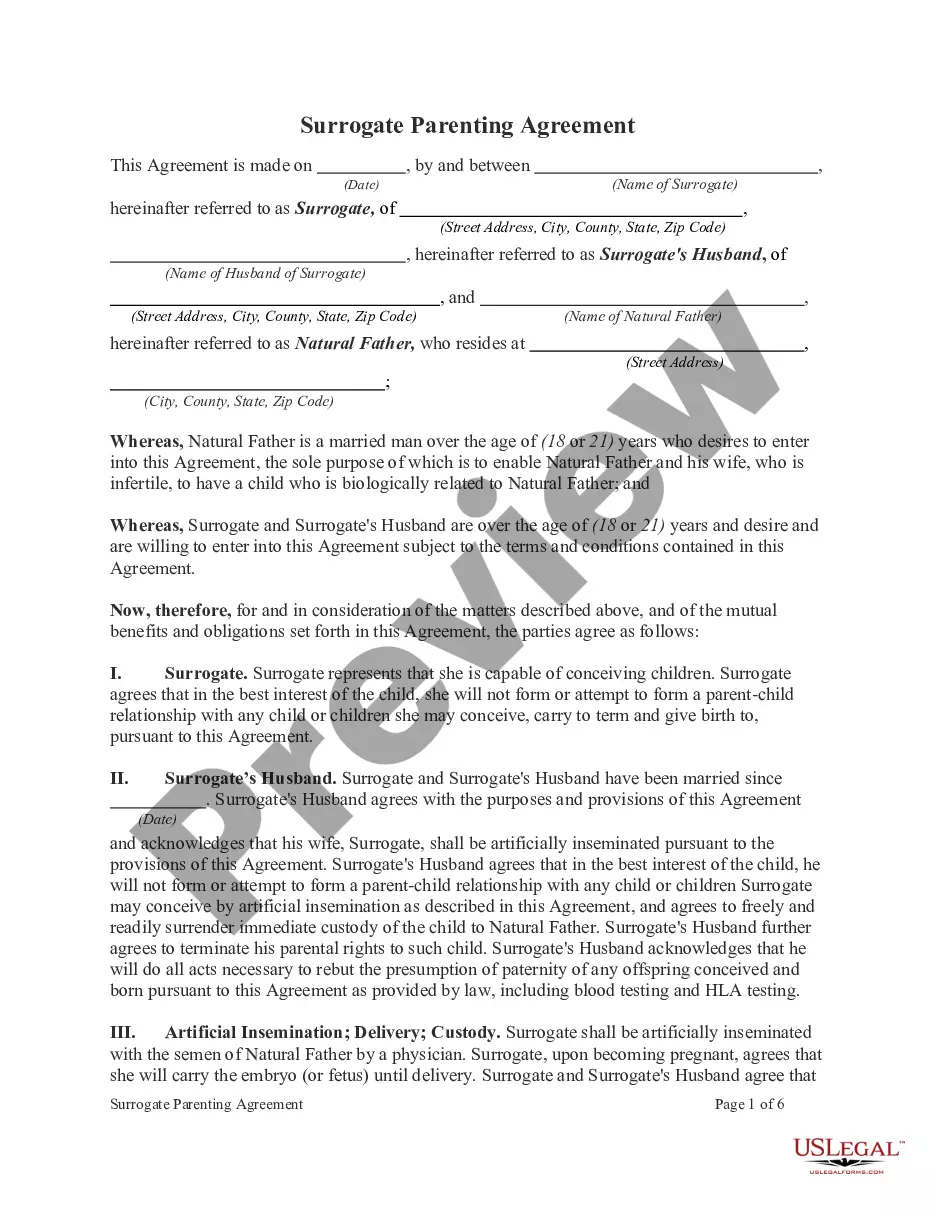
- Details of the surrogate agreement, including rights and responsibilities.
- Information about egg donor agreements and sperm donor agreements.
- Pre-birth order descriptions and their importance.
- Legal frameworks, including references to the Uniform Parentage Act (UPA).




When this form is needed
This guide is useful when individuals or couples consider surrogacy as a method to build their family. It is also applicable when engaging with legal processes associated with surrogacy arrangements, such as establishing parental rights and drafting necessary agreements.
Who should use this form
- Individuals or couples seeking to become parents through surrogacy.
- Surrogate mothers who wish to understand their rights and obligations.
- Legal professionals involved in family law and surrogacy cases.
- Health professionals working with intended parents and surrogates.
Completing this form step by step
- Identify the intended parents and the surrogate mother.
- Specify the type of surrogacy being used (gestational or traditional).
- Draft a comprehensive surrogacy agreement detailing all rights and responsibilities of each party.
- Consult legal professionals to review agreements and ensure compliance with state laws.
- File necessary petitions with local courts for parental recognition where applicable.
Is notarization required?
This form does not typically require notarization to be legally valid. However, some jurisdictions or document types may still require it. US Legal Forms provides secure online notarization powered by Notarize, available 24/7 for added convenience.
Get your form ready online
Our built-in tools help you complete, sign, share, and store your documents in one place.
Make edits, fill in missing information, and update formatting in US Legal Forms—just like you would in MS Word.
Download a copy, print it, send it by email, or mail it via USPS—whatever works best for your next step.
Sign and collect signatures with our SignNow integration. Send to multiple recipients, set reminders, and more. Go Premium to unlock E-Sign.
If this form requires notarization, complete it online through a secure video call—no need to meet a notary in person or wait for an appointment.
We protect your documents and personal data by following strict security and privacy standards.

Make edits, fill in missing information, and update formatting in US Legal Forms—just like you would in MS Word.

Download a copy, print it, send it by email, or mail it via USPS—whatever works best for your next step.

Sign and collect signatures with our SignNow integration. Send to multiple recipients, set reminders, and more. Go Premium to unlock E-Sign.

If this form requires notarization, complete it online through a secure video call—no need to meet a notary in person or wait for an appointment.

We protect your documents and personal data by following strict security and privacy standards.
Mistakes to watch out for
- Not consulting legal counsel familiar with surrogacy laws.
- Overlooking state-specific regulations related to surrogacy.
- Failing to include essential terms in the surrogacy agreement.
- Neglecting to address psychological counseling for the surrogate.
Why use this form online
- Convenience of accessing legal information from anywhere.
- Editability allows customization to fit specific needs.
- Reliable guidance drafted by licensed attorneys.
- Time-saving, as forms can be downloaded immediately.
Looking for another form?







Form popularity
FAQ
The medical risks of surrogacy These risks include: for the child if more than one embryo is transferred this increases the risk of multiple birth. Multiple birth is associated with premature birth, low birth weight and health problems for the babies.
The intended parents must be so grateful! A surrogate knows that what she's doing will help her intended parents reach their dreams of having a family. You are such a wonderful person for doing this! How can I help?
The increase in price is due to the application of an IVF, in addition to legal preparations and agency requirements. According to West Coast Surrogacy, intended parents can expect to pay anywhere from $90,000 to $130,000 for their gestational surrogacy.
Write a Heartfelt Letter. A personal, handwritten letter to your surrogate is the perfect example of a heartfelt and meaningful gift. Surprise Her with a Thoughtful Gift. You may feel that a handwritten letter is not enough to express your gratitude. Be Aware & Supportive of Her Needs.
Critics of surrogacy argue that intended parents who use surrogates are interested only in their reproductive ability; they see this practice as womb-renting, especially when the woman carrying the pregnancy is in a financially disadvantageous position to the intended parents.
General ethical principles. Surrogacy is an acceptable procedure if it is an altruistic act by a woman to help a couple for which it is impossible or medically contraindicated to carry a pregnancy.
A few of the many issues raised by surrogacy include: the rights of the children produced; the ethical and practical ramifications of the further commodification of women's bodies; the exploitation of poor and low income women desperate for money; the moral and ethical consequences of transforming a normal biological
Surrogacy is often thought to be a 'treatment' option for the infertile or an alternative to adoption, and so to be celebrated in fulfilling people's desires to be parents. However, surrogacy also brings a wealth of more complex ethical issues around gender, labour, payment, exploitation and inequality.
Decide if Surrogacy is the Right Choice. The first step in any surrogacy process is to carefully consider whether surrogacy is right for you. Prepare for Surrogacy. Find a Match. Satisfy Legal Requirements. Begin the Fertilization and Embryo Transfer Process. Welcome the New Baby!