Payroll Deduction Authorization Form for Optional Matters - Employee
What this document covers
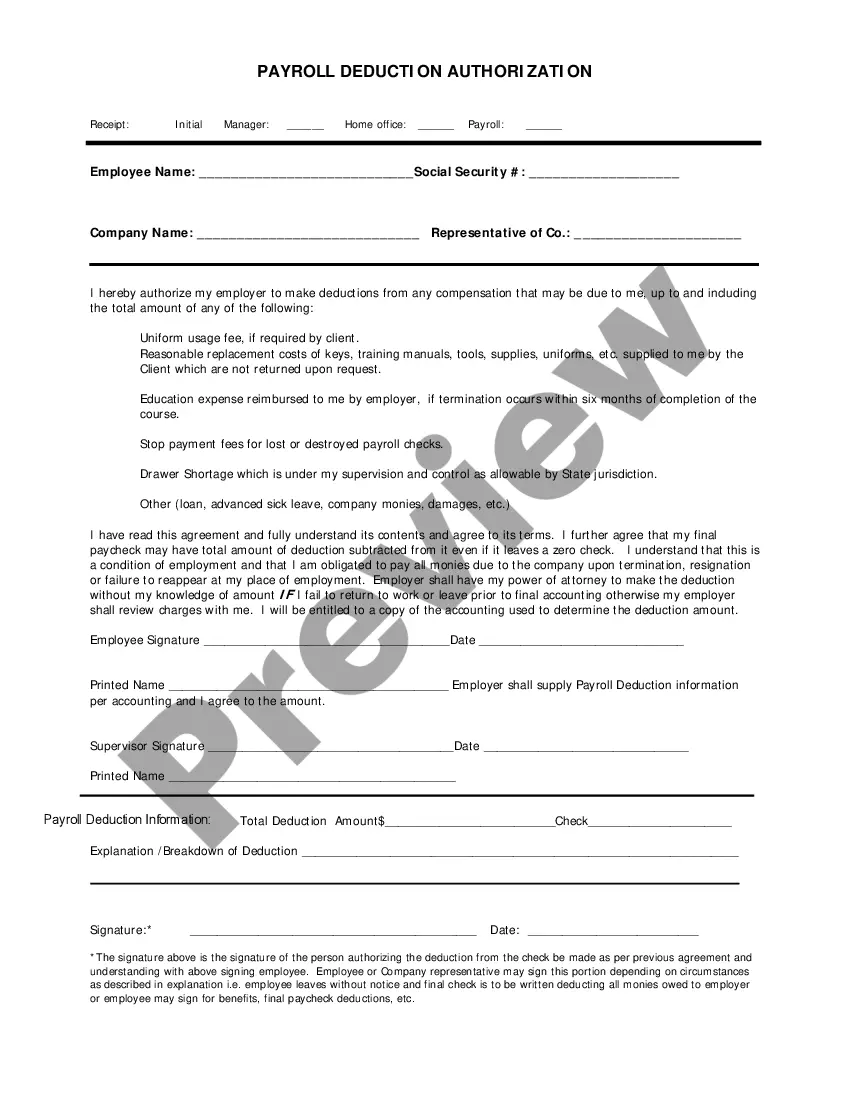
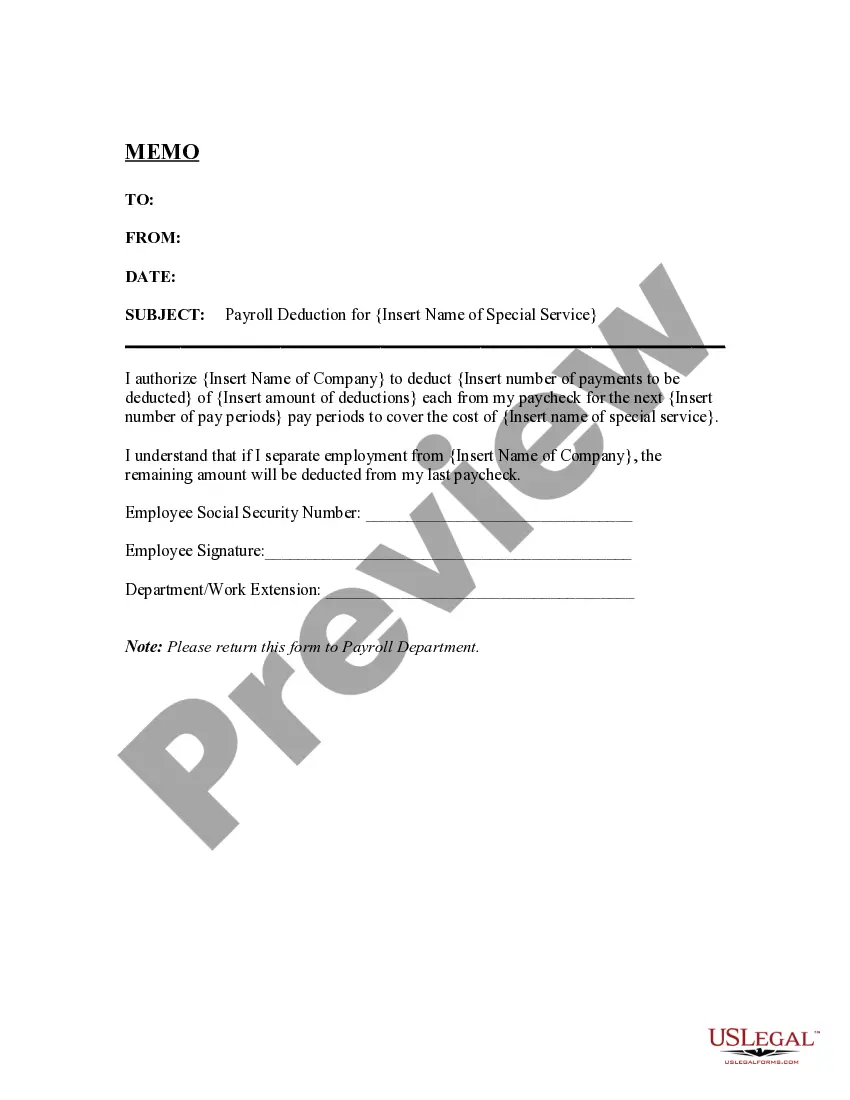
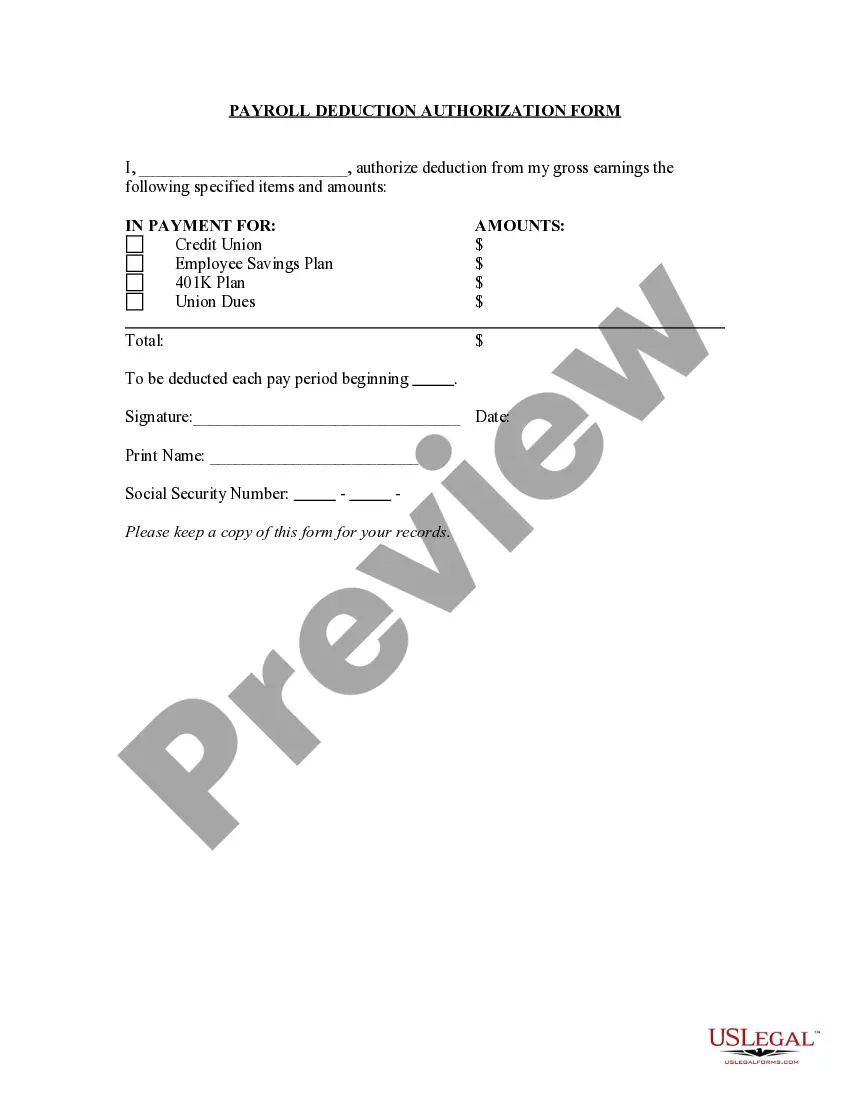
The Payroll Deduction Authorization Form for Optional Matters - Employee is a legal document that allows employees to authorize their employer to deduct specific amounts from their compensation. This form differs from other payroll deduction forms by focusing on optional matters such as uniform fees, training costs, and reimbursement for education expenses. It ensures both the employer and employee have a clear understanding of the deductions allowed and the conditions under which they apply.
Key components of this form
- Employee Name and Social Security Number
- Company Name and Company Representative
- Details of authorized deductions
- Employee and Supervisor signatures
- Total deduction amount and breakdown

Situations where this form applies
This form should be used when employees wish to authorize specific deductions from their paychecks. Employees may need to complete this form to cover fees for uniform usage, replace items not returned, reimburse education expenses under certain conditions, or address any other agreed-upon deductions. Utilizing this form clarifies the terms ahead of time and protects both partyâs interests in the event of termination or resignation.
Who this form is for
This form is intended for:
- Employees who are subject to payroll deductions for various optional matters
- Employers who require a formal agreement for authorized deductions from employee paychecks
- Businesses needing a standardized process for managing payroll deductions
How to complete this form
- Enter the employeeâs name and Social Security number at the top of the form.
- Provide the company name and the name of the company representative.
- Check off and specify the types of deductions being authorized.
- Both the employee and supervisor should sign and date the form.
- Fill in the total deduction amount and provide a detailed explanation of the deductions.
Notarization guidance
This form does not typically require notarization unless specified by local law. Employees should check their state regulations to confirm if notarization is necessary for their situation.
Get your form ready online
Our built-in tools help you complete, sign, share, and store your documents in one place.
Make edits, fill in missing information, and update formatting in US Legal Forms—just like you would in MS Word.
Download a copy, print it, send it by email, or mail it via USPS—whatever works best for your next step.
Sign and collect signatures with our SignNow integration. Send to multiple recipients, set reminders, and more. Go Premium to unlock E-Sign.
If this form requires notarization, complete it online through a secure video call—no need to meet a notary in person or wait for an appointment.
We protect your documents and personal data by following strict security and privacy standards.

Make edits, fill in missing information, and update formatting in US Legal Forms—just like you would in MS Word.

Download a copy, print it, send it by email, or mail it via USPS—whatever works best for your next step.

Sign and collect signatures with our SignNow integration. Send to multiple recipients, set reminders, and more. Go Premium to unlock E-Sign.

If this form requires notarization, complete it online through a secure video call—no need to meet a notary in person or wait for an appointment.

We protect your documents and personal data by following strict security and privacy standards.
Avoid these common issues
- Leaving the date unfilled or incorrectly completed.
- Failing to sign both employee and supervisor signatures.
- Not specifying the deduction amounts or types clearly.
- Ignoring state-specific payroll deduction laws that may apply.
Benefits of completing this form online
- Convenience of accessing and completing the form from anywhere.
- Editable fields allow for easy customization based on individual circumstances.
- Reliable templates ensure compliance with legal requirements.
Legal use & context
- The form provides legal documentation of the employee's consent to deductions.
- It protects employers by establishing clear communication regarding payroll deductions.
- Failure to complete this form may lead to misunderstandings about deduction amounts upon termination.
Summary of main points
- This form is essential for laying out authorized payroll deductions.
- Correct completion and signing by both parties ensure legal validity and compliance.
- Each deduction type listed on the form should be understood and agreed upon by the employee.
Looking for another form?

Form popularity
FAQ
Retirement or 401(k) plan contributions. Health insurance premiums for medical, dental and vision plans. Life insurance premiums. Contributions to a flexible spending account or pre-tax health savings plan.
Voluntary deductions are amounts which an employee has elected to have subtracted from gross pay. Examples are group life insurance, healthcare and/or other benefit deductions, Credit Union deductions, etc.Post tax deductions are withheld after all taxes have been calculated and withheld.
Debit "Wages Expense" for the full amount the company must pay for the pay period. Credit "Net Payroll Payable" and any deductions required. Add the total number of debits and then add the total number of credits.
Some mandatory payroll tax deductions that employers are required by law to withhold from an employee's paycheck include: Federal income tax withholding. Social Security & Medicare taxes also known as FICA taxes. State income tax withholding.
Optional employee deductions include all amounts reducing an employee's net pay that are made at the request of the employee. Some examples of optional employee deductions are agency maintenance, group health insurance, organizational dues, parking, United Way, and U.S. savings bonds.
FICA tax. Federal Insurance Contributions Act (FICA) tax is made up of Social Security and Medicare taxes. Federal income tax. State and local taxes. Garnishments. Health insurance premiums. Retirement plans. Life insurance premiums. Job-related expenses.
Medical expenses.Property, state, and local income taxes.Home mortgage interest.Charitable contributions.Investment interest expense.Miscellaneous deductions.
Dues to professional societies, excluding lobbying and political organizations.Home office costs.Job search expenses in your current occupation, even if you don't land a new job.Legal fees related to doing or keeping your job.Employees Can Deduct Workplace Expenses For Tax Years Prior to\nturbotax.intuit.com > tax-tips > jobs-and-career > employees-can-deduct-w...