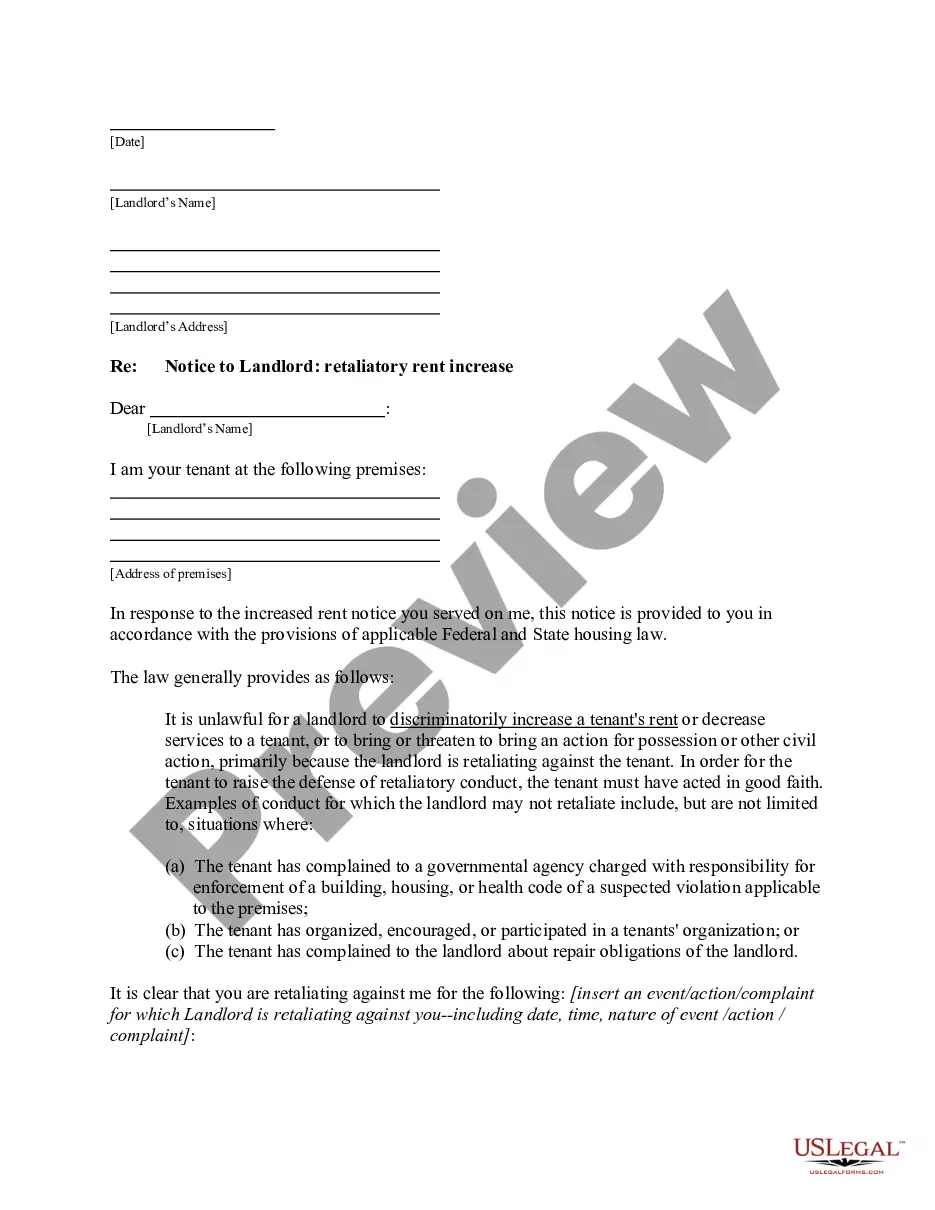
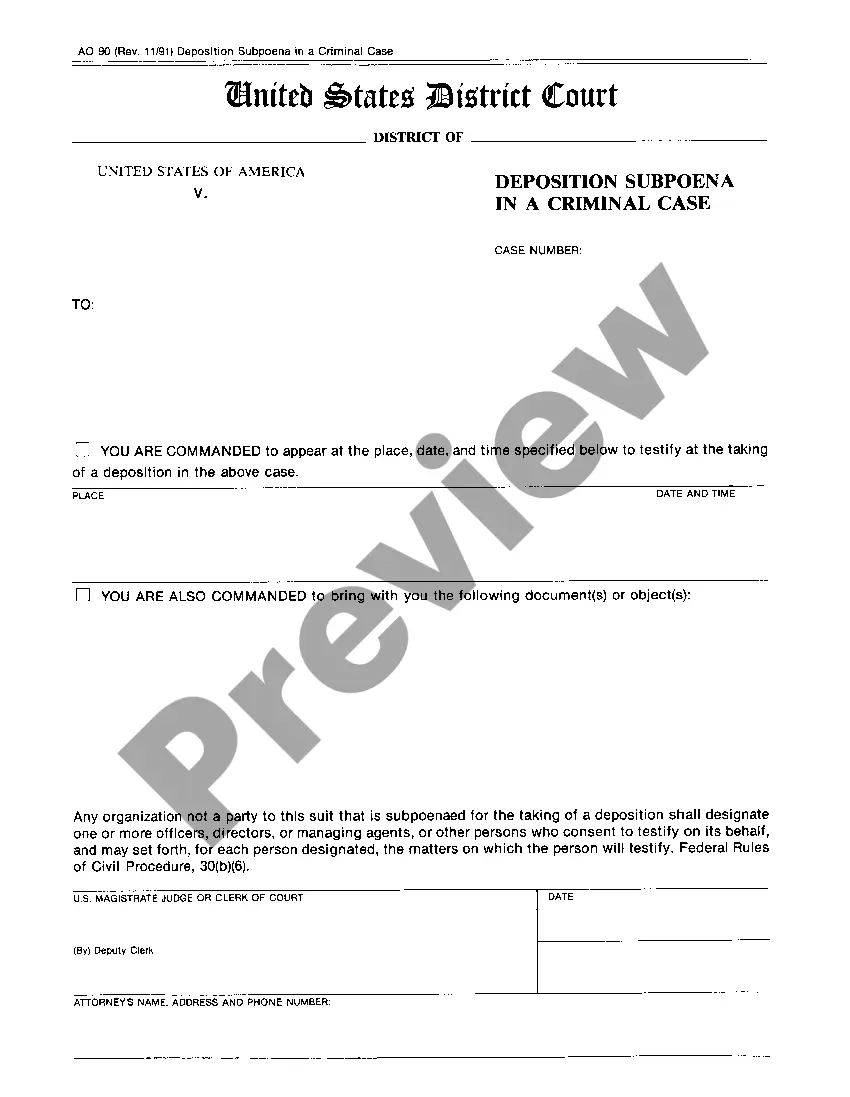
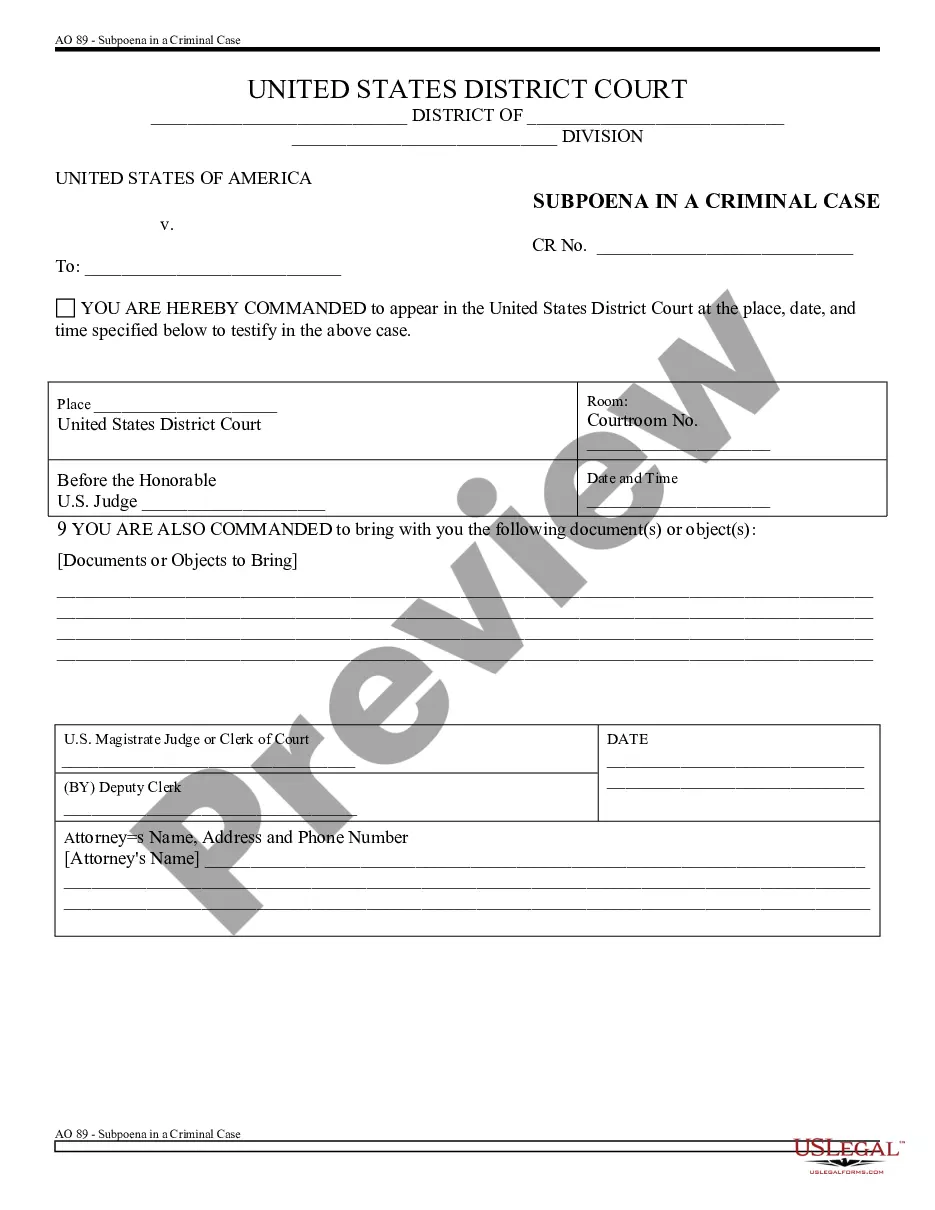
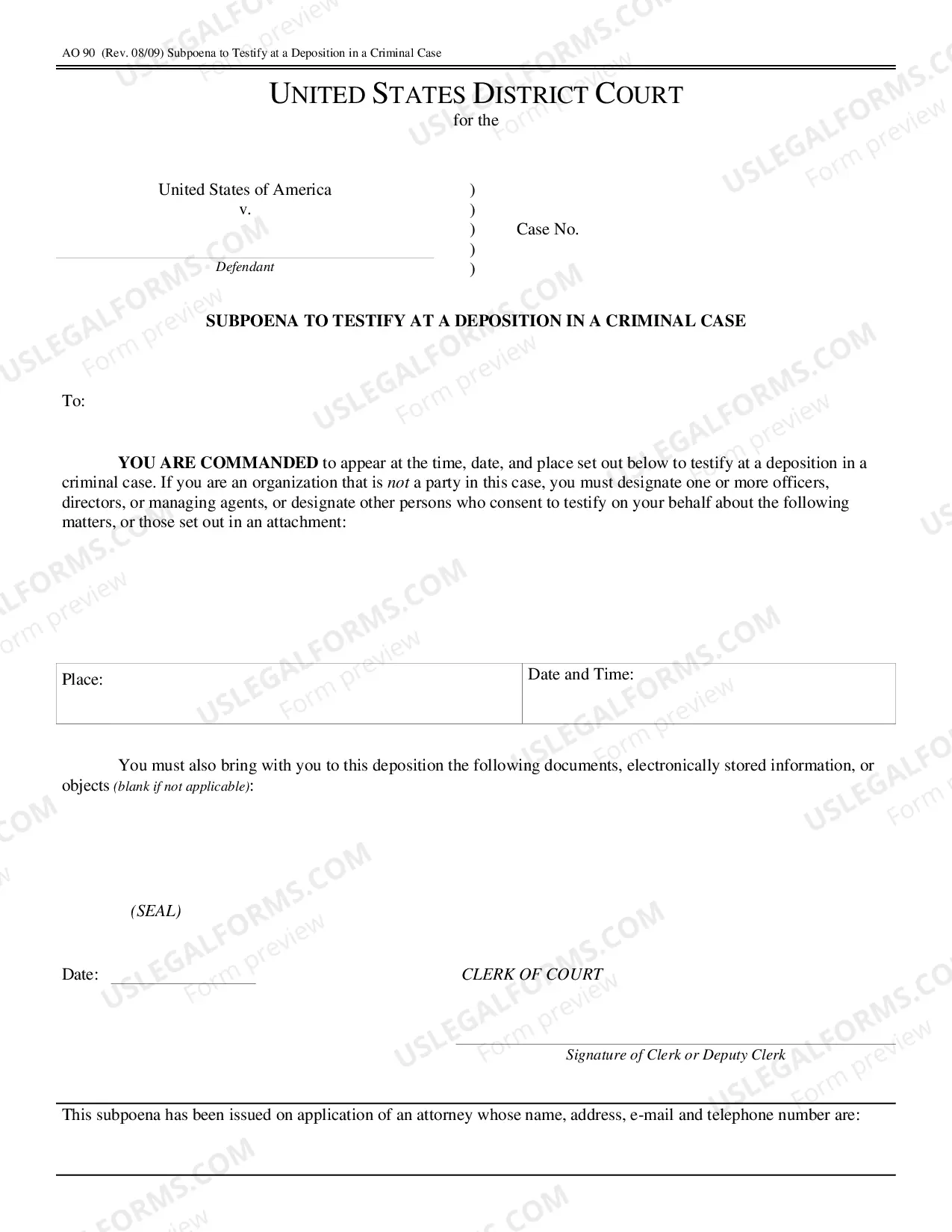
AO-90 Deposition Subpoena in a Criminal Case - Federal District Court Official Form
Does this form need to be notarized?
Notarization is generally not required for this form. However, certain states or situations might demand it. You can complete notarization online through US Legal Forms, powered by Notarize, using a verified video call available anytime.
Get your form ready online
Our built-in tools help you complete, sign, share, and store your documents in one place.
Make edits, fill in missing information, and update formatting in US Legal Forms—just like you would in MS Word.
Download a copy, print it, send it by email, or mail it via USPS—whatever works best for your next step.
Sign and collect signatures with our SignNow integration. Send to multiple recipients, set reminders, and more. Go Premium to unlock E-Sign.
If this form requires notarization, complete it online through a secure video call—no need to meet a notary in person or wait for an appointment.
We protect your documents and personal data by following strict security and privacy standards.

Make edits, fill in missing information, and update formatting in US Legal Forms—just like you would in MS Word.

Download a copy, print it, send it by email, or mail it via USPS—whatever works best for your next step.

Sign and collect signatures with our SignNow integration. Send to multiple recipients, set reminders, and more. Go Premium to unlock E-Sign.

If this form requires notarization, complete it online through a secure video call—no need to meet a notary in person or wait for an appointment.

We protect your documents and personal data by following strict security and privacy standards.
Looking for another form?
Form popularity
FAQ
Additional Resources. The federal courts have operated as tribunals for the prosecution of crimes defined by federal law and the Constitution.
A subpoena must issue from the court where the action is pending.The clerk must issue a subpoena, signed but otherwise in blank, to a party who requests it. That party must complete it before service. An attorney also may issue and sign a subpoena if the attorney is authorized to practice in the issuing court.
The U.S. district courts are the trial courts of the federal court system. The district courts can hear most federal cases, including civil and criminal cases.
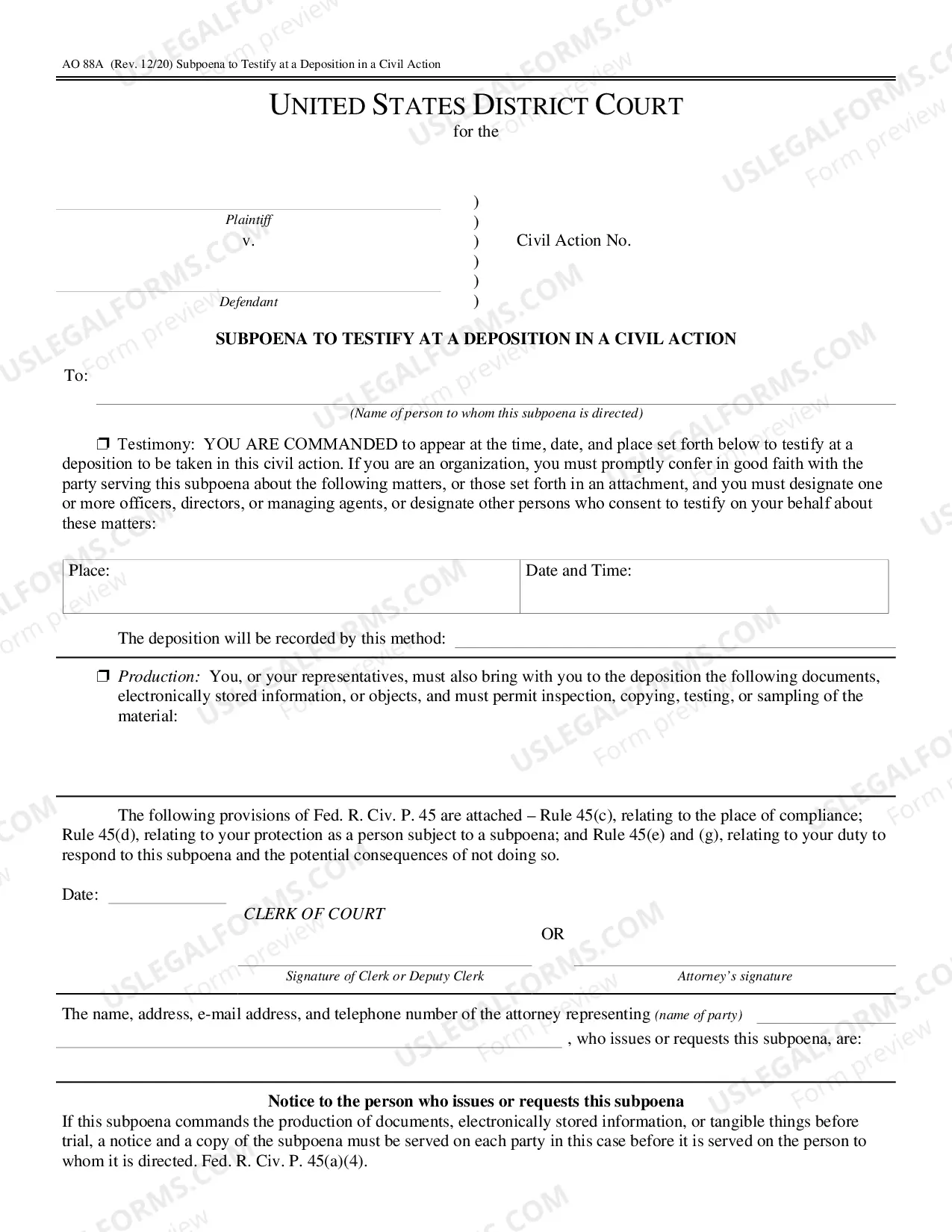
What is a Subpoena?In federal court proceedings, a subpoena can take the following titles: Subpoena To Testify at a Deposition In A Civil Action; Subpoena To Appear And Testify At A Hearing Or Trial In A Civil Action; or Subpoena To Produce Documents, Information, Or Objects Or To Permit Inspection of Premises.
Unlike state court where the Code of Civil Procedure provides timing requirements, a deposition notice in federal court need only give reasonable written notice. (Rule 30(b)(1).)
Specifically, the rule states that before it is served on the person to whom it is directed, a notice and a copy of the subpoena must be served on each party. FRCP(a)(4). This means that each party must be served with a notice of the subpoena and a copy of the subpoena itself.
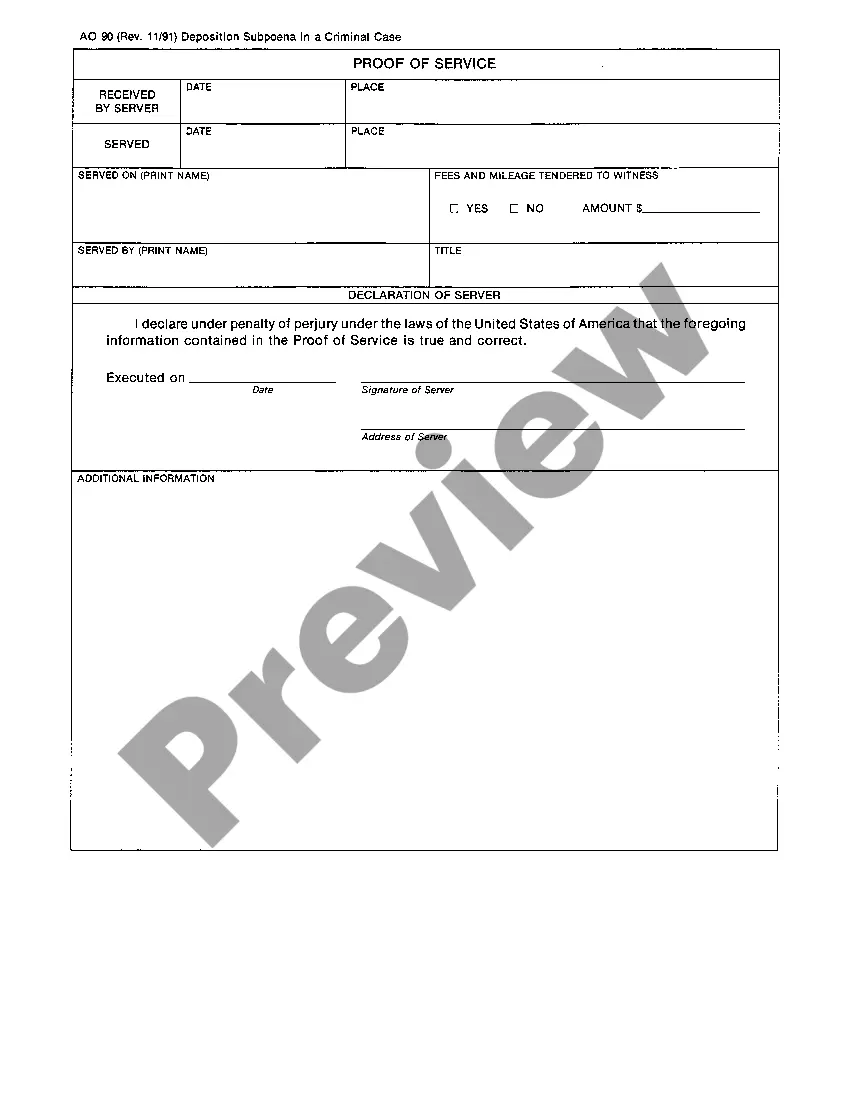
Any person who is at least 18 years old and not a party may serve a subpoena. Serving a subpoena requires delivering a copy to the named person and, if the subpoena requires that person's attendance, tendering the fees for 1 day's attendance and the mileage allowed by law.
Under the current federal rule, you can issue a subpoena from the district court in which your action is pending and serve it anywhere in the United States; however, there are geographic limitations on where you can require the discovery to take place, and you will have to go to the district court with jurisdiction
A subpoena is a court order that says that your witness has to come to court. It can also say that someone has to bring certain papers to court at your trial.Your witness will not come to court; or. Someone will not give you the documents you need to prove your case.