Anchor Tenant Vacancy Clause
Understanding this form
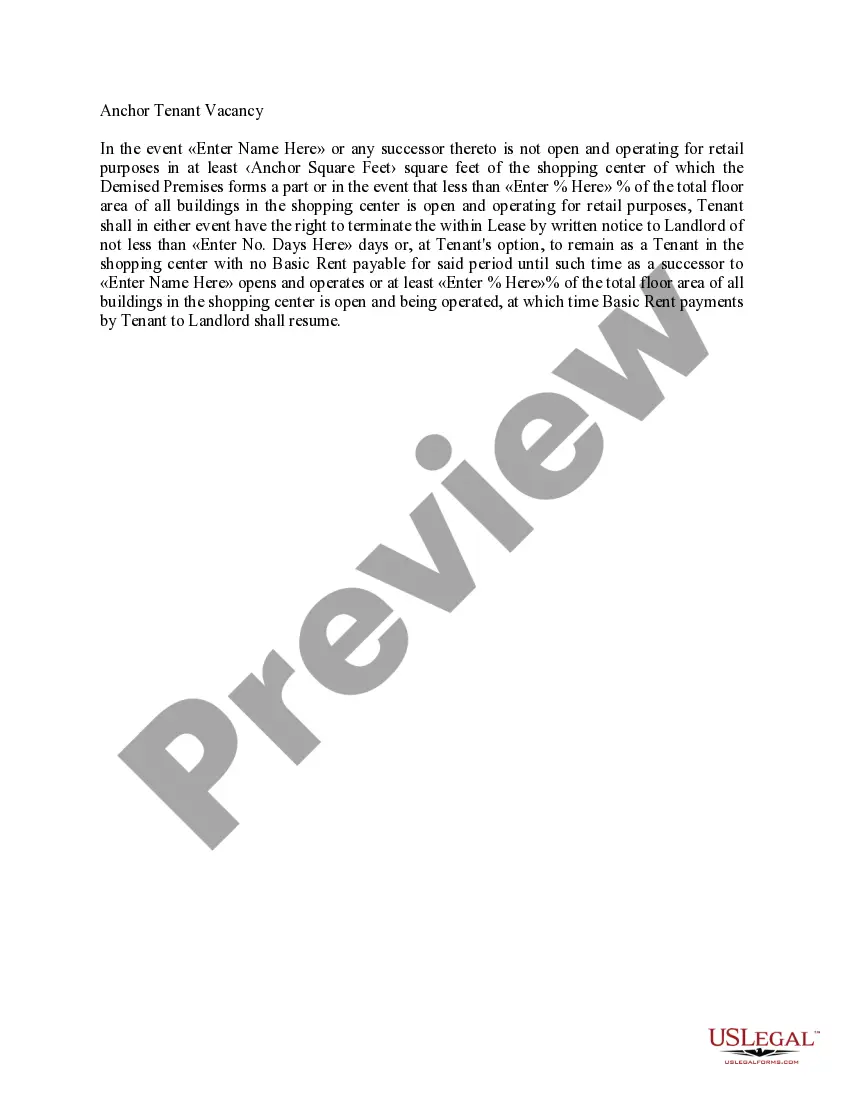
The Anchor Tenant Vacancy Clause is a legal document that outlines the rights of tenants in a shopping center if the main tenant (or "Anchor Tenant") vacates the premises. This form serves to protect tenants by allowing them options such as relinquishing the lease or remaining in the property without payment of rent until the area is fully operational. This clause is essential for tenants needing assurance of their rights within a commercial lease agreement, specifically related to the presence and functionality of key retailers in the area.
Key components of this form
- Definition of the "Anchor Tenant" and its operational requirements
- Conditions under which the tenant may terminate the lease
- Right to remain in the premises rent-free during specified conditions
- Notification period required for lease termination
- Criteria for resuming rent payments once conditions are met
When to use this document
This form is applicable in situations where an Anchor Tenant in a shopping center has closed or is no longer operational. If key retail operations are significantly reduced, landlords and tenants may reference this clause to determine next steps in their leasing arrangement. It is especially useful if a tenant is considering their options regarding continued occupancy or lease termination based on the presence of the Anchor Tenant.
Who this form is for
This form is designed for:
- Tenants in a commercial lease agreement within a shopping center
- Landlords seeking to establish clear terms related to the Anchor Tenant's vacancy
- Commercial property managers overseeing tenant relationships within retail locations
Steps to complete this form
- Identify the parties involved, including the tenant and landlord.
- Specify the retail area size in square feet as related to the Anchor Tenant's vacancy.
- Indicate the percentage of operational retail space needed to avoid lease termination.
- Fill in the required notification period in days for the landlord to be officially informed.
- Include signatures of both parties to finalize the agreement.
Is notarization required?
This form does not typically require notarization unless specified by local law. However, it's always best to check regional regulations to ensure legality.
Get your form ready online
Our built-in tools help you complete, sign, share, and store your documents in one place.
Make edits, fill in missing information, and update formatting in US Legal Forms—just like you would in MS Word.
Download a copy, print it, send it by email, or mail it via USPS—whatever works best for your next step.
Sign and collect signatures with our SignNow integration. Send to multiple recipients, set reminders, and more. Go Premium to unlock E-Sign.
If this form requires notarization, complete it online through a secure video call—no need to meet a notary in person or wait for an appointment.
We protect your documents and personal data by following strict security and privacy standards.

Make edits, fill in missing information, and update formatting in US Legal Forms—just like you would in MS Word.

Download a copy, print it, send it by email, or mail it via USPS—whatever works best for your next step.

Sign and collect signatures with our SignNow integration. Send to multiple recipients, set reminders, and more. Go Premium to unlock E-Sign.

If this form requires notarization, complete it online through a secure video call—no need to meet a notary in person or wait for an appointment.

We protect your documents and personal data by following strict security and privacy standards.
Avoid these common issues
- Failing to specify the definitions clearly, such as what constitutes an Anchor Tenant.
- Not including the required notifications periods accurately.
- Overlooking necessary signatures or dates before submitting the form.
Benefits of using this form online
- Quick and easy access to professionally drafted legal templates.
- Conveniently fill out and edit the form from anywhere.
- Reliable legal compliance by using templates that are regularly updated.
Looking for another form?
Form popularity
FAQ
Related Content. Also known as the prime tenant, draw tenant or key tenant. A tenant usually strategically located in a shopping center to generate and maximize consumer traffic for other smaller retail tenants in the center.
Requiring the continued presence of an anchor store as a condition of the lease is known as a co-tenancy clause.
An anchor tenant is a large and well-known business that occupies a significant amount of space in a commercial real estate property. This type of tenant is often the first tenant to sign a lease agreement with a developer or landlord, and is crucial to the success of the property.
Anchor tenants are the largest or most prominent stores in a retail location. They help draw customers into the area either because they have unique items or they're a well-known name. In strip centers, anchor tenants are often big-box stores like Target, Wal-Mart or grocery stores.
What are Anchor Tenants in Commercial Real Estate? Anchor tenants are the largest or most prominent stores in a retail commercial real estate development. They generally help draw customers into the area. In strip centers and power centers, anchor tenants are often big-box stores or grocery stores.
The Future of the Anchor Tenants Concept One example is the Apple Store, which, in recent years, has become an increasingly common?and successful?anchor tenant for shopping malls.
In a commercial retail center, an anchor tenant is one who leases the largest amount of space. As a commercial real estate company, we like grocery store anchored retail centers. Example anchors include companies like WalMart, Kroger, Safeway, and Whole Foods.