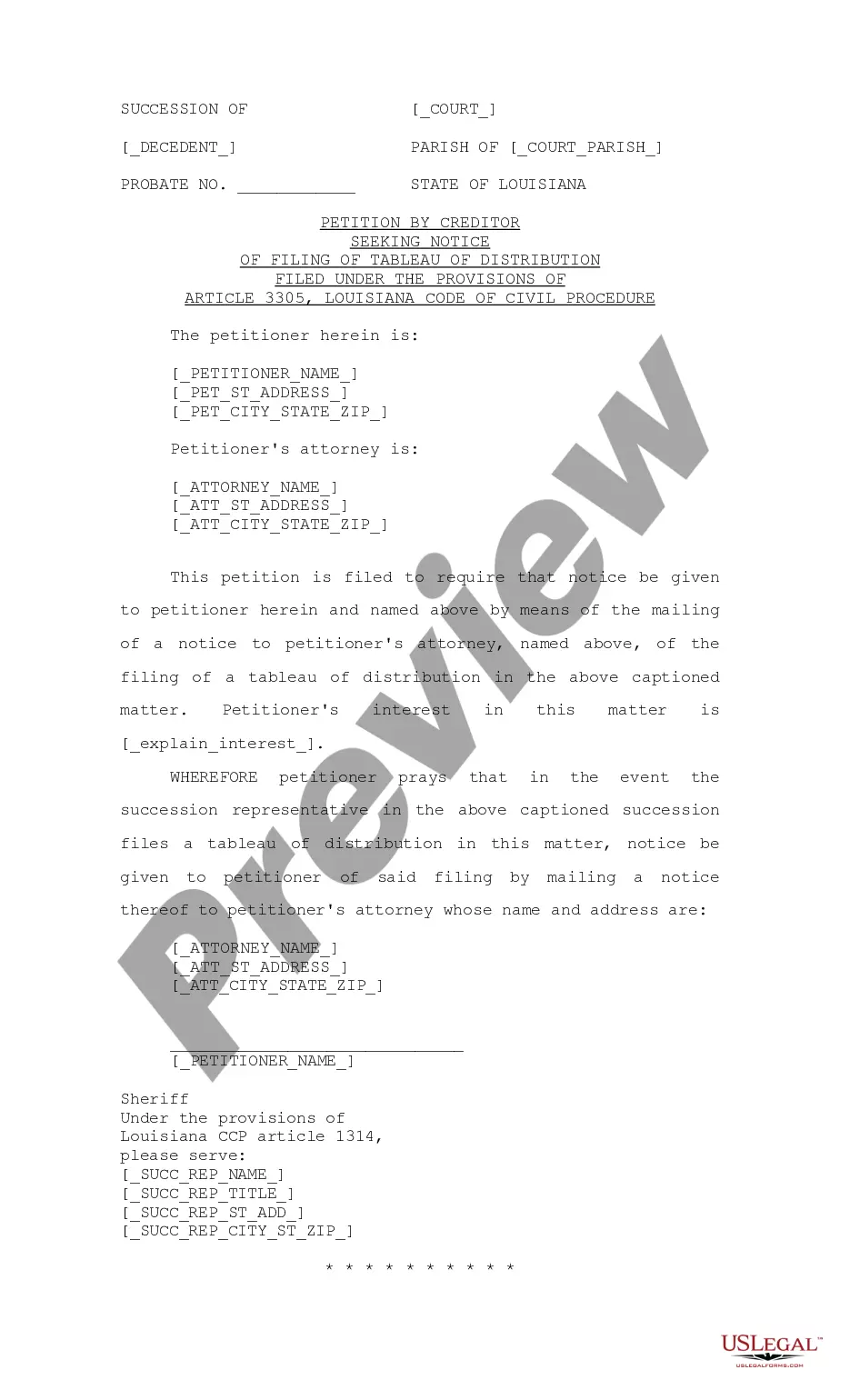
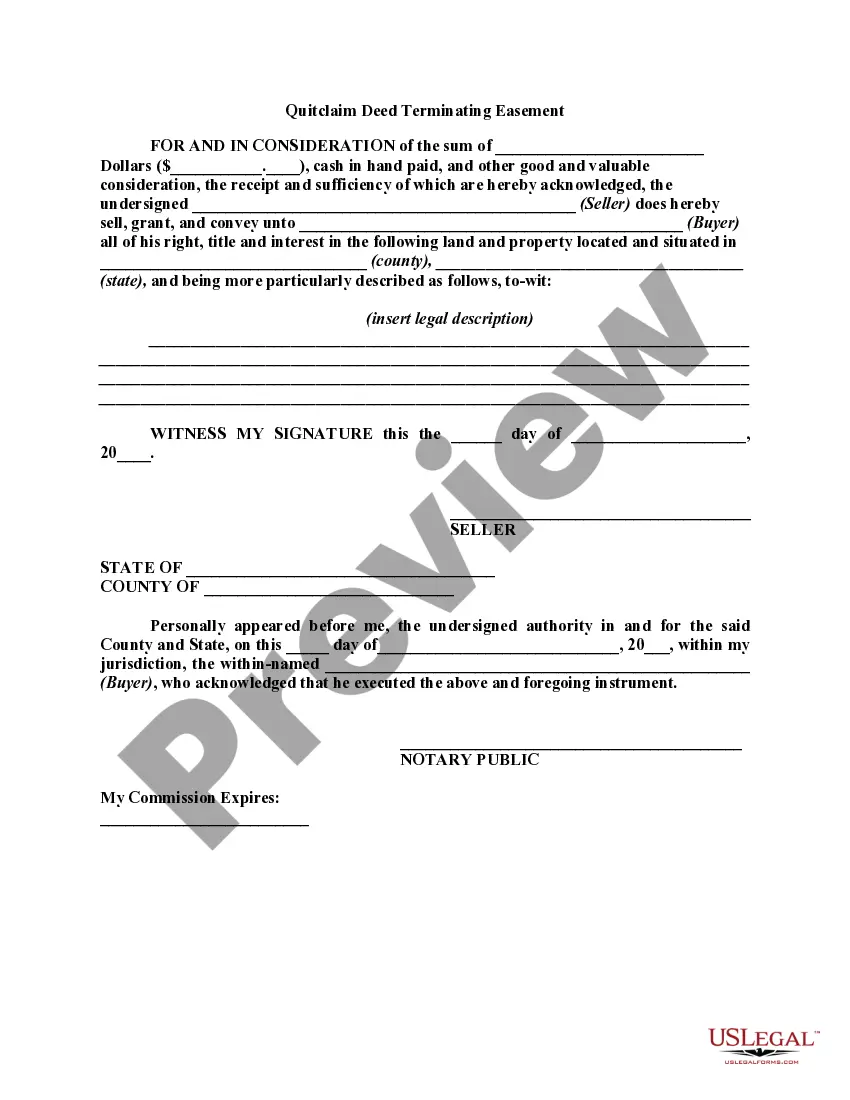
Quitclaim Deed Terminating Easement
Understanding this form
A quitclaim deed terminating easement is a legal document that allows a property owner, the grantor, to transfer any interest they may have in a specific easement to another party. Unlike other forms of property transfer, this quitclaim deed does not guarantee that the grantor possesses any ownership rights; it merely conveys whatever interest might exist. This form is especially relevant when a property owner wishes to formally terminate an easement that affects their property.
Main sections of this form
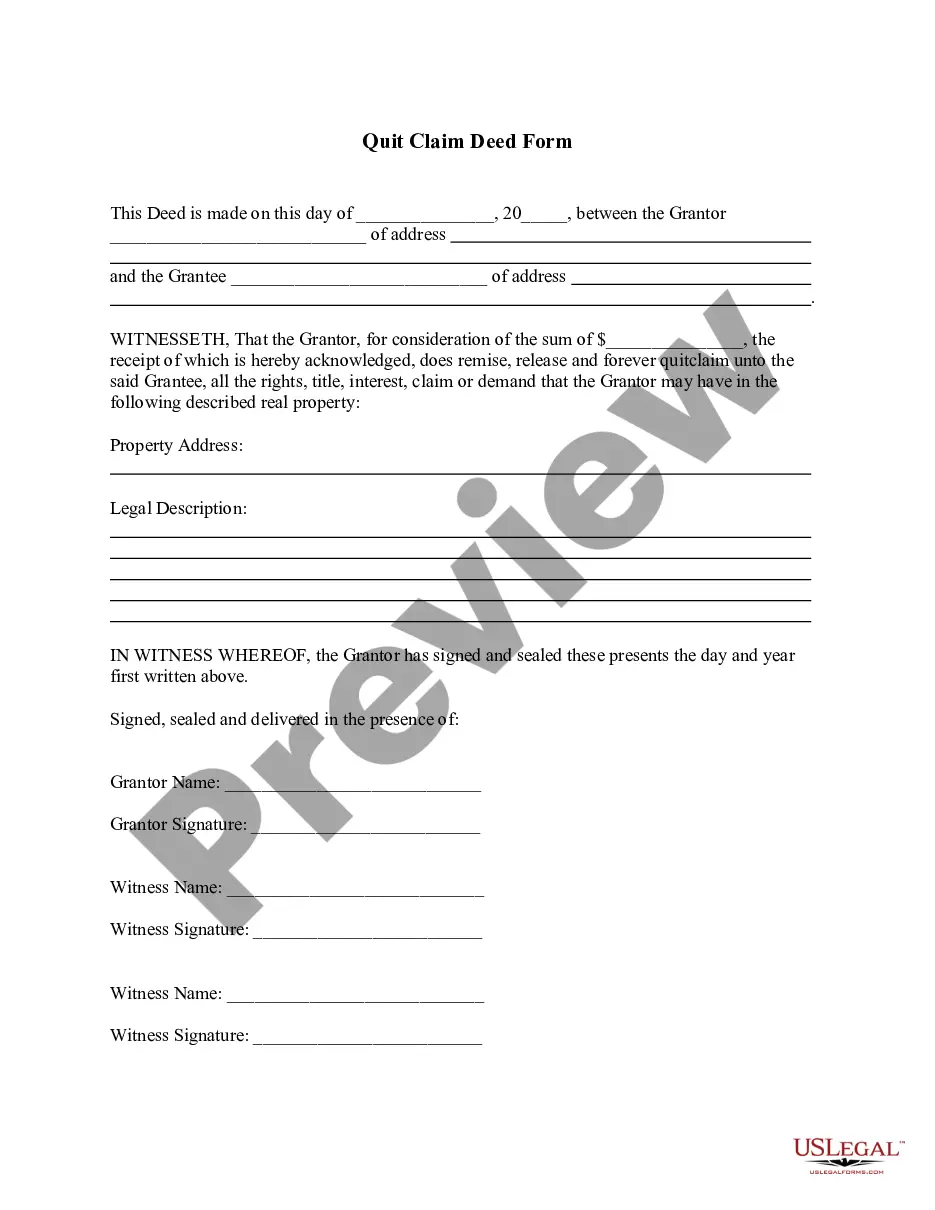
- Seller's details, including name and address
- Buyer's details, including name and address
- Consideration amount being paid for the transfer
- Legal description of the property in question
- Signature and date lines for both seller and notary public

When to use this form
This form is typically used in scenarios where a property owner wants to revoke an easement that has been granted to another party. Common situations include situations where the easement is no longer needed, the parties have reached an agreement to terminate the easement, or changes in property ownership necessitate the termination of the easement rights.
Who should use this form
- Property owners wishing to terminate an easement
- Real estate professionals involved in property transactions
- Attorneys assisting clients with real property issues
- Individuals needing to ensure the legal status of their property rights
How to prepare this document
- Identify the parties involved: Include full names and addresses of the grantor (seller) and grantee (buyer).
- Specify the consideration: Indicate the amount being paid for the termination of the easement.
- Detail the property: Provide a complete legal description of the property affected by the easement.
- Include dates: Enter the date on which the form is signed.
- Gather signatures: The seller must sign the form in front of a notary public for legal validation.
Is notarization required?
This document requires notarization to meet legal standards. US Legal Forms provides secure online notarization powered by Notarize, allowing you to complete the process through a verified video call, available 24/7.
Get your form ready online
Our built-in tools help you complete, sign, share, and store your documents in one place.
Make edits, fill in missing information, and update formatting in US Legal Forms—just like you would in MS Word.
Download a copy, print it, send it by email, or mail it via USPS—whatever works best for your next step.
Sign and collect signatures with our SignNow integration. Send to multiple recipients, set reminders, and more. Go Premium to unlock E-Sign.
If this form requires notarization, complete it online through a secure video call—no need to meet a notary in person or wait for an appointment.
We protect your documents and personal data by following strict security and privacy standards.

Make edits, fill in missing information, and update formatting in US Legal Forms—just like you would in MS Word.

Download a copy, print it, send it by email, or mail it via USPS—whatever works best for your next step.

Sign and collect signatures with our SignNow integration. Send to multiple recipients, set reminders, and more. Go Premium to unlock E-Sign.

If this form requires notarization, complete it online through a secure video call—no need to meet a notary in person or wait for an appointment.

We protect your documents and personal data by following strict security and privacy standards.
Avoid these common issues
- Failing to complete the legal description of the property accurately
- Not having the document notarized, if applicable
- Forgetting to specify the consideration amount
- Incorrectly identifying the parties involved in the transaction
Why use this form online
- Convenience of downloading and printing the form at any time
- Editability to fill out information accurately
- Access to forms created by licensed attorneys for additional peace of mind
- Simplified process without the need for in-person meetings
Looking for another form?
Form popularity
FAQ
For the most part, a property owner can't block an easement if it was already mentioned in the property's deed. If the property owner tries to contest the easement's boundaries, then it's a good idea to have a property survey conducted by a reputable local company in Guadalupe County, TX.
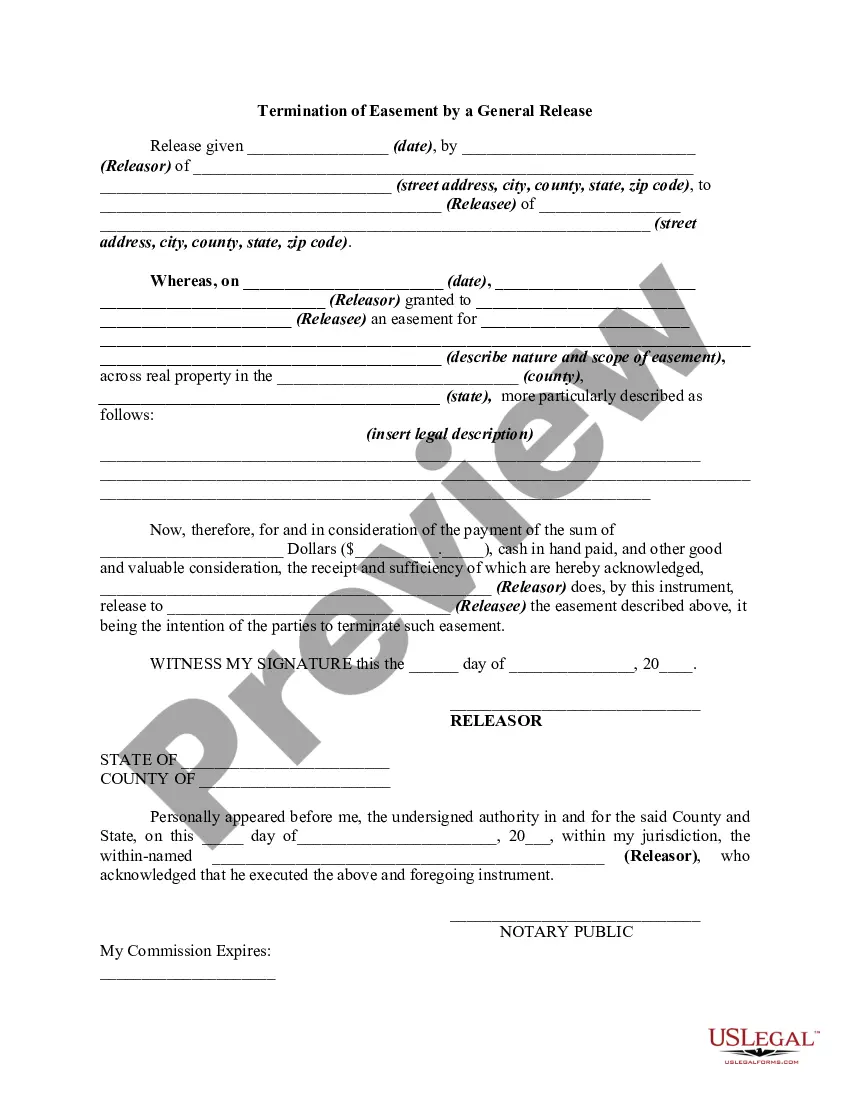
Easement by prescription. Which of the following actions would terminate an easement? A release signed by the holder of the dominant tenement.
An easement may terminate for numerous reasons. The most common include: impossibility of purpose, merger, elimination of necessity, abandonment, adverse possession, eminent domain, and the express terms of the easement itself.
2d 669 (Tex. 1974). The easement use must be uninterrupted and continuous for a period of at least 10 years. Davis v.
Explanation: An owner cannot have an easement in her own land. Therefore, if the owner of the dominant tenement obtains ownership of the servient tenement, the easement is terminated by merger.
Generally, the owner of any easement has a duty to maintain the easement. If the easement is owned by more than one person, or is attached parcels of land under different ownership, each owner must share in the cost of maintaining the easement pursuant to their agreement.
Easements may be extinguished by abandonment. Abandonment takes place whenever cessation of use occurs accompanied by a clear intent never to use the easement again. Mere nonuse does not constitute aban- donment. However, the intent may be inferred from the circumstances if such evidence is clear and definite.