Arizona Closing Statement of Personal Representative
Overview of this form
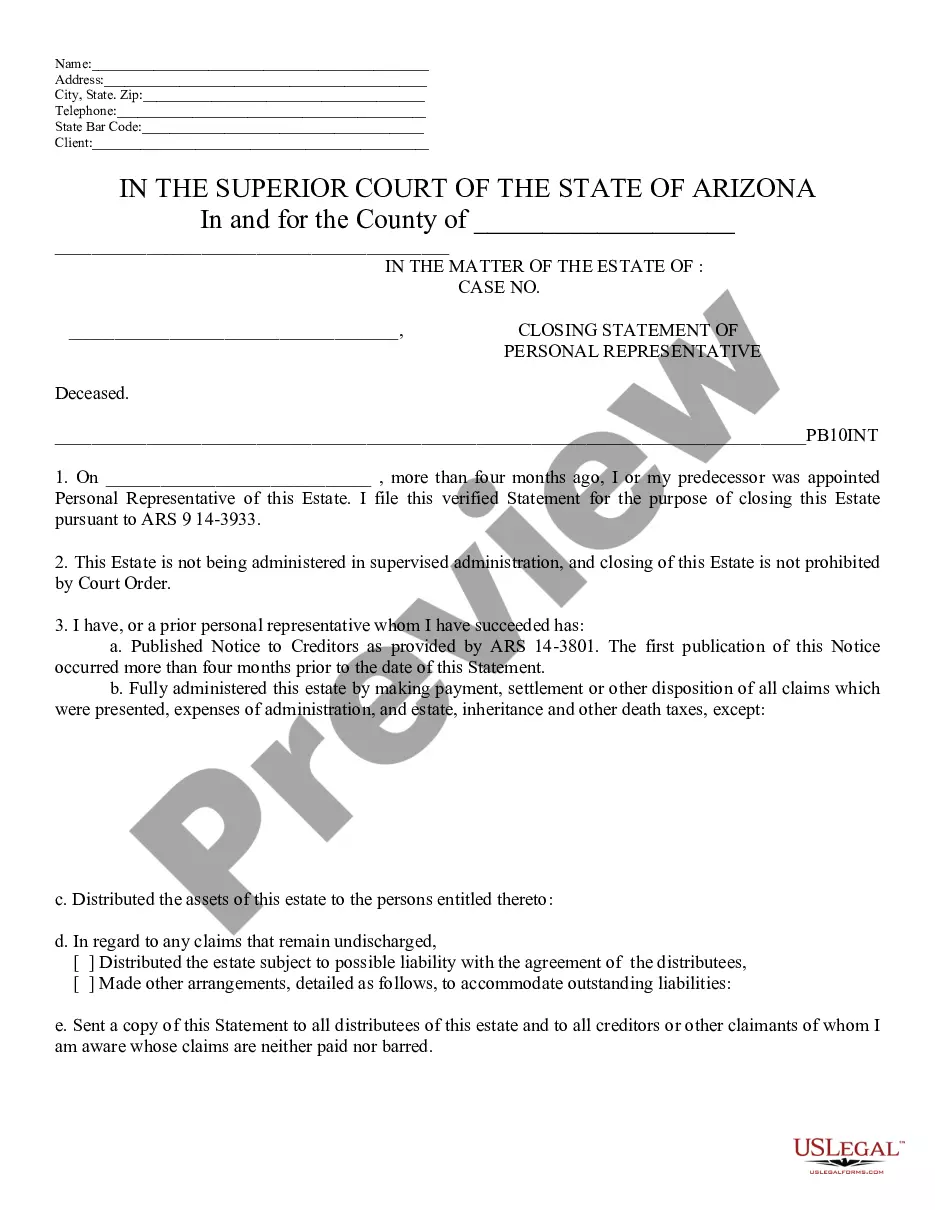
The Closing Statement of Personal Representative is a legal document used by the administrator of an estate to formally conclude their duties after completing the distribution of estate assets. This form is specifically designed for use in Arizona and should be signed in front of a Notary Public. Unlike other estate-related documents, this statement ensures that all obligations and distributions are accounted for, providing a clear record of the estate's administration.
Key components of this form
- Address and contact information of the personal representative.
- Statement of the estate's administration status, including notice to creditors.
- Details of asset distribution to beneficiaries.
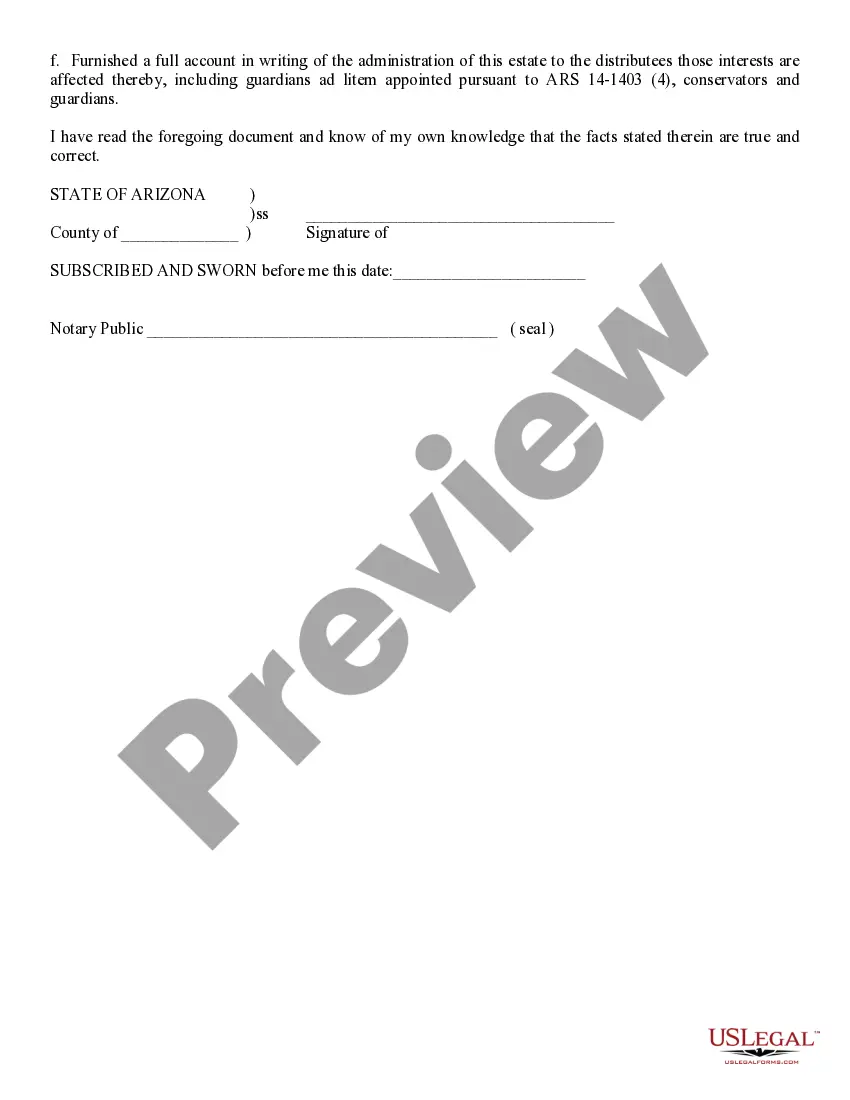
- Verification by the personal representative confirming the accuracy of the information.
- Notary Public acknowledgment section for legal validity.
When this form is needed
This form should be used when the personal representative has completed all necessary estate administration activities, including settling debts and distributing assets to beneficiaries, and is ready to officially close the estate. It is typically completed after a period of at least four months since the appointment of the personal representative.
Who should use this form
- Personal representatives (executors or administrators) of an estate in Arizona.
- Individuals who have managed the affairs of a deceased person's estate.
- Legal professionals assisting clients in closing estate matters.
Steps to complete this form
- Identify the personal representative by providing your name and contact details at the top of the form.
- Specify the estate's case number and the name of the deceased person.
- Confirm that the estate has been fully administered, including settlement of all claims and expenses.
- List the dates and details regarding publication of notices to creditors and asset distributions.
- Sign the document in the presence of a Notary Public, ensuring all information is truthful and accurate.
Notarization guidance
Yes, this form must be notarized to be legally valid. Notarization ensures that the personal representativeâs signature is verified and the document is acknowledged in a legal context. US Legal Forms offers integrated online notarization services available 24/7 through secure video calls, allowing for a convenient and compliant process without the need for travel.
Get your form ready online
Our built-in tools help you complete, sign, share, and store your documents in one place.
Make edits, fill in missing information, and update formatting in US Legal Forms—just like you would in MS Word.
Download a copy, print it, send it by email, or mail it via USPS—whatever works best for your next step.
Sign and collect signatures with our SignNow integration. Send to multiple recipients, set reminders, and more. Go Premium to unlock E-Sign.
If this form requires notarization, complete it online through a secure video call—no need to meet a notary in person or wait for an appointment.
We protect your documents and personal data by following strict security and privacy standards.

Make edits, fill in missing information, and update formatting in US Legal Forms—just like you would in MS Word.

Download a copy, print it, send it by email, or mail it via USPS—whatever works best for your next step.

Sign and collect signatures with our SignNow integration. Send to multiple recipients, set reminders, and more. Go Premium to unlock E-Sign.

If this form requires notarization, complete it online through a secure video call—no need to meet a notary in person or wait for an appointment.

We protect your documents and personal data by following strict security and privacy standards.
Avoid these common issues
- Failing to publish notice to creditors prior to filing the statement.
- Not allowing sufficient time (over four months) for creditor claims before closing the estate.
- Neglecting to obtain notarization, which is required for the statement to be legally valid.
Benefits of using this form online
- Immediate access to a professionally drafted document.
- Convenient download in multiple formats (Word and Rich Text).
- Easily customizable to fit your specific estate details.
Looking for another form?

Form popularity
FAQ
Closing out an estate in Arizona involves several steps, including settling debts and distributing assets to beneficiaries. Once these tasks are complete, you will need to prepare and file an Arizona Closing Statement of Personal Representative to finalize the process. Using platforms like USLegalForms can help streamline this task, providing you with the correct forms and guidance for a smooth closure.
In Arizona, an executor typically has up to one year to settle an estate, although this timeframe may vary depending on the complexity of the estate. During this period, the executor must manage debts, distribute assets, and complete an Arizona Closing Statement of Personal Representative to document the conclusion. Considering this timeline helps ensure that all tasks are completed efficiently and legally.
When an estate closes, it means that all debts have been settled, assets have been distributed, and the executor has completed their duties. The final step often includes filing an Arizona Closing Statement of Personal Representative. This document signifies that all legal requirements have been met and the estate is officially concluded.
To become a personal representative in Arizona, you need to be appointed by the court during the probate process. This usually requires filing a petition along with the Arizona Closing Statement of Personal Representative. It is advisable to understand your responsibilities fully and possibly consult an attorney to guide you through the appointment process.
Not all estates in Arizona require probate. Generally, if an estate's value is below a specific threshold or consists solely of joint assets or assets with designated beneficiaries, it may bypass probate. However, estates that do not meet these criteria typically need a proper Arizona Closing Statement of Personal Representative to finalize the process.
A letter of appointment of personal representative is a legal document issued by a court. This letter officially designates an individual to administer the estate of a deceased person in Arizona. It empowers the personal representative to perform duties such as managing assets and preparing the Arizona Closing Statement of Personal Representative. If you're facing this situation, platforms like UsLegalForms can help simplify the process and provide the necessary templates.
Arizona law typically requires that an estate be settled within 18 months of the personal representative's appointment. However, various factors can affect this timeline, such as the complexity of the estate and any disputes that arise. Timely management of the estate, including preparation of the Arizona Closing Statement of Personal Representative, is vital for a smooth resolution. Staying organized can help you meet legal deadlines and provide closure for all involved.
While it is not legally required to have an attorney for closing on a house in Arizona, it is often beneficial. An attorney can navigate the complexities of the process and ensure that all documents, including the Arizona Closing Statement of Personal Representative, are correctly managed. Without legal guidance, you risk overlooking essential steps. Therefore, consider the advantages an attorney brings to your transaction.
In Arizona, a personal representative holds significant authority in managing an estate. This role includes settling debts, distributing assets, and filing necessary documents, including the Arizona Closing Statement of Personal Representative. A personal representative acts on behalf of the deceased, ensuring that the estate is handled according to the law. Understanding their responsibilities can help streamline the process.
A personal representative in Arizona is an individual appointed by the court to administer an estate after a person's death. This person is responsible for managing estate affairs, including collecting assets, paying debts, and distributing property to heirs. As you prepare the Arizona Closing Statement of Personal Representative, understanding the duties and powers of this role is crucial for a smooth probate process.