Arkansas Transfer on Death Deed or TOD - Beneficiary Deed for Husband and Wife to a Trust
About this form
This Transfer on Death Deed, also known as a beneficiary deed, is designed specifically for use by married couples to transfer property to a trust upon the death of the last spouse. Unlike a traditional will, this deed allows the transfer to occur outside the probate process, providing a more efficient way to manage property succession. It is essential for couples looking to securely designate a trust as the beneficiary while retaining control over the property during their joint lifetimes.
Main sections of this form
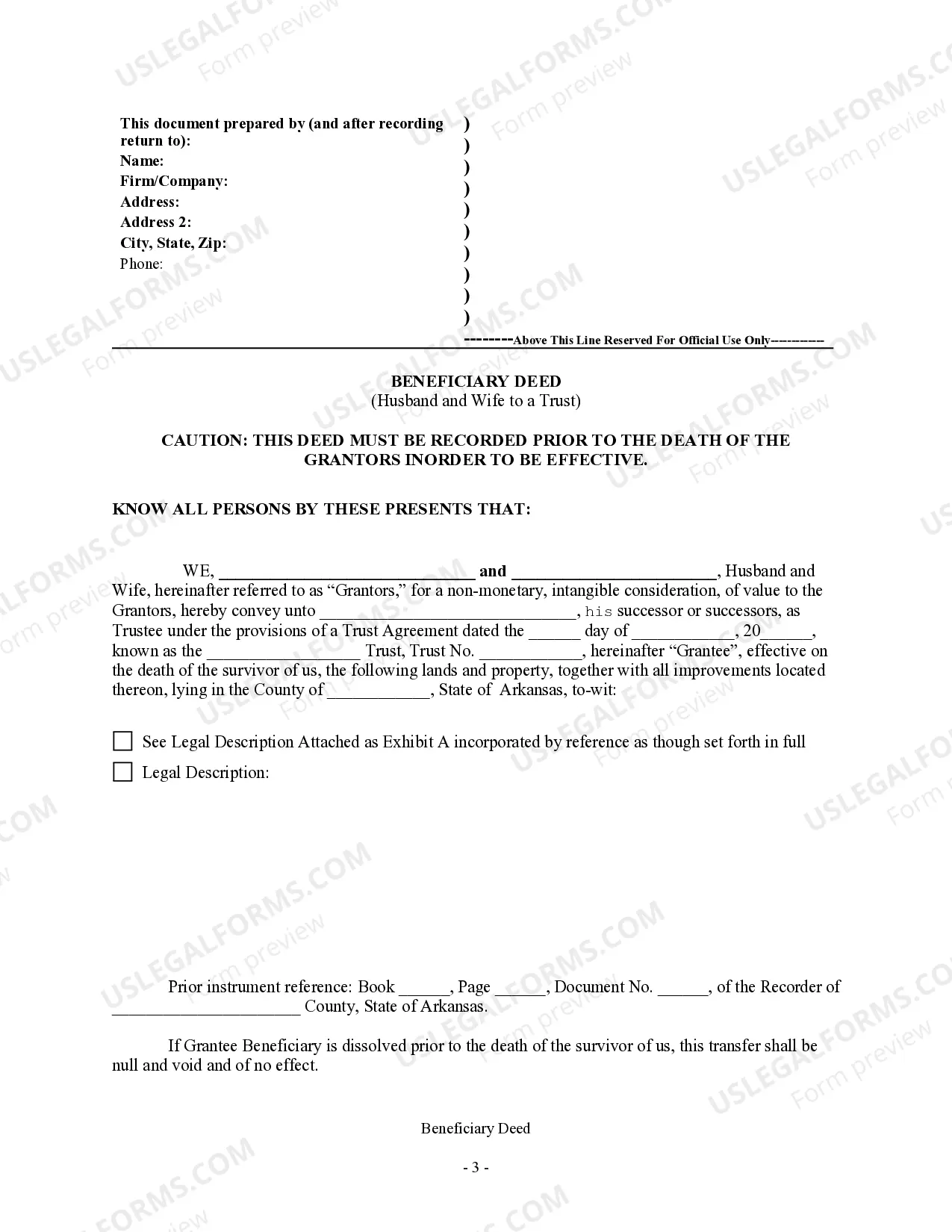
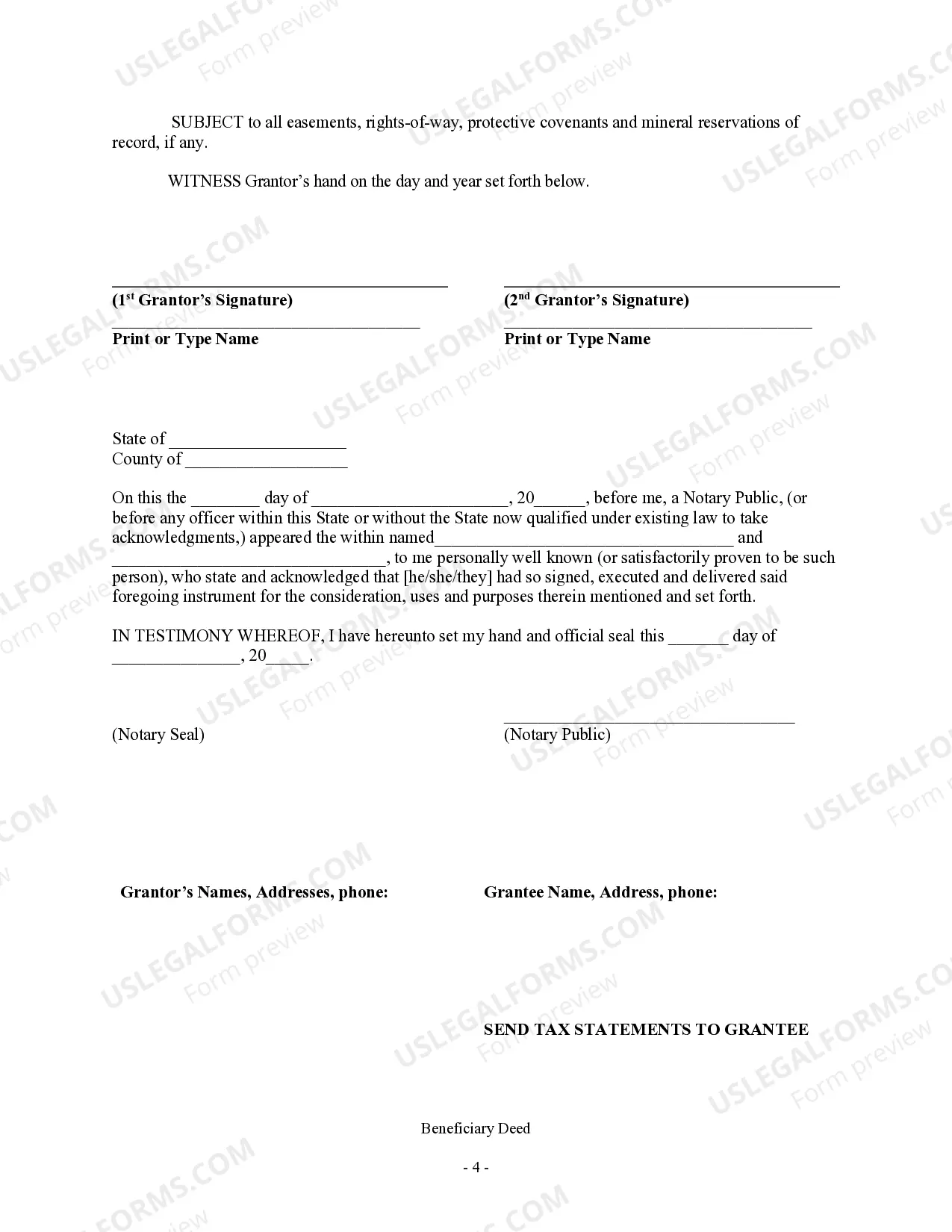
- Names of the Grantors (Husband and Wife) who are transferring the property.
- Designation of the Grantee as a Trust, along with the trust agreement details.
- Legal description of the property being transferred.
- Provision for the deed to be effective upon the death of the last Grantor.
- Signatures of the Grantors and notary acknowledgment.



When to use this document
This form is typically used when a husband and wife wish to transfer ownership of their property to a trust effective upon the death of the surviving spouse. This legal instrument is particularly useful for estate planning purposes. It ensures that the trust will receive the property directly without going through probate, simplifying the transfer process for beneficiaries.
Intended users of this form
- Married couples wanting to ensure property transfer to a trust after their death.
- Individuals looking to avoid probate and simplify their estate settlement process.
- Those who have established a trust and want to designate it as the beneficiary of their property.
Steps to complete this form
- Identify the Grantors by entering the full names of both the husband and wife.
- Specify the Grantee as the designated trust, including the trust name and agreement details.
- Provide the legal description of the property to be transferred.
- Ensure both Grantors sign the deed in the designated spaces.
- Obtain a notary's signature and seal to validate the transfer.
Notarization guidance
Yes, this form must be notarized to be legally valid. Notarization verifies the identities of the parties and adds a layer of authenticity to the document. US Legal Forms offers integrated online notarization services, available 24/7 through secure video calls, ensuring convenience and compliance without the need to travel.
Get your form ready online
Our built-in tools help you complete, sign, share, and store your documents in one place.
Make edits, fill in missing information, and update formatting in US Legal Forms—just like you would in MS Word.
Download a copy, print it, send it by email, or mail it via USPS—whatever works best for your next step.
Sign and collect signatures with our SignNow integration. Send to multiple recipients, set reminders, and more. Go Premium to unlock E-Sign.
If this form requires notarization, complete it online through a secure video call—no need to meet a notary in person or wait for an appointment.
We protect your documents and personal data by following strict security and privacy standards.

Make edits, fill in missing information, and update formatting in US Legal Forms—just like you would in MS Word.

Download a copy, print it, send it by email, or mail it via USPS—whatever works best for your next step.

Sign and collect signatures with our SignNow integration. Send to multiple recipients, set reminders, and more. Go Premium to unlock E-Sign.

If this form requires notarization, complete it online through a secure video call—no need to meet a notary in person or wait for an appointment.

We protect your documents and personal data by following strict security and privacy standards.
Common mistakes
- Failing to include the correct legal description of the property.
- Not obtaining the necessary notarization for the deed.
- Leaving sections of the form blank that require input from both Grantors.
- Not filing the deed before the death of the last Grantor.
Why complete this form online
- Convenient access to downloadable forms that can be completed at your own pace.
- Editability of form fields using digital tools, making it easier to ensure accuracy.
- Access to templates drafted by licensed attorneys, enhancing reliability and compliance.
- The Transfer on Death Deed is valid only when filed before the death of the last grantor.
- This deed allows for property transfer without going through probate, making it a useful estate planning tool.
- It is reversible; grantors can revoke the deed any time before their deaths.
Summary of main points
- The Transfer on Death Deed allows for seamless transfer of property to a trust upon death.
- Completing and filing this form prevents property from going through probate.
- Always ensure proper notarization and compliance with local laws to avoid legal issues.
Looking for another form?
Form popularity
FAQ
Arkansas Transfer on Death Deed or TOD - Beneficiary Deed for Husband and Wife to a Trust transfers a property interest into a trust only after the death of the last grantor, while remaining revocable during life. It’s designed to comply with Arkansas statutes and may avoid probate for the conveyed property once the deed becomes effective.
Both tools serve different purposes. This form is a transfer on death deed that transfers property to a trust upon the death of the last grantor and can be revoked during life, potentially avoiding probate for the conveyed property. A full trust is a broader estate planning tool that can manage multiple assets and provide ongoing control.
This form is designed to comply with Arkansas statutes and may avoid probate for the conveyed property when properly filed before death. While it specifically targets a transfer to a trust, Arkansas statutes that authorize TOD arrangements support this approach for property within the scope of the deed. Consult an attorney for current requirements.
This form allows a married couple to transfer property to a trust upon the death of the last grantor, with the transfer being revocable during life. This can help control when and how the house passes to heirs and may reduce probate for that property.
This Arkansas TOD deed to a trust transfers the property to a trust upon the death of the last grantor and may avoid probate for the conveyed property. A traditional trust, used during life and after death, offers broader asset management and control beyond a single property transfer.
This form transfers property to a trust upon the death of the last grantor and can be revoked during life, which is different from a standard TOD deed that typically passes property directly to an individual and may not involve a trust or revocation.