Alabama Final Judgment of Divorce
What this document covers
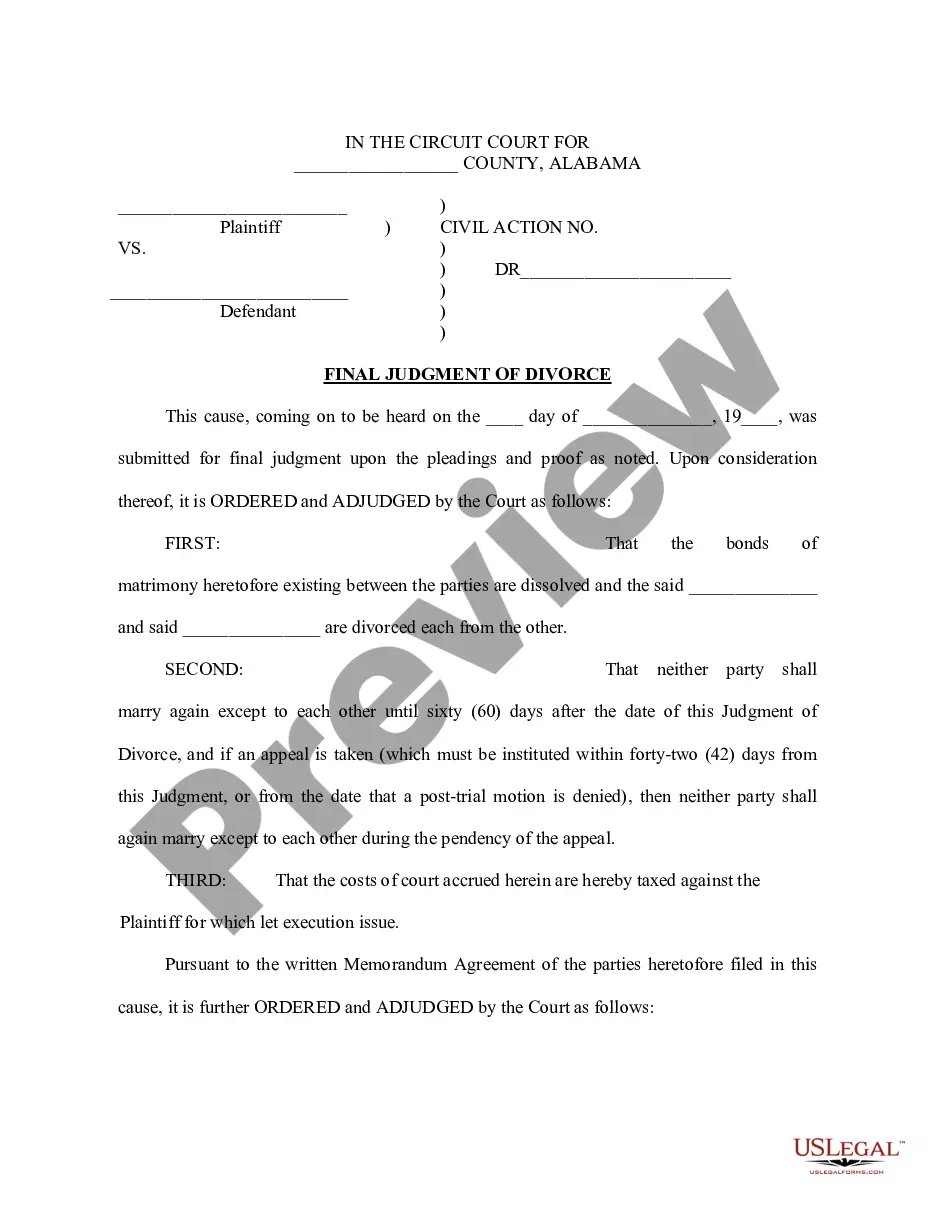
The Final Judgment of Divorce is a legal document that formally dissolves a marriage and outlines the court's decisions regarding the division of property and custody arrangements for minor children. This form serves as the final decree in a divorce case, distinguishing it from other forms that may only initiate proceedings or establish temporary orders.
Key parts of this document
- Details of the parties involved, including their names and addresses.
- Section addressing the dissolution of marriage.
- Custody arrangements for any minor children involved.
- Child support obligations and terms.
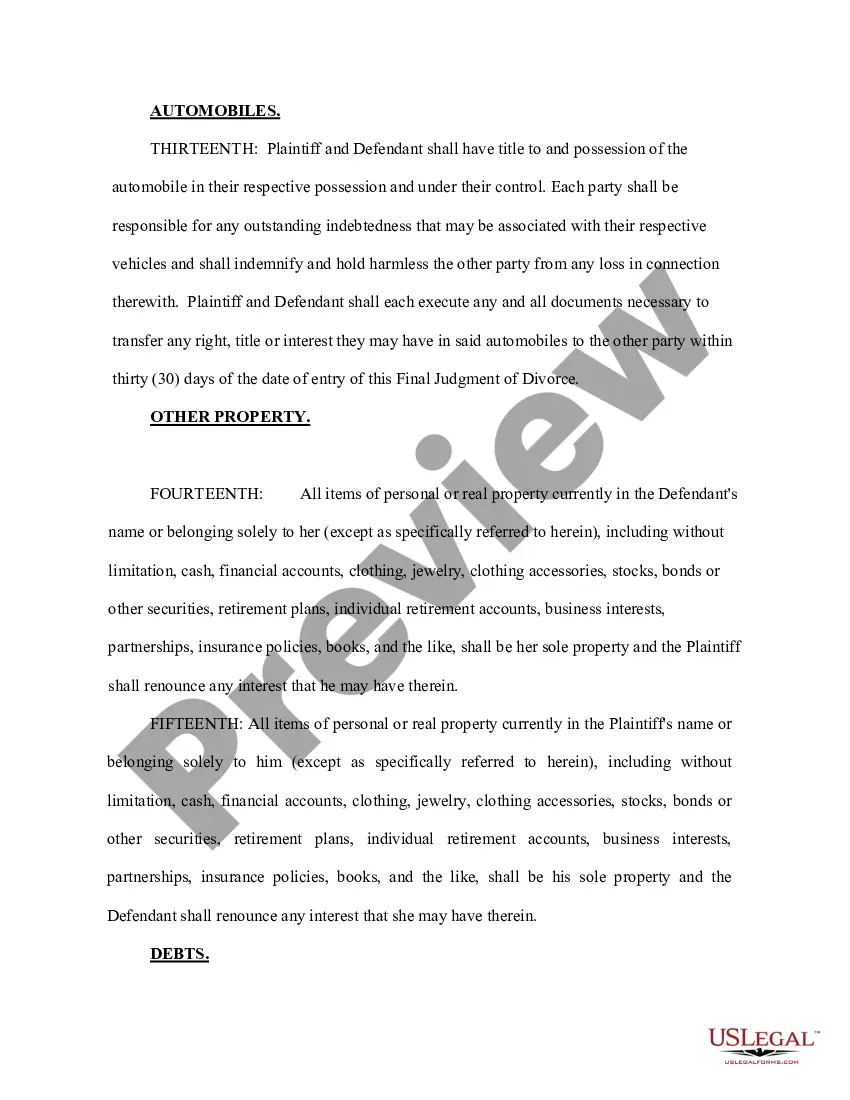
- Division of property and debts between the parties.
- Provisions for alimony and other financial responsibilities.



When to use this document
You should use the Final Judgment of Divorce when you have completed all necessary steps in your divorce proceedings and are ready to finalize the dissolution of your marriage. This form is appropriate for couples who have settled their property division and custody issues, either through negotiation or following a court trial.
Who should use this form
- Individuals pursuing a divorce in Alabama.
- Couples who have reached an agreement on property division and child custody.
- Parents who need a structured plan for child support and visitation.
Completing this form step by step
- Identify the parties by entering their full names and addresses at the top of the form.
- Clearly specify the date of the final judgment and any other pertinent case details.
- Fill in the custody arrangement for any minor children, including names and dates of birth.
- Detail child support amounts, including who is responsible for healthcare costs.
- Outline property settlements, debts, and any additional financial agreements.
- Sign and date the form appropriately as required.
Is notarization required?
This form does not typically require notarization to be legally valid. However, some jurisdictions or document types may still require it. US Legal Forms provides secure online notarization powered by Notarize, available 24/7 for added convenience.
Get your form ready online
Our built-in tools help you complete, sign, share, and store your documents in one place.
Make edits, fill in missing information, and update formatting in US Legal Forms—just like you would in MS Word.
Download a copy, print it, send it by email, or mail it via USPS—whatever works best for your next step.
Sign and collect signatures with our SignNow integration. Send to multiple recipients, set reminders, and more. Go Premium to unlock E-Sign.
If this form requires notarization, complete it online through a secure video call—no need to meet a notary in person or wait for an appointment.
We protect your documents and personal data by following strict security and privacy standards.

Make edits, fill in missing information, and update formatting in US Legal Forms—just like you would in MS Word.

Download a copy, print it, send it by email, or mail it via USPS—whatever works best for your next step.

Sign and collect signatures with our SignNow integration. Send to multiple recipients, set reminders, and more. Go Premium to unlock E-Sign.

If this form requires notarization, complete it online through a secure video call—no need to meet a notary in person or wait for an appointment.

We protect your documents and personal data by following strict security and privacy standards.
Avoid these common issues
- Failing to provide accurate information about the parties or children.
- Omitting specific amounts for child support or property division.
- Not including all necessary signatures where required.
- Leaving out critical details about visitation rights and responsibilities.
Why use this form online
- Convenience of downloading and completing the form at your own pace.
- Editable fields allow for personal customization to match your specific situation.
- Reliable templates drafted by licensed attorneys to ensure compliance with legal standards.
Legal use & context
The Final Judgment of Divorce serves as a legally binding document once filed with the court, outlining the terms agreed upon by both parties and ensuring compliance with Alabama law.
Main things to remember
- The Final Judgment of Divorce officially finishes the divorce process and details custody, support, and property arrangements.
- It's crucial to accurately complete this form to avoid legal issues later.
- This document should be filed with the respective circuit court to be legally effective.
- Always consult with a legal professional if there are disputes or complexities that arise during the divorce.
Looking for another form?
Form popularity
FAQ
The Final Judgment of Divorce is the final court order that dissolves a marriage in Alabama and settles permanent terms, including custody, child support, and the division of property and debts. Use it once all steps are completed and the parties have settled or been adjudicated these terms; it replaces temporary orders as the final decree.
This form is appropriate once all necessary steps in the divorce proceedings are complete and the parties have settled property division and custody issues. It then records the dissolution, including the parties’ details, custody arrangements for any children, child support terms, and the division of property and debts, plus alimony provisions where applicable.
The Final Judgment of Divorce is the final decree dissolving the marriage in Alabama, issued by the court after the issues have been settled. It includes orders on the dissolution of marriage, custody arrangements for any minor children, child support terms, property and debt division, and alimony provisions, and it replaces temporary orders.
Before finalization, ensure the document reflects the key parts: identities of the parties, the dissolution of marriage, and the agreed or court-imposed custody arrangements, child support terms, and the division of property and debts, along with alimony provisions. Verify accuracy, consistency with prior agreements or orders, and that all terms are correctly stated.
The form’s key parts address custody for minor children, child support terms, and the division of property and debts, plus alimony, with details of the parties and the overall dissolution. It provides a final, enforceable plan that comes into effect once entered by the court, replacing prior temporary arrangements.
The Final Judgment of Divorce is the final decree dissolving the marriage and establishing permanent orders for custody, child support, property division, debts, and alimony. A temporary order, by contrast, governs interim arrangements during the divorce process and may be superseded by the final judgment once entered.