Self Employed Ss Withholding
Description
Get your form ready online
Our built-in tools help you complete, sign, share, and store your documents in one place.
Make edits, fill in missing information, and update formatting in US Legal Forms—just like you would in MS Word.
Download a copy, print it, send it by email, or mail it via USPS—whatever works best for your next step.
Sign and collect signatures with our SignNow integration. Send to multiple recipients, set reminders, and more. Go Premium to unlock E-Sign.
If this form requires notarization, complete it online through a secure video call—no need to meet a notary in person or wait for an appointment.
We protect your documents and personal data by following strict security and privacy standards.

Make edits, fill in missing information, and update formatting in US Legal Forms—just like you would in MS Word.

Download a copy, print it, send it by email, or mail it via USPS—whatever works best for your next step.

Sign and collect signatures with our SignNow integration. Send to multiple recipients, set reminders, and more. Go Premium to unlock E-Sign.

If this form requires notarization, complete it online through a secure video call—no need to meet a notary in person or wait for an appointment.

We protect your documents and personal data by following strict security and privacy standards.
Looking for another form?








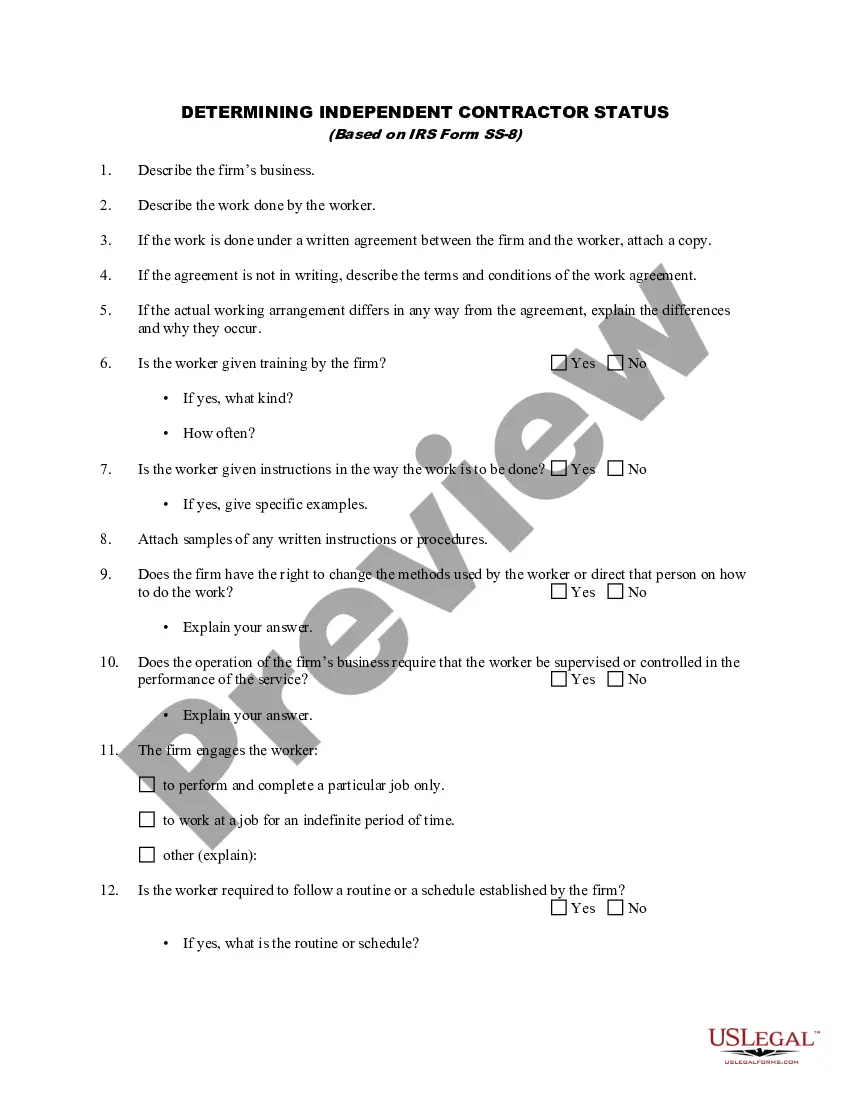
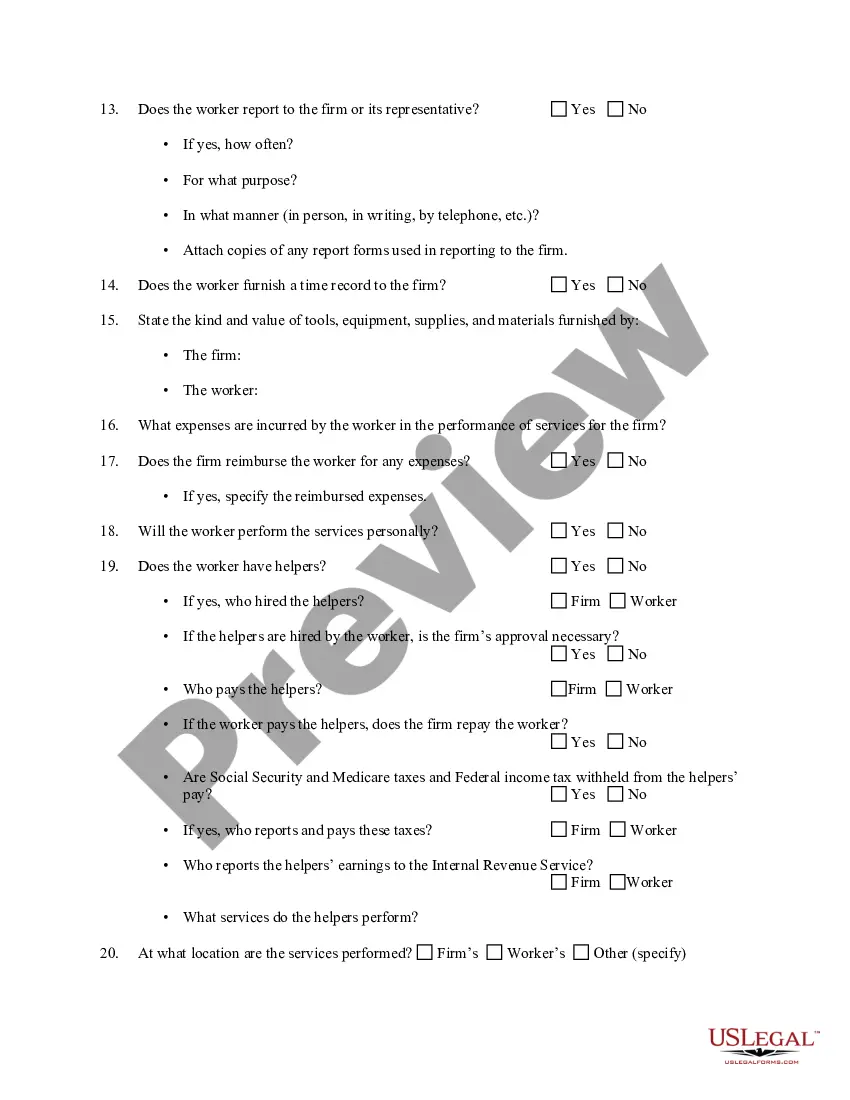
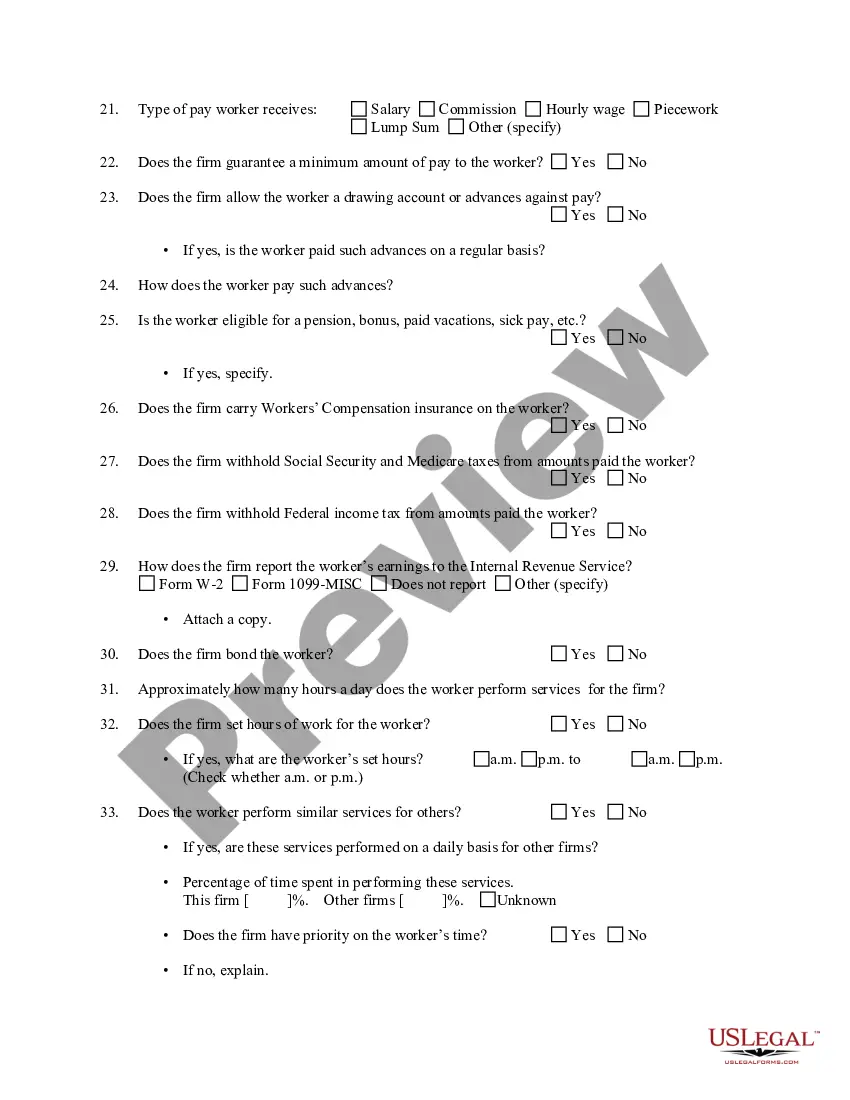
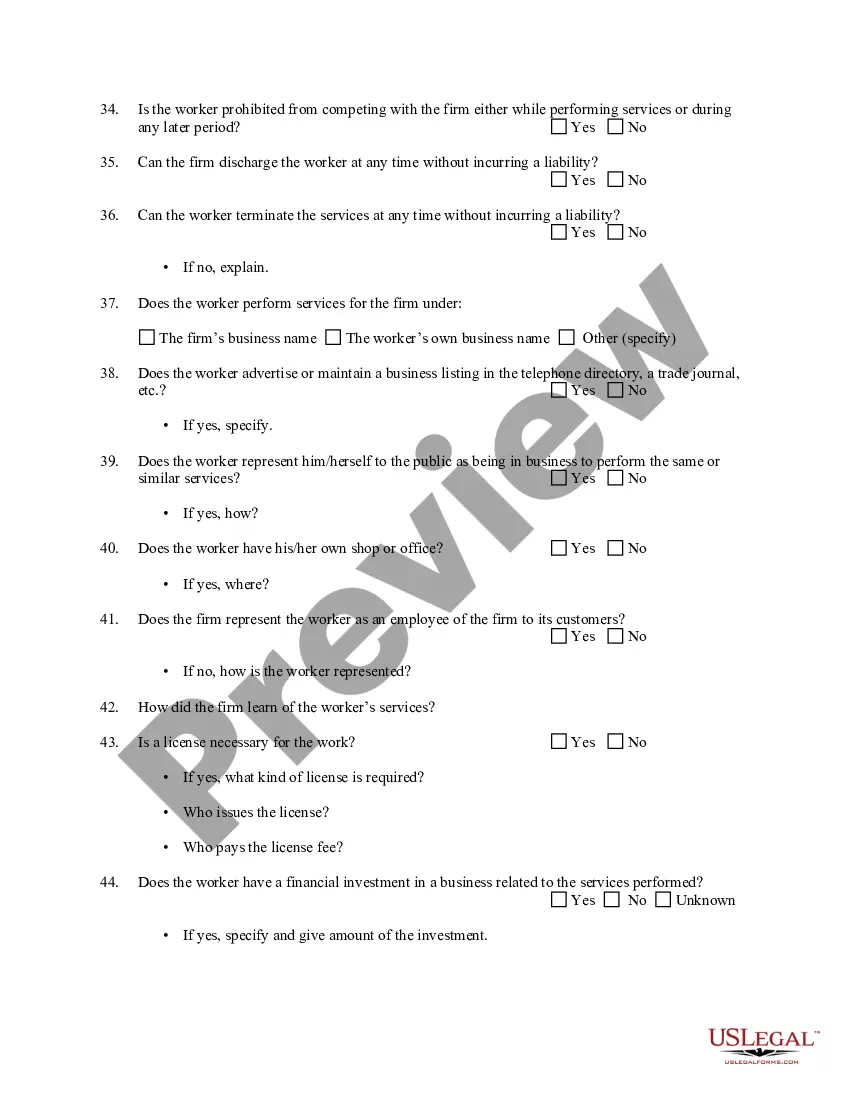
How to fill out Determining Self-Employed Independent Contractor Status?
Regardless of whether for commercial objectives or personal issues, everyone must handle legal circumstances at some stage in their existence.
Completing legal documents requires meticulous care, starting from selecting the correct form example. For example, if you choose an incorrect version of the Self Employed Ss Withholding, it will be rejected upon submission.
With an extensive US Legal Forms catalog available, you do not need to waste time searching for the appropriate template online. Utilize the library’s straightforward navigation to find the suitable template for any circumstance.
- Obtain the template you require by utilizing the search field or catalog navigation.
- Review the form’s description to ensure it aligns with your situation, state, and county.
- Click on the form’s preview to view it.
- If it is the incorrect form, return to the search function to find the Self Employed Ss Withholding sample you need.
- Obtain the template if it fulfills your criteria.
- If you possess a US Legal Forms profile, simply click Log in to access previously saved templates in My documents.
- If you do not have an account yet, you can download the form by clicking Buy now.
- Choose the suitable pricing option.
- Complete the profile registration form.
- Select your payment method: you can utilize a credit card or PayPal account.
- Choose the document format you prefer and download the Self Employed Ss Withholding.
- Once it is downloaded, you can fill out the form using editing applications or print it and complete it manually.
Form popularity
FAQ
There is no W-2 self-employed specific form that you can create. Instead, you must report your self-employment income on Schedule C (Form 1040) to report income or (loss) from any business you operated or profession you practiced as a sole proprietor in which you engaged for profit.
Here's how you'd calculate your self-employment taxes: Determine your self-employment tax base. Multiply your net earnings by 92.35% (0.9235) to get your tax base: $50,000 x 92.35% = $46,175. Calculate your self-employment tax. Multiply your tax base by the self-employed tax rate: $46,175 x 15.3% (0.153) = $7,064.78.
Social Security is financed through a dedicated payroll tax. Employers and employees each pay 6.2 percent of wages up to the taxable maximum of $160,200 (in 2023), while the self-employed pay 12.4 percent.
At its most basic, here is how to file self-employment taxes step-by-step. Calculate your income and expenses. That is a list of the money you've made, less the amount you've spent. ... Determine if you have a net profit or loss. Fill out an information return. ... Fill out a 1040 and other self-employment tax forms.
Send the tax return and schedules, along with your self-employment tax, to the IRS. Even if you don't owe any income tax, you must complete Form 1040 and Schedule SE to pay self-employment Social Security tax. This is true even if you already get Social Security benefits. Family members may operate a business together.