Pthread_cancel Terminate Called Without An Active Exception
Description
Get your form ready online
Our built-in tools help you complete, sign, share, and store your documents in one place.
Make edits, fill in missing information, and update formatting in US Legal Forms—just like you would in MS Word.
Download a copy, print it, send it by email, or mail it via USPS—whatever works best for your next step.
Sign and collect signatures with our SignNow integration. Send to multiple recipients, set reminders, and more. Go Premium to unlock E-Sign.
If this form requires notarization, complete it online through a secure video call—no need to meet a notary in person or wait for an appointment.
We protect your documents and personal data by following strict security and privacy standards.

Make edits, fill in missing information, and update formatting in US Legal Forms—just like you would in MS Word.

Download a copy, print it, send it by email, or mail it via USPS—whatever works best for your next step.

Sign and collect signatures with our SignNow integration. Send to multiple recipients, set reminders, and more. Go Premium to unlock E-Sign.

If this form requires notarization, complete it online through a secure video call—no need to meet a notary in person or wait for an appointment.

We protect your documents and personal data by following strict security and privacy standards.
Looking for another form?






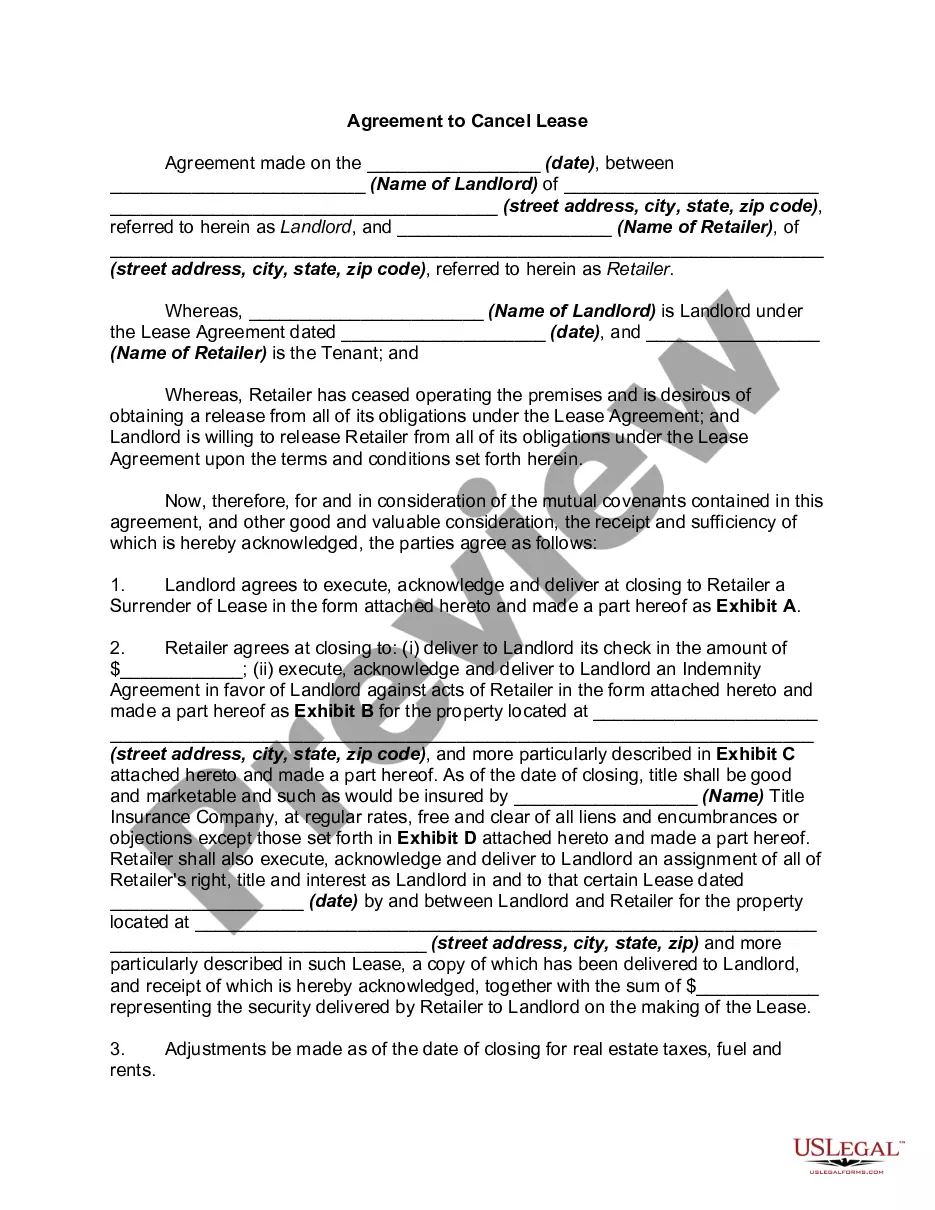
How to fill out Agreement To Cancel Or Terminate Lease?
Finding a reliable source for the latest and most suitable legal samples is a significant part of managing administrative tasks.
Identifying the correct legal documents requires precision and meticulousness, which is why it is crucial to obtain samples of Pthread_cancel Terminate Called Without An Active Exception exclusively from credible sources, such as US Legal Forms. An unsuitable template will consume your time and hinder the progress of your situation.
Eliminate the complications associated with your legal paperwork. Explore the comprehensive US Legal Forms collection to discover legal samples, verify their applicability to your situation, and download them immediately.
- Utilize the catalog navigation or search bar to locate your template.
- Examine the form’s details to ensure it meets the criteria of your state and locality.
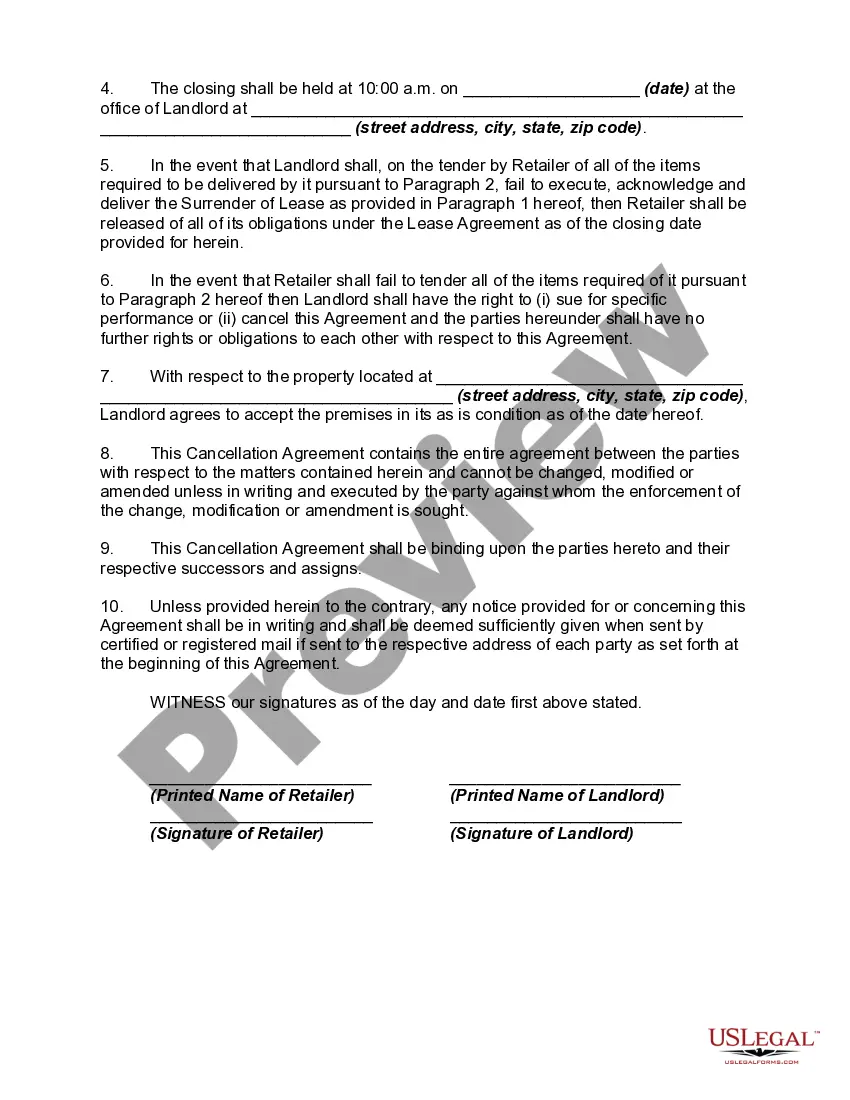
- Check the form preview, if available, to confirm that the form is indeed what you need.
- Return to your search and seek the appropriate document if the Pthread_cancel Terminate Called Without An Active Exception does not fulfill your requirements.
- Once you are confident about the form’s applicability, download it.
- If you are a registered user, click Log in to verify and access your selected templates in My documents.
- If you have not created an account yet, click Buy now to acquire the template.
- Choose the pricing option that best fits your needs.
- Proceed with the registration to complete your purchase.
- Finalize your transaction by selecting a payment method (credit card or PayPal).
- Select the document format for downloading Pthread_cancel Terminate Called Without An Active Exception.
- Once the form is on your device, you can either edit it using an editor or print it out and fill it in manually.
Form popularity
FAQ
When a pure virtual method is called and there is no active exception, the program can trigger a termination error. This usually happens when a derived class object attempts to access a base class method that is not implemented. In the context of multithreading, handling such scenarios properly is essential to avoid facing a 'Pthread_cancel terminate called without an active exception' situation, which can disrupt your application's flow.
The std::terminate function is a standard C++ function that is called when an exception is thrown but not caught, leading to program termination. This function can also be invoked by the throw statement in certain cases or when an unhandled exception occurs. If you're debugging issues related to threads, understanding std::terminate can help you navigate potential pitfalls, especially when faced with messages like 'Pthread_cancel terminate called without an active exception'.
When you see the message 'terminate called without an active exception', it indicates that the program has tried to execute a termination due to an exception that doesn't exist at that moment. This situation often arises during complex operations, such as multithreading, where exceptions might not be properly caught. Understanding this concept is crucial when working with pthreads, as it helps prevent abrupt terminations.
The pthread_cancel function works by sending a cancellation request to the target thread, allowing it to terminate if it is in a state that permits cancellation. The thread can either handle the cancellation request or ignore it, depending on its cancellation state and type. If you find yourself wrestling with a 'Pthread_cancel terminate called without an active exception' scenario, you may want to explore how cancellation points affect thread behavior.
To terminate a pthread, you can use the pthread_cancel function, which sends a cancellation request to the specified thread. This allows you to gracefully end a thread's execution while managing resources properly. However, if you encounter a 'Pthread_cancel terminate called without an active exception' error, it may indicate that you need to review your exception handling strategy in the context of multithreading.
The phrase 'terminate called without an active exception' refers to a situation in C++ where the program attempts to end due to an exception that wasn't properly managed. This often occurs when a destructor is invoked during stack unwinding but there's no exception currently being processed. To avoid confusion, understanding how pthread_cancel works can be beneficial, especially if you're investigating issues related to thread termination.
No, the exit() function does not terminate all threads in a program. It only ends the calling thread and does not affect other threads that might be running. If you need to ensure all threads stop, consider using pthread_cancel, which can help you handle the situation more effectively, especially in cases where you encounter a 'Pthread_cancel terminate called without an active exception' error.
To exit a pthread, you can use the pthread_exit function. This function allows a thread to terminate its execution cleanly. However, if you encounter the issue of 'Pthread_cancel terminate called without an active exception', it indicates that your thread is trying to perform a cancellation without the necessary context. Make sure to handle thread cancellation properly by using the appropriate exception handling techniques in your code.