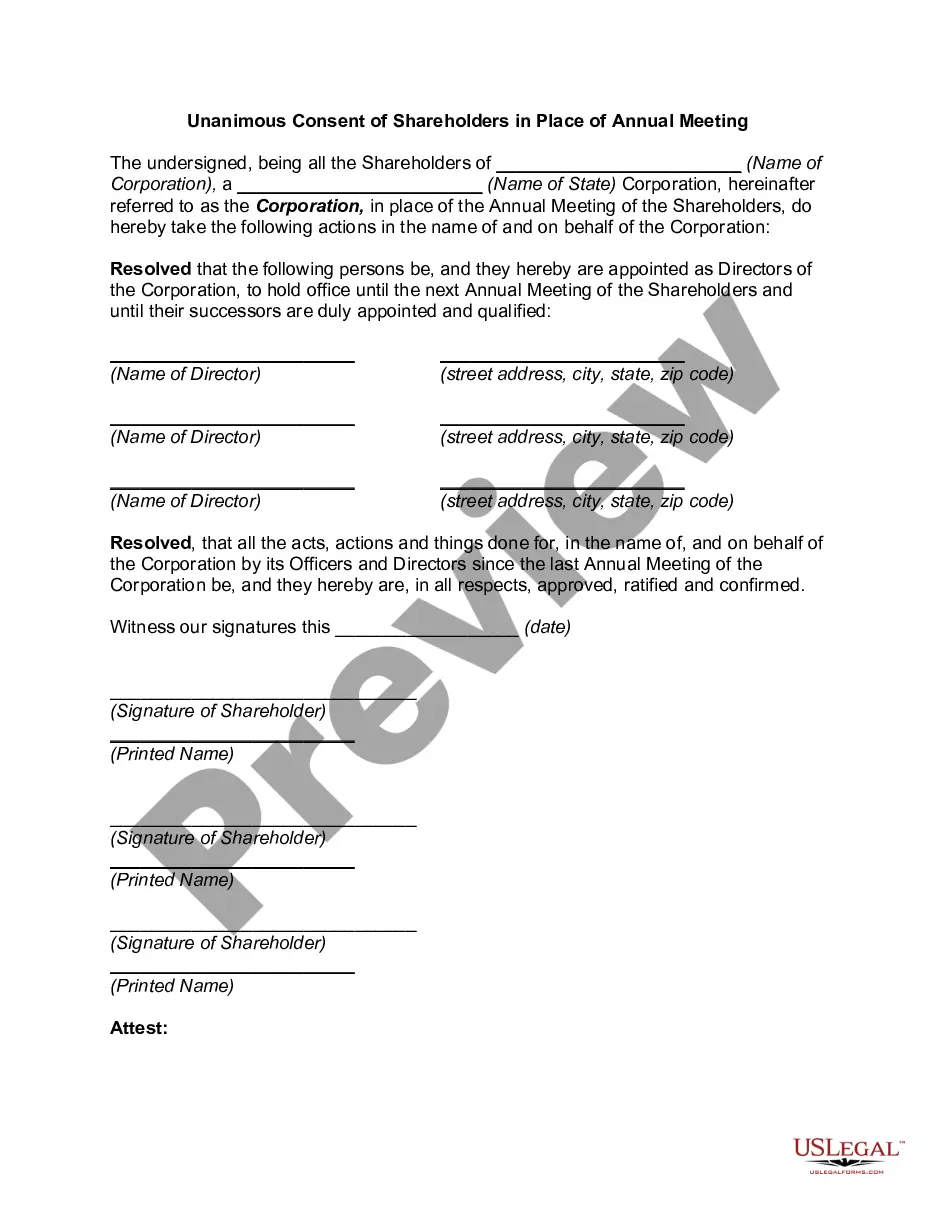
Annual General Meeting Corporate Governance Checklist For Shareholders In Cook
Description



Get your form ready online
Our built-in tools help you complete, sign, share, and store your documents in one place.
Make edits, fill in missing information, and update formatting in US Legal Forms—just like you would in MS Word.
Download a copy, print it, send it by email, or mail it via USPS—whatever works best for your next step.
Sign and collect signatures with our SignNow integration. Send to multiple recipients, set reminders, and more. Go Premium to unlock E-Sign.
If this form requires notarization, complete it online through a secure video call—no need to meet a notary in person or wait for an appointment.
We protect your documents and personal data by following strict security and privacy standards.

Make edits, fill in missing information, and update formatting in US Legal Forms—just like you would in MS Word.

Download a copy, print it, send it by email, or mail it via USPS—whatever works best for your next step.

Sign and collect signatures with our SignNow integration. Send to multiple recipients, set reminders, and more. Go Premium to unlock E-Sign.

If this form requires notarization, complete it online through a secure video call—no need to meet a notary in person or wait for an appointment.

We protect your documents and personal data by following strict security and privacy standards.
Looking for another form?



Form popularity
FAQ
3. What documents do owners need before the AGM? The draft annual financial statements, a proposed budget of income and expenditure and the schedule of replacement values (for insurance purposes). A form of proxy allows an owner who may not be able to attend the AGM, to appoint a proxy to attend and vote on his behalf.
An AGM is a mandatory annual meeting of shareholders. At the AGM, your company will present its financial statements (also known as "accounts") before the shareholders (also known as "members") so that they can raise any queries regarding the financial position of the company.
Documents of Annual General Meeting Register of contracts. Register of Directors, KMP and their Shareholding. Report of Statutory Auditor on ESOP. Draft Letter for Appointment of Independent Director.
In many companies, every shareholder or guarantor can attend and vote at general meetings.
As the name implies, an annual general meeting (AGM) is a yearly meeting where shareholders and board members converge to discuss business matters, review financial reports, and vote on the election or removal of company directors. AGMs are mandatory for both public and private companies.
Calling and purpose of an AGM An association's constitution must specify the manner of calling an AGM and the manner in which notice of the AGM is given. If the Model constitution applies, members must be given at least 14 days' notice of an AGM or 21 days' notice if a special resolution is to be proposed.
You need to have your financial statements in order to have your AGM; and you need to have had your AGM before you can file for your annual return. In most instances your financial accounts can remain unaudited (read our guide on IRAS obligations to find out if you need to have your accounts audited).
Requirements of an Annual General Meeting: Timely Conduct: AGMs must be held within the timeframe specified by law, typically within a certain number of months after the financial year ends. Notice to Shareholders. Disclosure of Information. Shareholder Participation. Record-Keeping:
An AGM (also known as an annual shareholder meeting) is a yearly meeting between shareholders and board members where they gather to: Discuss business matters. Review financial statements. Address resolutions.

