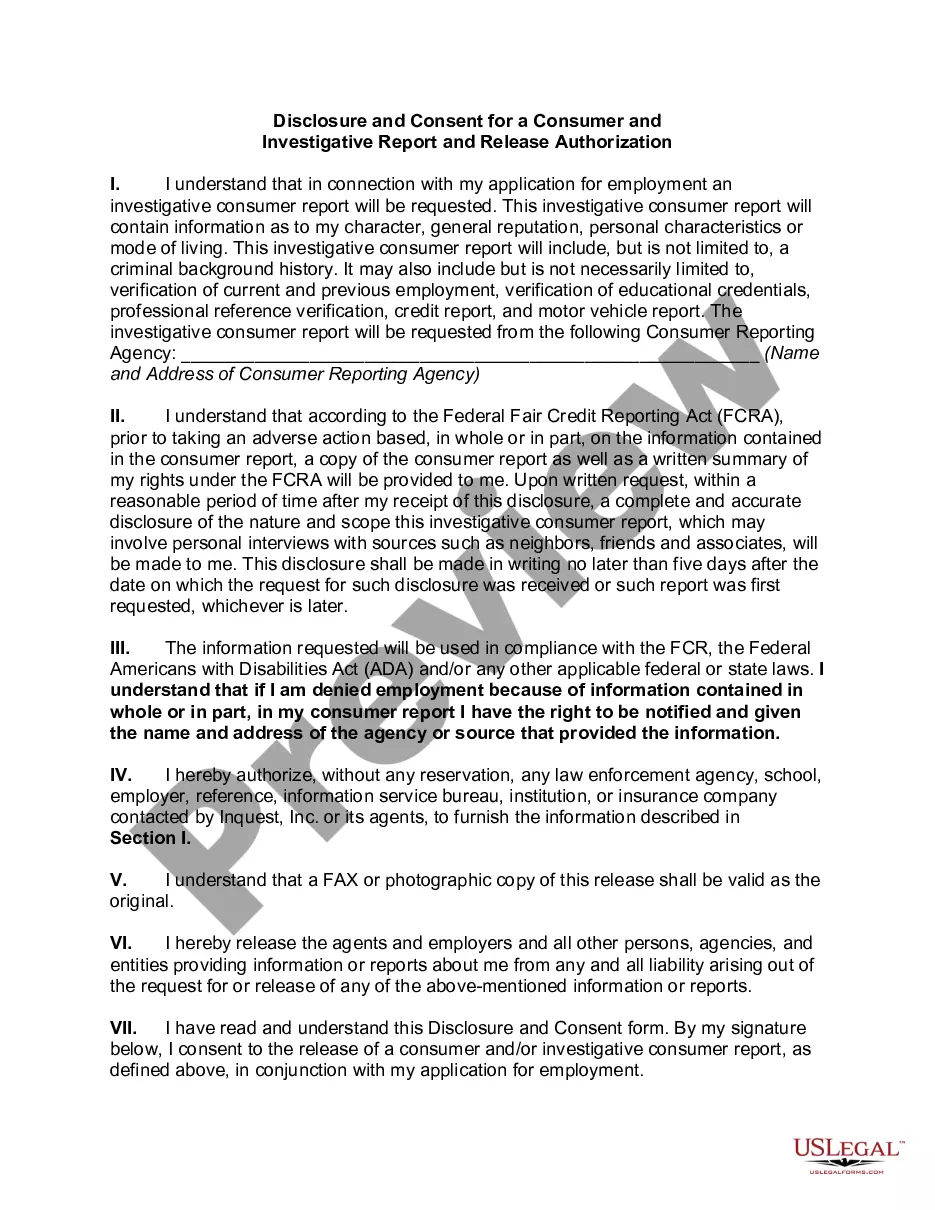
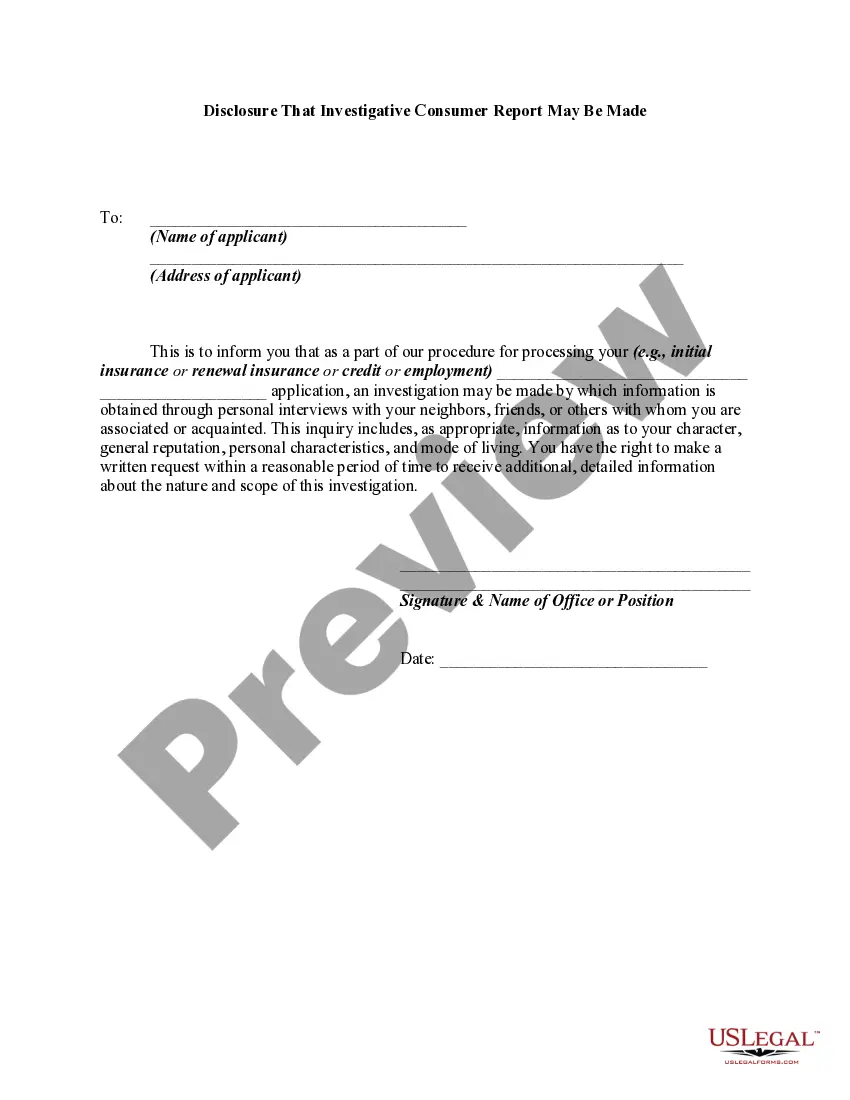
Consumer Reporting Agency Under Fcra In Fulton
Description


Get your form ready online
Our built-in tools help you complete, sign, share, and store your documents in one place.
Make edits, fill in missing information, and update formatting in US Legal Forms—just like you would in MS Word.
Download a copy, print it, send it by email, or mail it via USPS—whatever works best for your next step.
Sign and collect signatures with our SignNow integration. Send to multiple recipients, set reminders, and more. Go Premium to unlock E-Sign.
If this form requires notarization, complete it online through a secure video call—no need to meet a notary in person or wait for an appointment.
We protect your documents and personal data by following strict security and privacy standards.

Make edits, fill in missing information, and update formatting in US Legal Forms—just like you would in MS Word.

Download a copy, print it, send it by email, or mail it via USPS—whatever works best for your next step.

Sign and collect signatures with our SignNow integration. Send to multiple recipients, set reminders, and more. Go Premium to unlock E-Sign.

If this form requires notarization, complete it online through a secure video call—no need to meet a notary in person or wait for an appointment.

We protect your documents and personal data by following strict security and privacy standards.
Looking for another form?

Form popularity
FAQ
The compliance requirements for the credit reporting agencies include the following: Establish FCRA Policies. Review FCRA Provisions & Applicability. Establish Smooth Consumer Consent Acquisition Processes. Ensure Reports Are Used Only for Permissible Purposes. Provide Adverse Action Notices.
Under section 609(a), a consumer reporting agency must, upon request, clearly and accurately disclose to the consumer “all information in the consumer's file at the time of the request” and “the sources of the information.” This requirement applies to all consumer reporting agencies.
Final answer: Consumers must be provided with a Notice of Information Practices under the Fair Credit Reporting Act, which outlines how their personal financial information is used and their rights regarding this information.
What is a credit reporting agency? Credit reporting agencies (also known as credit bureaus or consumer reporting agencies) that collect information relevant to your credit and financial history. There are three credit agencies: TransUnion, Equifax, and Experian.
A creditor must provide notice if it has: Taken adverse action on a completed credit application; Taken adverse action on an incomplete credit application; Taken adverse action on an existing credit account; or.
A creditor must notify the applicant of adverse action within: 30 days after receiving a complete credit application. 30 days after receiving an incomplete credit application. 30 days after taking action on an existing credit account.
A dispute notice from a consumer must include: 1) Sufficient information to identify the account or other relationship that is in dispute, such as an account number and the name, address, and telephone number of the consumer; 2) The specific information that the consumer is disputing and an explanation of the basis for ...
