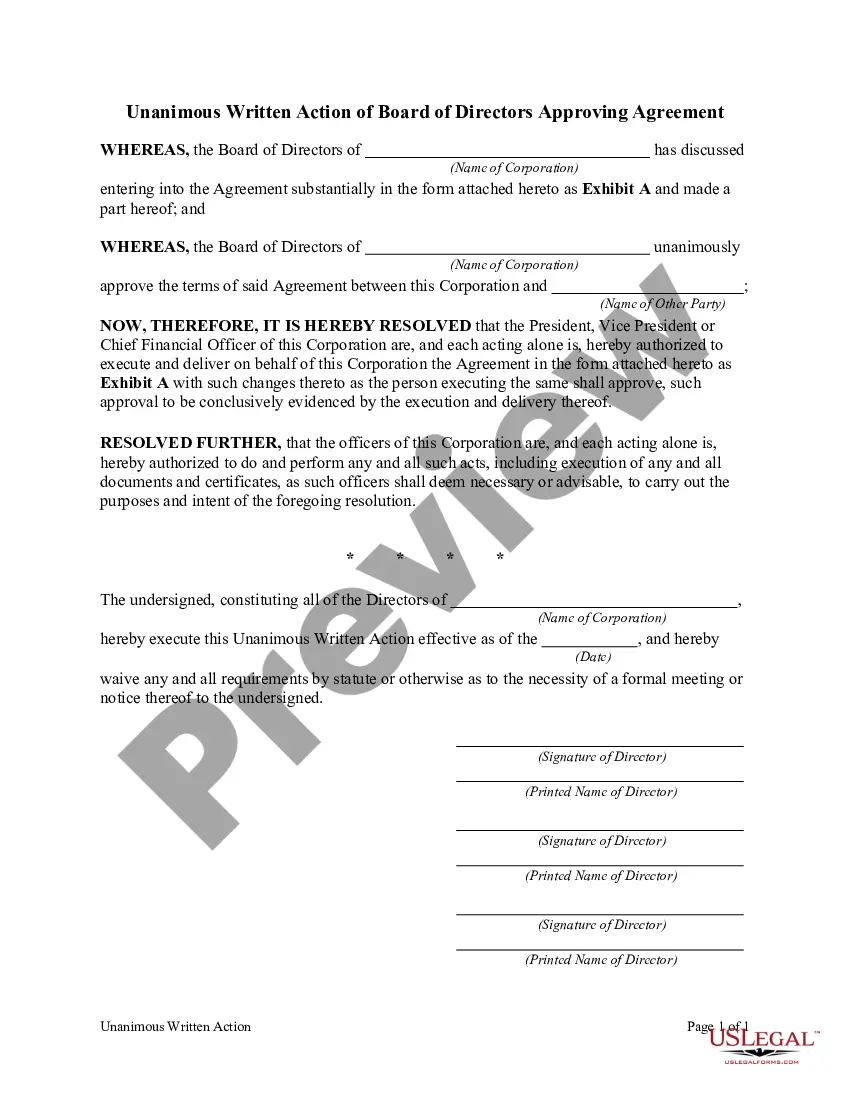
Board Directors Corporate Without Ceo In Arizona
Description



Get your form ready online
Our built-in tools help you complete, sign, share, and store your documents in one place.
Make edits, fill in missing information, and update formatting in US Legal Forms—just like you would in MS Word.
Download a copy, print it, send it by email, or mail it via USPS—whatever works best for your next step.
Sign and collect signatures with our SignNow integration. Send to multiple recipients, set reminders, and more. Go Premium to unlock E-Sign.
If this form requires notarization, complete it online through a secure video call—no need to meet a notary in person or wait for an appointment.
We protect your documents and personal data by following strict security and privacy standards.

Make edits, fill in missing information, and update formatting in US Legal Forms—just like you would in MS Word.

Download a copy, print it, send it by email, or mail it via USPS—whatever works best for your next step.

Sign and collect signatures with our SignNow integration. Send to multiple recipients, set reminders, and more. Go Premium to unlock E-Sign.

If this form requires notarization, complete it online through a secure video call—no need to meet a notary in person or wait for an appointment.

We protect your documents and personal data by following strict security and privacy standards.
Looking for another form?



Form popularity
FAQ
The steps include: Build Relevant Experience. Develop a Strong Professional Network. Develop a Value Proposition. Identify Open Positions. Participate in the Selection Process.
Three things: Natural capability, fuelled by experience and leadership ability. Formal qualifications in one or more core governance topics like ESG or cybersecurity. A formal qualification in corporate governance.
How to gain an appointment to a board of directors Select the type of board to serve. Search for openings. Select the right company. Familiarize yourself with the directors. Conduct in-depth research on the board and company. Network at special events. Request an appointment. Craft a high-quality resume or CV for an interview.
Usually, they are nominated by the Board for a vacancy or recruited by the Board or CEO because they have specific experience in a field...or they have strong relationships within the industry. I always advise people to contact every director of any company of interest and either meet with them in person or by phone.
It is a good practice for each board meeting to include an in camera or executive session where board members can meet privately, without the CEO present. In camera is simply Latin for “in chamber” or private.
For a smaller board, the process often involves being interviewed, whereas larger organizations tend to have a more formalized review before nominating someone for a seat. In publicly traded companies, board members are approved by shareholders at the recommendation of management.
Becoming a member of a board of directors requires a combination of relevant experience, a nomination and election process, and adherence to the organization's governance policies. Networking and demonstrating expertise in relevant areas can also enhance one's chances of being considered for a board position.
Being a board member puts you in one of the most influential positions within an organisation. This means you can directly impact things such as the experience of employees or customers. Depending on the nature of the organisation, this impact may also expand into the wider society.
The members of the association who are eligible to vote at the time of the meeting may remove any member of the board of directors, other than a member appointed by the declarant, by a majority vote of those voting on the matter at a meeting of the members.
First off, the federal law requires that all nonprofits have a board of directors with at least three members. The individuals on this committee should have the experience to help you work toward your nonprofit's vision statement. You can set up your board in different ways based on your goals.