Annual Board Directors Sample With No Experience In Clark
Description

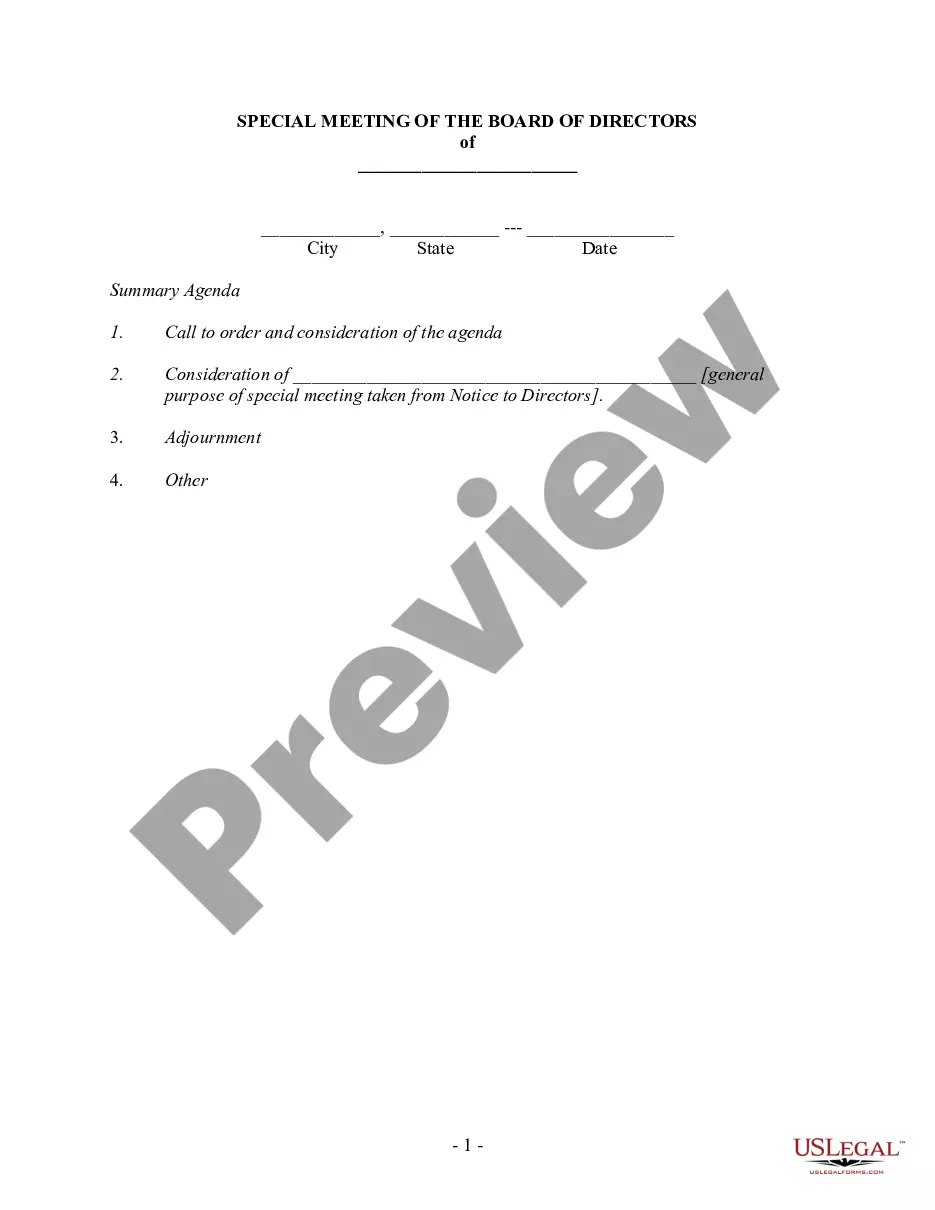


Get your form ready online
Our built-in tools help you complete, sign, share, and store your documents in one place.
Make edits, fill in missing information, and update formatting in US Legal Forms—just like you would in MS Word.
Download a copy, print it, send it by email, or mail it via USPS—whatever works best for your next step.
Sign and collect signatures with our SignNow integration. Send to multiple recipients, set reminders, and more. Go Premium to unlock E-Sign.
If this form requires notarization, complete it online through a secure video call—no need to meet a notary in person or wait for an appointment.
We protect your documents and personal data by following strict security and privacy standards.

Make edits, fill in missing information, and update formatting in US Legal Forms—just like you would in MS Word.

Download a copy, print it, send it by email, or mail it via USPS—whatever works best for your next step.

Sign and collect signatures with our SignNow integration. Send to multiple recipients, set reminders, and more. Go Premium to unlock E-Sign.

If this form requires notarization, complete it online through a secure video call—no need to meet a notary in person or wait for an appointment.

We protect your documents and personal data by following strict security and privacy standards.
Looking for another form?








Form popularity
FAQ
Here is a sample outline of what might be covered in the orientation: Your nonprofit's mission and history, and its statement of values. Bios of current board members and key staff. Board member agreement (Blue Avocado) Conflict of interest policy and questionnaire. Recent financial reports and audited financials.
In most states the laws dictate the minimum size for nonprofit boards. Usually it is three, but in some states only one board member is required. Some boards function under a representational mandate; their composition needs to reflect the constituency, and this creates an upward pressure on the size.
The humble board binder holds more power than you might imagine. Far from just a collection of paperwork, a well-assembled board binder is a vital tool for maintaining effective governance, promoting transparency, and equipping board members with the knowledge they need to fulfill their duties confidently.
Generally, a board of three to five members is ideal. Too many members can make decision-making difficult, and too few may not provide the necessary insight and expertise.
“Between seven and 10 directors is where you want to be,” he says. That's enough directors to staff major oversight committees without overtaxing them, ing to Elson, yet small enough to have relationships among directors and between individual directors and the CEO.
The answer to this question is a resounding yes! In fact, ing to business Insider, "There's no law that says a board of directors has to be made up of more than one person, and plenty of companies are run by a single director."
Ask your friends, neighbors, colleagues and class mates. Ask if they can join the board, volunteer on a committee or introduce you to others. If you have donors - either individuals, Foundations, or corporations - start there. Ask if they would be willing to introduce you to others who have an interest in your mission.
However, the IRS requires a minimum of three board members for tax-exempt status. Find out more. ? How does a nonprofit choose board members? Look for board candidates who have passion, motivation, know-how, availability, integrity, and adaptability.
Develop a Strong Professional Network Attend industry conferences, join relevant associations, and connect with professionals who already serve on boards or in your industry of interest. Building relationships with current board members can open doors to future opportunities.

