Texas Petition Form For Parents
Description
Get your form ready online
Our built-in tools help you complete, sign, share, and store your documents in one place.
Make edits, fill in missing information, and update formatting in US Legal Forms—just like you would in MS Word.
Download a copy, print it, send it by email, or mail it via USPS—whatever works best for your next step.
Sign and collect signatures with our SignNow integration. Send to multiple recipients, set reminders, and more. Go Premium to unlock E-Sign.
If this form requires notarization, complete it online through a secure video call—no need to meet a notary in person or wait for an appointment.
We protect your documents and personal data by following strict security and privacy standards.

Make edits, fill in missing information, and update formatting in US Legal Forms—just like you would in MS Word.

Download a copy, print it, send it by email, or mail it via USPS—whatever works best for your next step.

Sign and collect signatures with our SignNow integration. Send to multiple recipients, set reminders, and more. Go Premium to unlock E-Sign.

If this form requires notarization, complete it online through a secure video call—no need to meet a notary in person or wait for an appointment.

We protect your documents and personal data by following strict security and privacy standards.
Looking for another form?



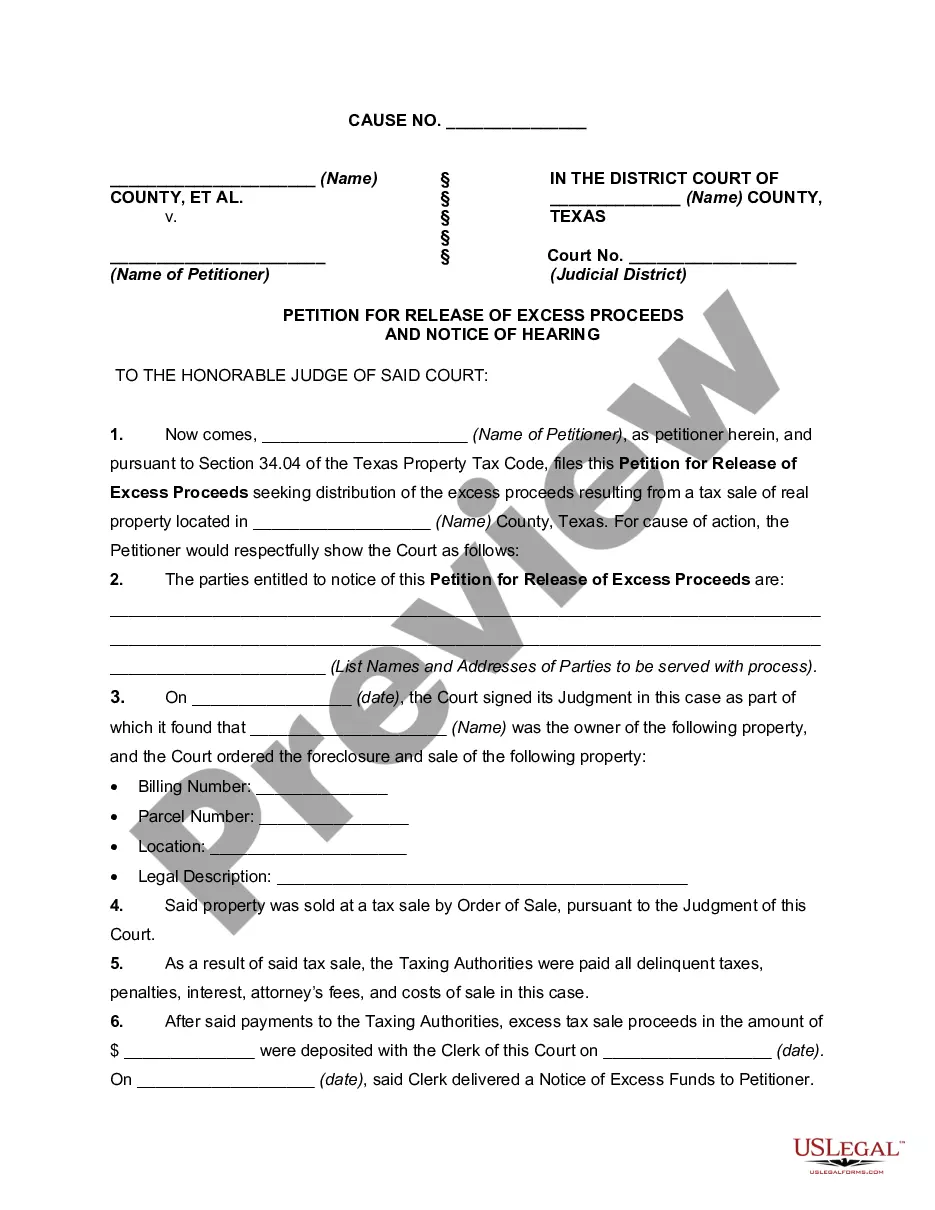
How to fill out Texas Petition For Release Of Excess Proceeds And Notice Of Hearing?
Whether for business purposes or for individual matters, everybody has to handle legal situations at some point in their life. Filling out legal papers needs careful attention, starting with selecting the proper form sample. For example, if you pick a wrong edition of a Texas Petition Form For Parents, it will be declined when you submit it. It is therefore important to have a reliable source of legal documents like US Legal Forms.
If you need to get a Texas Petition Form For Parents sample, follow these easy steps:
- Find the sample you need by using the search field or catalog navigation.
- Check out the form’s description to ensure it fits your case, state, and region.
- Click on the form’s preview to see it.
- If it is the wrong form, get back to the search function to locate the Texas Petition Form For Parents sample you need.
- Get the file when it meets your requirements.
- If you already have a US Legal Forms account, simply click Log in to access previously saved files in My Forms.
- In the event you don’t have an account yet, you may download the form by clicking Buy now.
- Pick the correct pricing option.
- Complete the account registration form.
- Pick your transaction method: use a credit card or PayPal account.
- Pick the document format you want and download the Texas Petition Form For Parents.
- When it is saved, you can complete the form by using editing applications or print it and complete it manually.
With a substantial US Legal Forms catalog at hand, you do not have to spend time seeking for the right sample across the web. Take advantage of the library’s easy navigation to find the correct form for any occasion.
Form popularity
FAQ
A judge will not approve just any agreement, though. They must find that it is in the child's best interest. The agreement must be in writing and included in the order that you present to the judge. You cannot permanently waive child support.
In a Petition to Adjudicate Parentage, the court will determine the child's legal parents, usually through DNA testing or other evidence. Once the parentage is established, the court can make decisions about child support, custody, and visitation rights.
To get started, there are three primary steps to follow. Step One: Enlist in the Help of an Attorney. While it's possible to pursue custody without a lawyer, this is generally not recommended. ... Step Two: Fill out Forms and Prepare Documents. ... Step Three: Begin Collecting Evidence.
The simple answer to this question is: it's possible, but only if the agreement is approved by a judge. In this article, our experienced Fort Worth child support attorneys will explain what happens if parents want to forgo child support and answer some frequently asked questions about this arrangement.
Parental rights can only be terminated by court order in Texas. A signed voluntary relinquishment or waiver of interest, or even a failure to file with the paternity registry, is not enough to forever end parental rights. A judge must sign a court order to end those rights forever.