Texas Intestate Succession Law
Description
Get your form ready online
Our built-in tools help you complete, sign, share, and store your documents in one place.
Make edits, fill in missing information, and update formatting in US Legal Forms—just like you would in MS Word.
Download a copy, print it, send it by email, or mail it via USPS—whatever works best for your next step.
Sign and collect signatures with our SignNow integration. Send to multiple recipients, set reminders, and more. Go Premium to unlock E-Sign.
If this form requires notarization, complete it online through a secure video call—no need to meet a notary in person or wait for an appointment.
We protect your documents and personal data by following strict security and privacy standards.

Make edits, fill in missing information, and update formatting in US Legal Forms—just like you would in MS Word.

Download a copy, print it, send it by email, or mail it via USPS—whatever works best for your next step.

Sign and collect signatures with our SignNow integration. Send to multiple recipients, set reminders, and more. Go Premium to unlock E-Sign.

If this form requires notarization, complete it online through a secure video call—no need to meet a notary in person or wait for an appointment.

We protect your documents and personal data by following strict security and privacy standards.
Looking for another form?




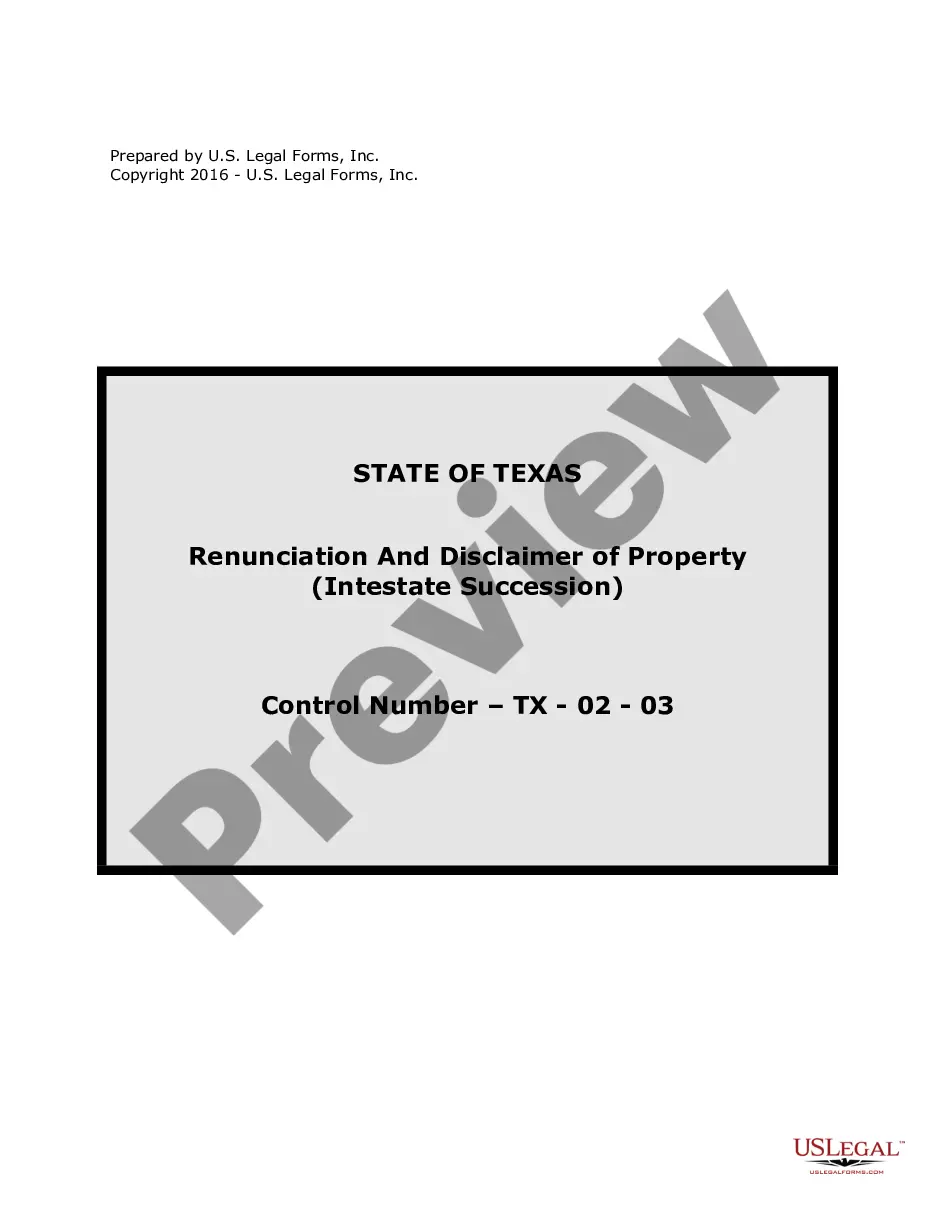
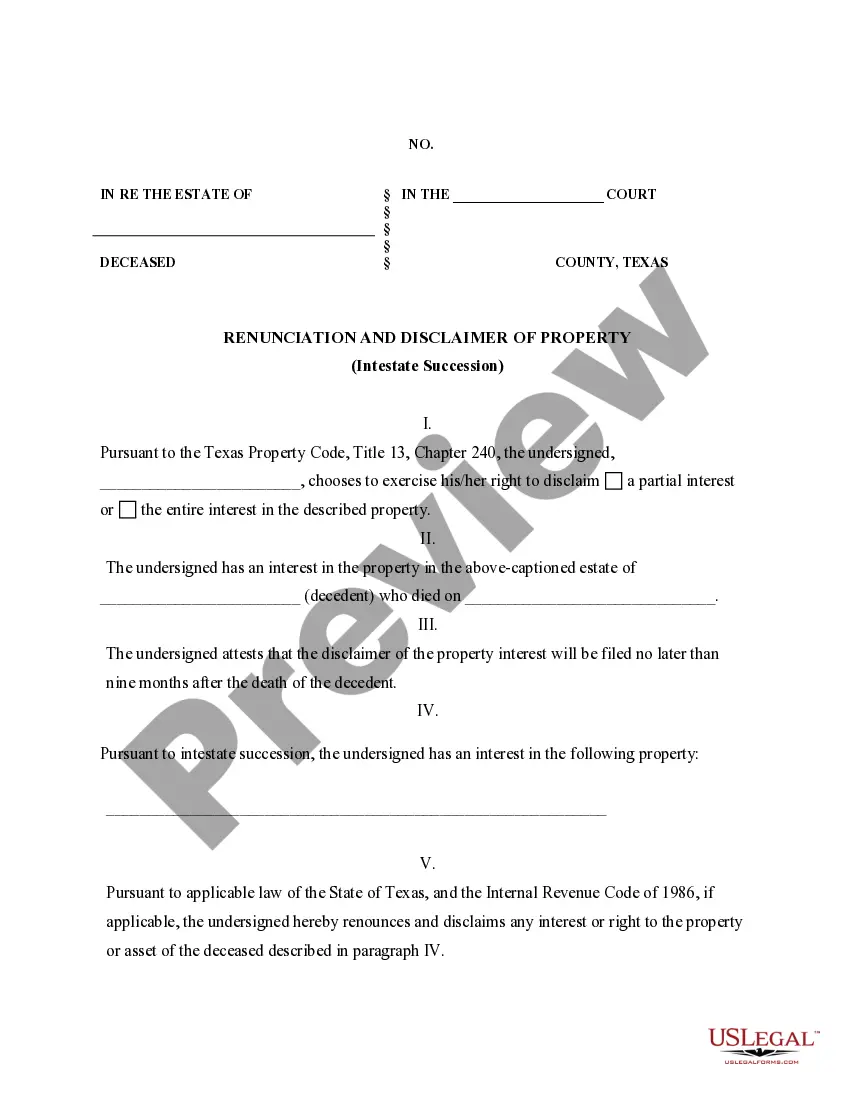
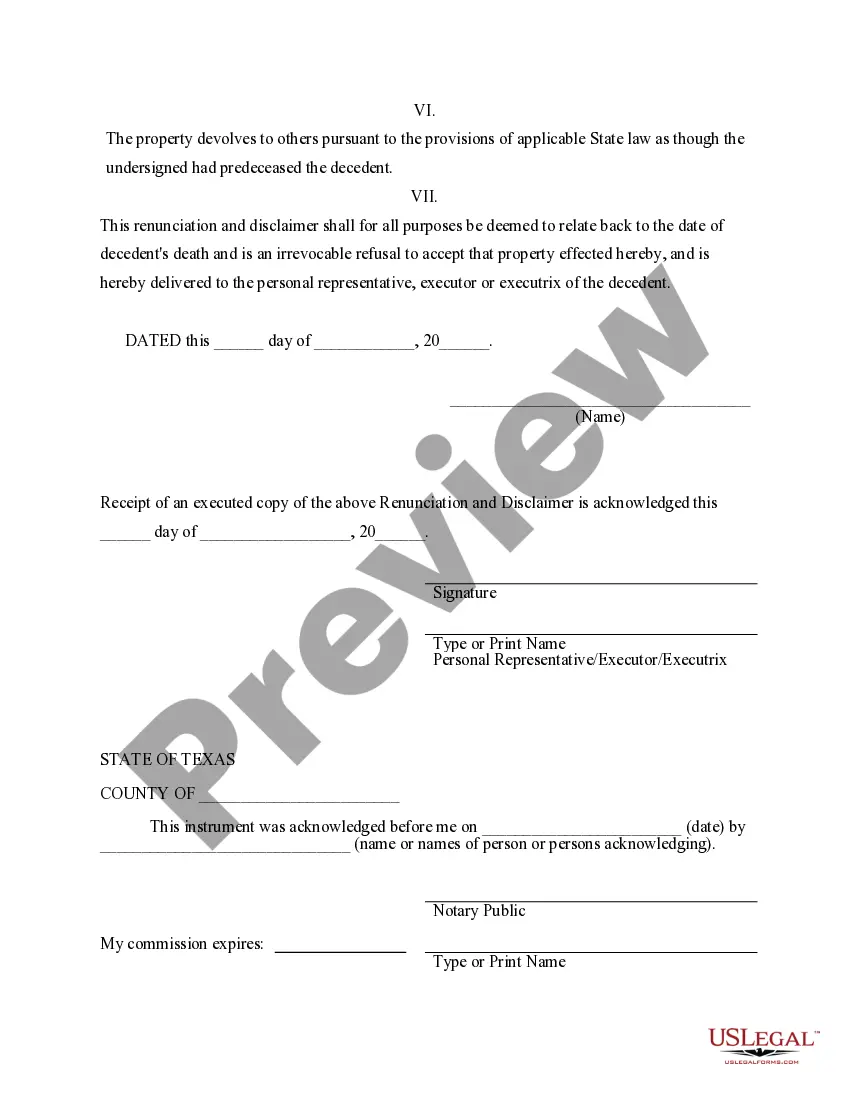
How to fill out Texas Renunciation And Disclaimer Of Property Received By Intestate Succession?
- If you're a returning user, log in to your account and access your necessary form template. Click the Download button after verifying your subscription is active.
- If this is your first time, start by previewing the relevant form description. Make sure it aligns with your needs and meets your local jurisdiction's requirements.
- If you find inconsistencies, utilize the Search tab to explore alternative templates until you find the right fit.
- To proceed, select the Buy Now button and pick a subscription plan that works for you while registering an account to access the vast library.
- Complete your transaction by entering your payment details using a credit card or your PayPal account.
- Finally, download the completed form and save it on your device. You can revisit it anytime through the My Forms section of your profile.
By using US Legal Forms, individuals and attorneys not only get access to a vast selection of over 85,000 legal forms but also benefit from expert assistance in completing these documents correctly.
Don't navigate Texas intestate succession law alone; start your journey with US Legal Forms today for a smooth, legally sound experience!
Form popularity
FAQ
Texas intestate succession law outlines how heirs inherit property when someone dies without a will. Generally, the estate is divided among children, parents, siblings, and other relatives according to a specific hierarchy. Each category of heir has defined rights and shares, which must be handled according to the law. Utilizing resources like uslegalforms can simplify the process of understanding and navigating these laws.
The inheritance rights of a surviving spouse in Texas depend on whether there are surviving children. If there are children from the marriage, the spouse has rights to a portion of the estate, with the remainder allocated to the children. If there are no children, the spouse may inherit the entire estate. Understanding these rights can help you make informed decisions about your assets.
In Texas, the automatic transfer of a house to a surviving spouse depends on various factors, including ownership type and existing wills. If the house is community property, the surviving spouse generally retains their share. However, if the house is owned solely by the deceased spouse, Texas intestate succession law will govern how it is divided among heirs. Knowing these details can guide you in estate planning.
Under Texas intestate succession law, a surviving spouse does not automatically inherit everything. If there are children from the marriage, the spouse will inherit a portion of the estate, with the remaining assets going to the children. If there are no children, the spouse may inherit all property. It's important to understand these nuances to ensure your estate plan reflects your wishes.
Texas intestate succession law generally follows a per stirpe distribution method, which means that a deceased person's share passes to their descendants. This method ensures that if a primary heir has died before the decedent, their children will inherit their share. Understanding this concept is essential when planning your estate, as it influences how your assets are distributed. Consulting with a legal expert can clarify how this applies to your specific situation.
In Texas, the right of survivorship is not automatic. It must be explicitly stated in the property deed or will. Texas intestate succession law does address how property is divided among heirs, but without a clear designation, surviving owners may not inherit automatically. Always consider legal counsel to ensure your intentions are documented properly.
Individuals who inherit property through Texas intestate succession law receive a legally defined share of the deceased's assets. This can include real estate, personal belongings, and financial accounts, distributed according to the established rules of succession. As each situation is unique, the exact assets inherited can vary significantly based on family ties and the size of the estate. To navigate these complexities effectively, platforms like UsLegalForms can offer valuable guidance.
In Texas, there is no inheritance tax; therefore, you can inherit any amount without facing taxation. This friendly aspect of Texas intestate succession law allows families to inherit assets without additional financial stress. It is wise to be aware of other potential taxes, such as estate taxes at the federal level, but many estates fall below the taxable threshold. You should always consider consulting a knowledgeable estate planner to clarify your situation.
Fortunately, Texas does not impose an inheritance tax. Thus, families do not need to worry about tax burdens when inheriting property under Texas intestate succession law. However, focusing on proper estate planning techniques can further secure your assets and streamline the inheritance process for your beneficiaries. Utilizing helpful resources, like those offered by UsLegalForms, can simplify your planning efforts.
Texas intestate succession law outlines how a person's assets are distributed when they die without a will. Typically, the deceased's spouse and children inherit first, with specific shares allocated to each based on familial relationships. If there are no immediate heirs, the law extends to include parents, siblings, and more distant relatives. Understanding these rules is crucial, as they ensure that your loved ones receive what is rightfully theirs.