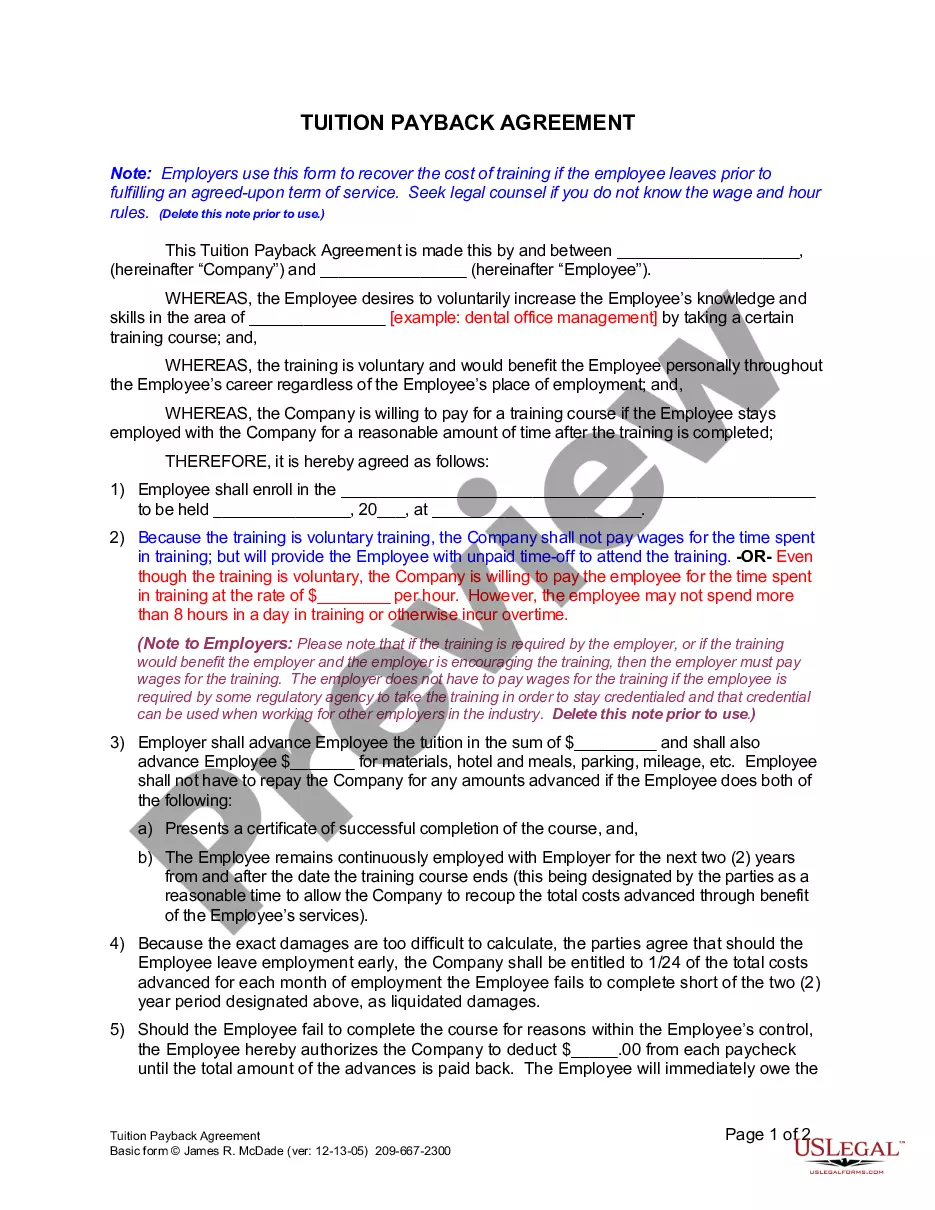
Tuition Reimbursement Payback Agreement Template With Notary
Description
Get your form ready online
Our built-in tools help you complete, sign, share, and store your documents in one place.
Make edits, fill in missing information, and update formatting in US Legal Forms—just like you would in MS Word.
Download a copy, print it, send it by email, or mail it via USPS—whatever works best for your next step.
Sign and collect signatures with our SignNow integration. Send to multiple recipients, set reminders, and more. Go Premium to unlock E-Sign.
If this form requires notarization, complete it online through a secure video call—no need to meet a notary in person or wait for an appointment.
We protect your documents and personal data by following strict security and privacy standards.

Make edits, fill in missing information, and update formatting in US Legal Forms—just like you would in MS Word.

Download a copy, print it, send it by email, or mail it via USPS—whatever works best for your next step.

Sign and collect signatures with our SignNow integration. Send to multiple recipients, set reminders, and more. Go Premium to unlock E-Sign.

If this form requires notarization, complete it online through a secure video call—no need to meet a notary in person or wait for an appointment.

We protect your documents and personal data by following strict security and privacy standards.
Looking for another form?

How to fill out California Tuition Payback Agreement?
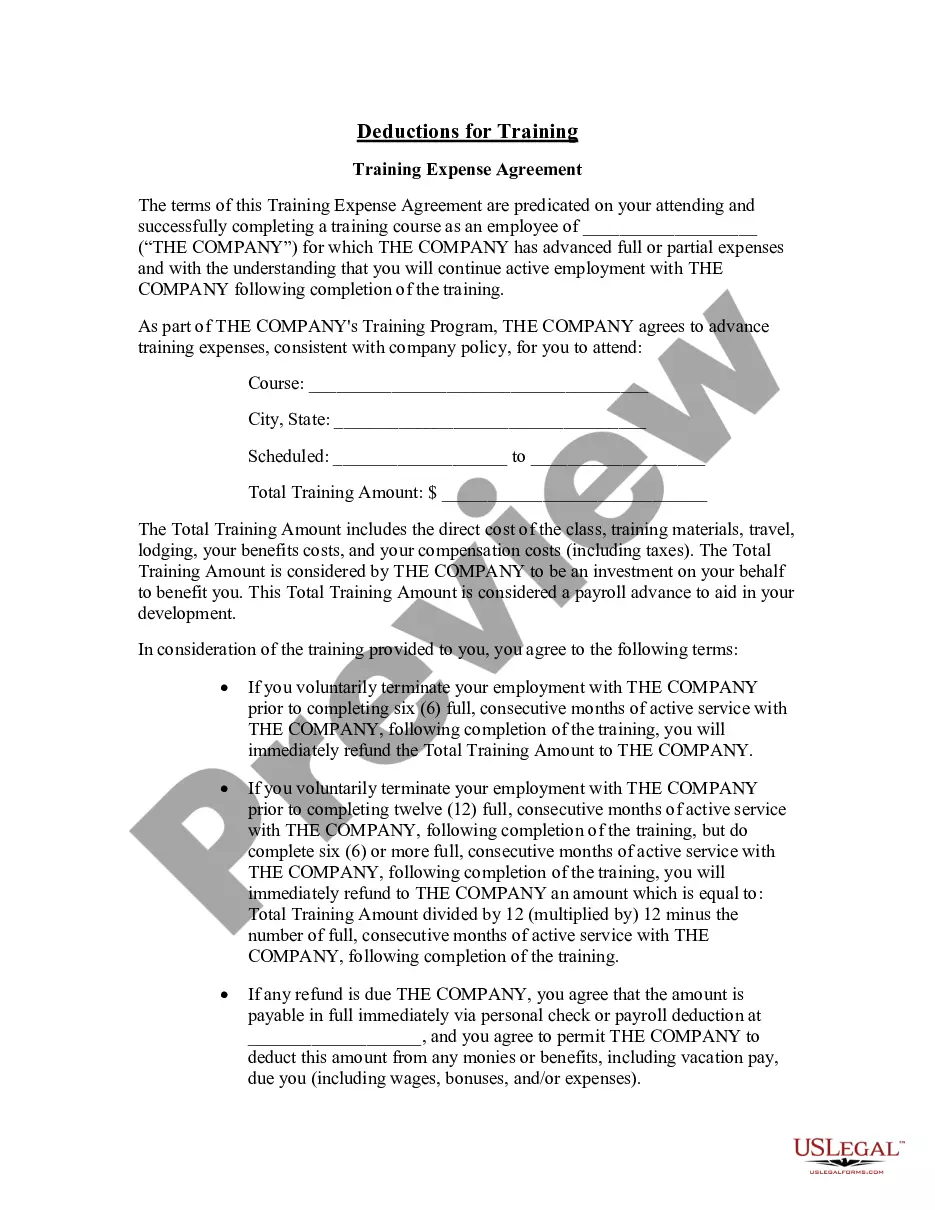
The Tuition Reimbursement Repayment Agreement Template With Notary presented on this page is a versatile legal document crafted by experienced attorneys in accordance with federal and state regulations.
For over 25 years, US Legal Forms has supplied individuals, businesses, and lawyers with more than 85,000 authenticated, state-specific documents for various professional and personal needs. It’s the fastest, simplest, and most dependable method to acquire the forms you require, as the service ensures bank-grade data protection and anti-virus security.
Subscribe to US Legal Forms to have access to verified legal documents for every aspect of life at your fingertips.
- Search for the document you require and verify it.
- Browse the sample you are looking for and preview it or read the form description to confirm it meets your needs. If it doesn’t, utilize the search bar to find the appropriate one. Click Buy Now when you have found the template you need.
- Choose a subscription and Log In.
- Select the payment plan that works for you and create an account. Use PayPal or a credit card for a quick transaction. If you already possess an account, Log In and review your subscription to proceed.
- Obtain the editable template.
- Select the format you prefer for your Tuition Reimbursement Repayment Agreement Template With Notary (PDF, Word, RTF) and download the document to your device.
- Complete and sign the documents.
- Print the template to fill it out manually. Alternatively, use an online multifunctional PDF editor to quickly and accurately complete and sign your form with an electronic signature.
- Redownload your documents as needed.
- Access the same document at any time. Open the My documents tab in your account to re-download any forms you’ve previously downloaded.
Form popularity
FAQ
Delaware Resident Permits To Carry Concealed Deadly Weapons A Delaware resident desiring to carry a concealed deadly weapon in this state must have a Delaware license to do so. A Delaware resident is someone who carries or is required to have a Delaware driver's license and/or is registered to vote in Delaware.
Delaware Resident Permits To Carry Concealed Deadly Weapons A Delaware resident desiring to carry a concealed deadly weapon in this state must have a Delaware license to do so. A Delaware resident is someone who carries or is required to have a Delaware driver's license and/or is registered to vote in Delaware.
It is unlawful to manufacture, sell, transfer, purchase, receipt, or possess magazines that hold more than 17 rounds. Members of the military, law enforcement officers, and any individual who holds a concealed carry permit issued by the Superior Court under § 1441 of this title are exempt.
"Delaware arbitrarily labels standard capacity magazines capable of holding more than 17 rounds as ?large capacity magazines? and bans them despite the fact that they, along with the firearms with which they are compatible, are in common use for lawful purposes," lawyers for the plaintiffs wrote in a 25 page complaint.
Delaware residents do not currently need a pistol permit to purchase a handgun in the state of Delaware. In Delaware, any resident who can legally own a gun and is at least 18 can open carry.
We allow small arms ammunition, in quantities not exceeding 11 lbs. (5 kg) per person, as checked-baggage only. The weapon must be securely boxed and intended for that person's own use. More than one passenger may not combine quantities into one package.
Last updated December 13, 2022 . In 2022, Delaware enacted a ban on the manufacture, sale, purchase, receipt, transfer, or possession of a large capacity magazine (LCM). An LCM is defined as any ammunition feeding device capable of accepting, or that can readily be converted to hold, more than 17 rounds of ammunition.
Delaware does not require the registration of firearms. Any system of firearm registration is expressly prohibited, except with respect to a person prohibited from receiving a firearm.