Alabama Involuntary Commitment Forms For Mental Health
Description
Get your form ready online
Our built-in tools help you complete, sign, share, and store your documents in one place.
Make edits, fill in missing information, and update formatting in US Legal Forms—just like you would in MS Word.
Download a copy, print it, send it by email, or mail it via USPS—whatever works best for your next step.
Sign and collect signatures with our SignNow integration. Send to multiple recipients, set reminders, and more. Go Premium to unlock E-Sign.
If this form requires notarization, complete it online through a secure video call—no need to meet a notary in person or wait for an appointment.
We protect your documents and personal data by following strict security and privacy standards.

Make edits, fill in missing information, and update formatting in US Legal Forms—just like you would in MS Word.

Download a copy, print it, send it by email, or mail it via USPS—whatever works best for your next step.

Sign and collect signatures with our SignNow integration. Send to multiple recipients, set reminders, and more. Go Premium to unlock E-Sign.

If this form requires notarization, complete it online through a secure video call—no need to meet a notary in person or wait for an appointment.

We protect your documents and personal data by following strict security and privacy standards.
Looking for another form?

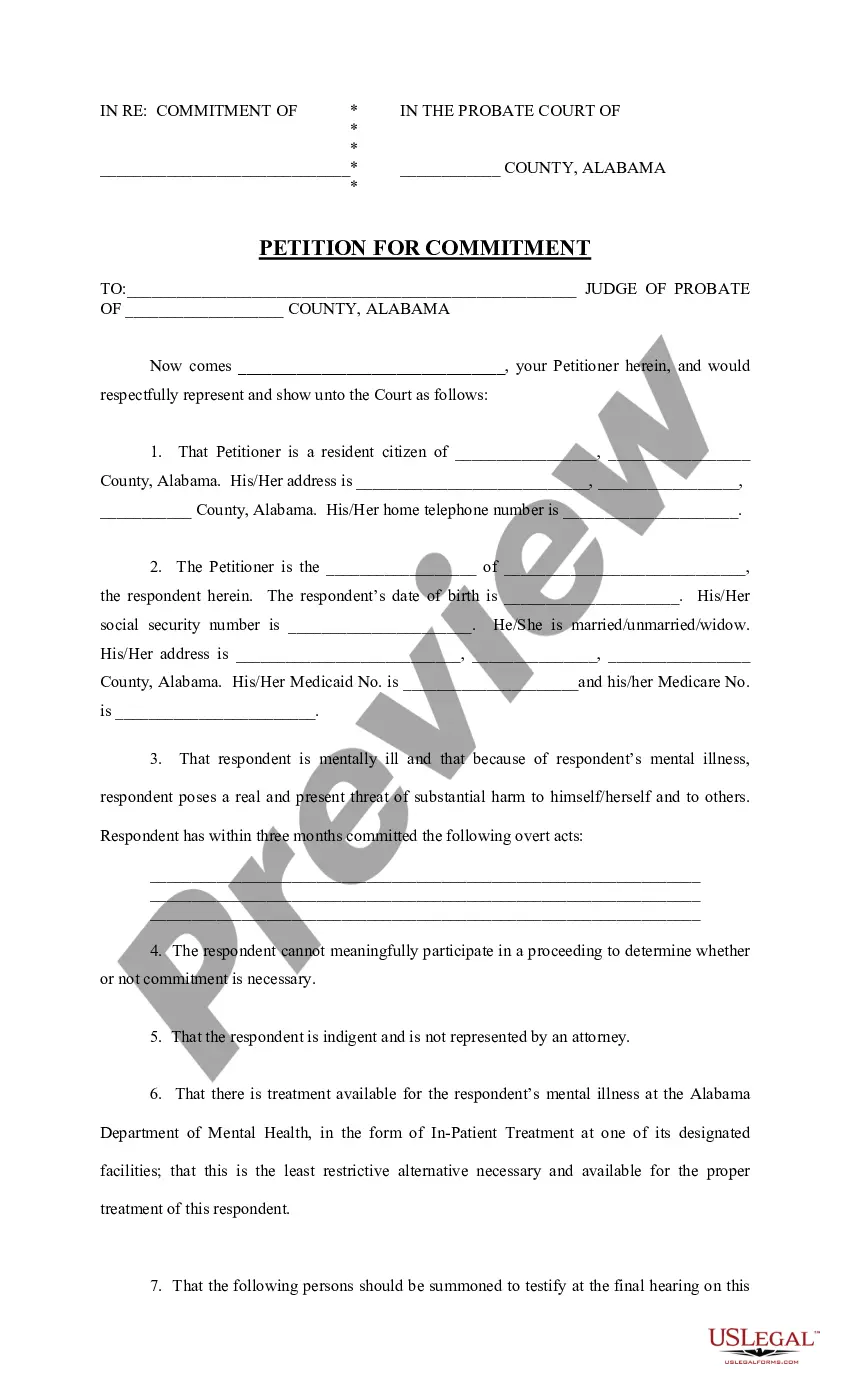
How to fill out Alabama Petition For Mental Health Commitment?
It’s clear that you cannot transform into a legal expert instantly, nor can you quickly learn how to draft Alabama Involuntary Commitment Forms For Mental Health without a specialized education.
Assembling legal documents is a lengthy process that necessitates specific training and expertise.
Therefore, why not entrust the development of the Alabama Involuntary Commitment Forms For Mental Health to the specialists.
View it (if this feature is available) and review the accompanying description to determine if Alabama Involuntary Commitment Forms For Mental Health is what you seek.
If you need a different template, restart your search. Create a free account and select a subscription plan to purchase the template. Click Buy now. After the payment is processed, you can obtain the Alabama Involuntary Commitment Forms For Mental Health, complete it, print it, and send or deliver it to the required individuals or organizations.
- Access US Legal Forms, which features one of the largest collections of legal templates, ranging from court documents to in-office communication formats.
- We acknowledge the significance of compliance with federal and local regulations.
- That’s why every form on our platform is tailored to specific locations and is current.
- Here’s how to begin using our website and obtain the form you require in just a few minutes.
- Search for the required form using the search bar at the top of the page.
Form popularity
FAQ
5150 is the number of the section of the Welfare and Institutions Code, which allows an adult who is experiencing a mental health crisis to be involuntarily detained for a 72- hour psychiatric hospitalization when evaluated to be a danger to others, or to himself or herself, or gravely disabled.
In order for an individual to be committed involuntarily, the following requirements are needed: (1) the patient is mentally ill; (2) the mental illness causes the patient to be dangerous to self or others or property as defined by NJSA §§ -27.2(h) and - 27.2(i); and (3) appropriate facilities or services are not ...
As stated above, to involuntarily commit a person, the state must prove the person is afflicted with a mental illness that causes the person to be dangerous to himself, others, or property. Generally, such proof requires medical (expert) testimony.
To have a person committed, you must file an application with the clerk of court in the county where the respondent (person you are committing) resides or is located.
Any person may seek to have another person committed by filing a petition with the Probate Court. WHAT MUST THE PETITION CONTAIN? Names and addresses of the other people with knowledge of the defendant's illness or who observed the person's overt acts and who may be called as his witnesses.