Delaware Notice of Dishonored Check - Criminal - Keywords: bad check, bounced check
What this document covers
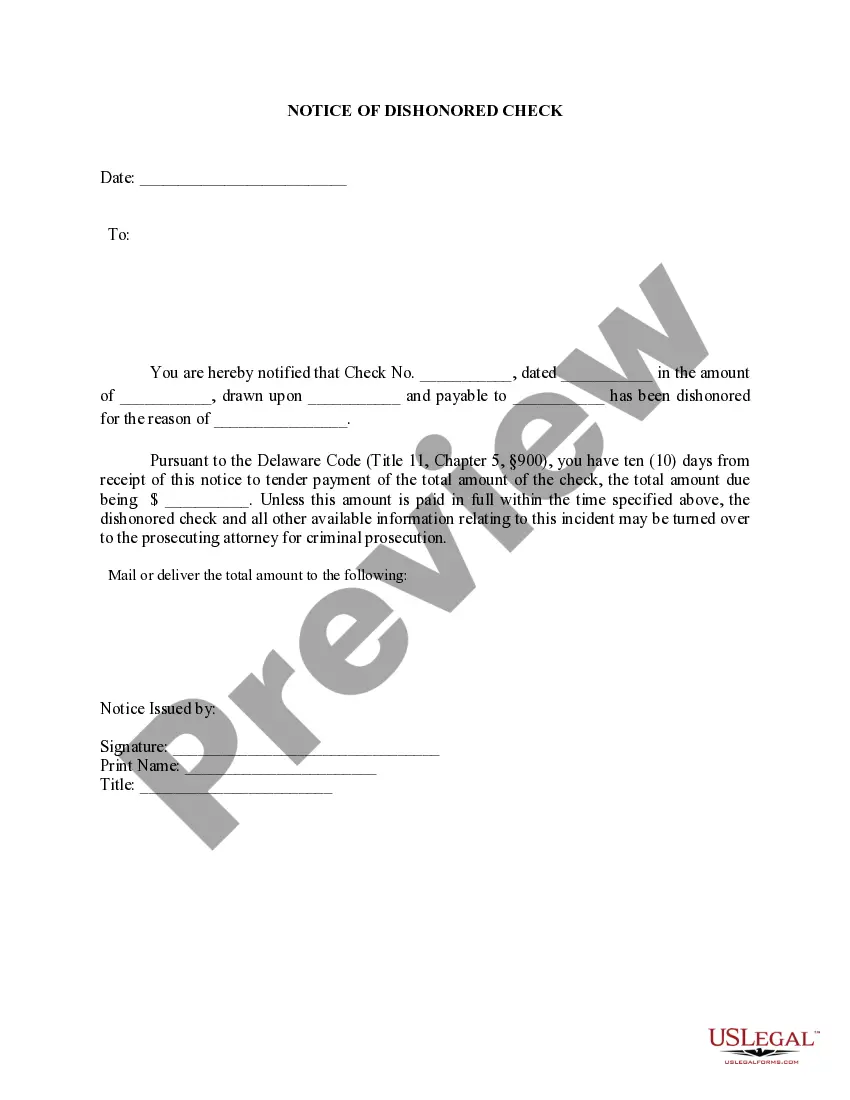
The Notice of Dishonored Check is a legal document used to inform a debtor that a check they issued has been returned unpaid by the bank. Commonly referred to as a bad check or a bounced check, this notice is crucial in initiating the recovery process for the amount owed. Unlike civil notices, this form is specific to criminal implications, making it essential for cases involving fraudulent checks.
Key components of this form
- Date of notice issuance.
- Name and contact information of the payee (the person who received the check).
- Name and contact information of the debtor (the person who wrote the check).
- Details of the dishonored check, including the check number, date, and amount.
- Explanation of the dishonor, such as insufficient funds or account closure.
- Deadline for remedying the situation, typically to avoid further legal actions.


When to use this form
This form should be used when a check you received has bounced due to insufficient funds or closure of the account. It is particularly applicable if you suspect the debtor may have committed fraud and you wish to notify them officially before taking legal action. Sending this notice can serve as an important step in the process of recovering the owed amount.
Who can use this document
- Business owners who have received a dishonored check.
- Individuals who have been issued a bad check by another party.
- Legal professionals handling debt recovery cases.
Steps to complete this form
- Fill in the date on which you are issuing the notice.
- Provide your name and contact information as the payee.
- Enter the name and address of the debtor.
- List details of the dishonored check, including the check number, date issued, and amount.
- State the reason for dishonor, such as insufficient funds or account closure.
- Set a deadline for payment to be made to avoid further actions.
Is notarization required?
Notarization is generally not required for this form. However, certain states or situations might demand it. You can complete notarization online through US Legal Forms, powered by Notarize, using a verified video call available anytime.
Get your form ready online
Our built-in tools help you complete, sign, share, and store your documents in one place.
Make edits, fill in missing information, and update formatting in US Legal Forms—just like you would in MS Word.
Download a copy, print it, send it by email, or mail it via USPS—whatever works best for your next step.
Sign and collect signatures with our SignNow integration. Send to multiple recipients, set reminders, and more. Go Premium to unlock E-Sign.
If this form requires notarization, complete it online through a secure video call—no need to meet a notary in person or wait for an appointment.
We protect your documents and personal data by following strict security and privacy standards.

Make edits, fill in missing information, and update formatting in US Legal Forms—just like you would in MS Word.

Download a copy, print it, send it by email, or mail it via USPS—whatever works best for your next step.

Sign and collect signatures with our SignNow integration. Send to multiple recipients, set reminders, and more. Go Premium to unlock E-Sign.

If this form requires notarization, complete it online through a secure video call—no need to meet a notary in person or wait for an appointment.

We protect your documents and personal data by following strict security and privacy standards.
Avoid these common issues
- Failing to include all necessary details about the dishonored check.
- Neglecting to specify the deadline for payment.
- Not properly addressing the notice to the correct debtor.
- Ignoring state-specific laws and requirements related to notice delivery.
Why use this form online
- Immediate access to a reliable legal form tailored for your needs.
- Edit and customize the document easily to meet specific circumstances.
- Secure download and storage of your legal documentation.
- Legally compliant formats that reflect the latest state laws.
Looking for another form?


Form popularity
FAQ
In Delaware, extortion is defined under Title 11, Chapter 2101 of the criminal code. This law outlines various methods of extortion, including threats related to the collection of debts, such as those involving a Delaware Notice of Dishonored Check. For instance, if someone has written a bad check or bounced check, coercing them for repayment can lead to serious legal consequences. It is essential to understand your rights and obligations in such situations, and using tools like USLegalForms can help clarify the legal process involved.
If a post-dated check bounces, it means that the check was unable to clear even though it was dated for a future date. This may lead to the same consequences as any bounced check, including potential legal ramifications and the issuance of a Delaware Notice of Dishonored Check - Criminal. To avoid these situations, it's beneficial to monitor your accounts closely and utilize services like U.S. Legal Forms, where you can find templates and information to navigate these issues effectively. Being proactive can save you from headaches down the line.
The term 'bounced check' originates from the idea that the check 'bounces back' to the payer because it cannot be processed. This happens when the writer's bank account does not have enough funds to cover the amount. It is essential to understand the implications of issuing a bounced check, as it may lead to legal issues, including a Delaware Notice of Dishonored Check - Criminal. Being informed about these consequences can help you manage your finances better.
A bounced check and a dishonored check refer to the same situation, where the check cannot be cashed due to insufficient funds. However, 'bounced check' often has a more casual connotation, while 'dishonored check' is a more formal term used in legal contexts. In Delaware, when a bounced check is issued, knowing the specifics of a Delaware Notice of Dishonored Check - Criminal can help you understand your rights and obligations. Awareness of these terms can protect you in financial dealings.
A dishonored check is commonly known as a bad check. This term refers to a check that cannot be processed due to insufficient funds in the account. Understanding this term is crucial when dealing with financial transactions, especially in Delaware, where a Delaware Notice of Dishonored Check - Criminal may come into play. If you ever encounter this situation, it’s important to address it promptly to avoid further complications.
Delaware Code 464 relates to the regulation of bad checks. It outlines the legal definitions and penalties for writing a check without adequate funds. Understanding this code is crucial for anyone dealing with bounced checks, as it provides legal guidelines under the Delaware Notice of Dishonored Check - Criminal framework.
The issuer of a bounced check bears the penalty. Penalties can vary but often include monetary fines or legal action. Under Delaware law, repeat offenses or checks written with insufficient funds can lead to more severe ramifications under the Delaware Notice of Dishonored Check - Criminal statutes.
The individual who issued the bounced cheque is the one who gets charged. Depending on the situation, legal action may ensue if the recipient pursues restitution. In Delaware, laws related to bad checks can result in substantial fines and can even affect your credit score.
When a check is dishonored, it means the bank refuses to process it due to insufficient funds or other issues. The check is then returned to the recipient, often marked as 'NSF' (non-sufficient funds). The issuer may then receive notice and might be subject to penalties under the Delaware Notice of Dishonored Check - Criminal laws.
Typically, the person who wrote the bounced check faces repercussions. This can include criminal charges, depending on the amount and circumstances. The Delaware Notice of Dishonored Check - Criminal system can involve fines, and potentially even jail time, if the bad check was issued with fraudulent intent.