District of Columbia Notice of Dishonored Check - Criminal - Keywords: bad check, bounced check
What is this form?
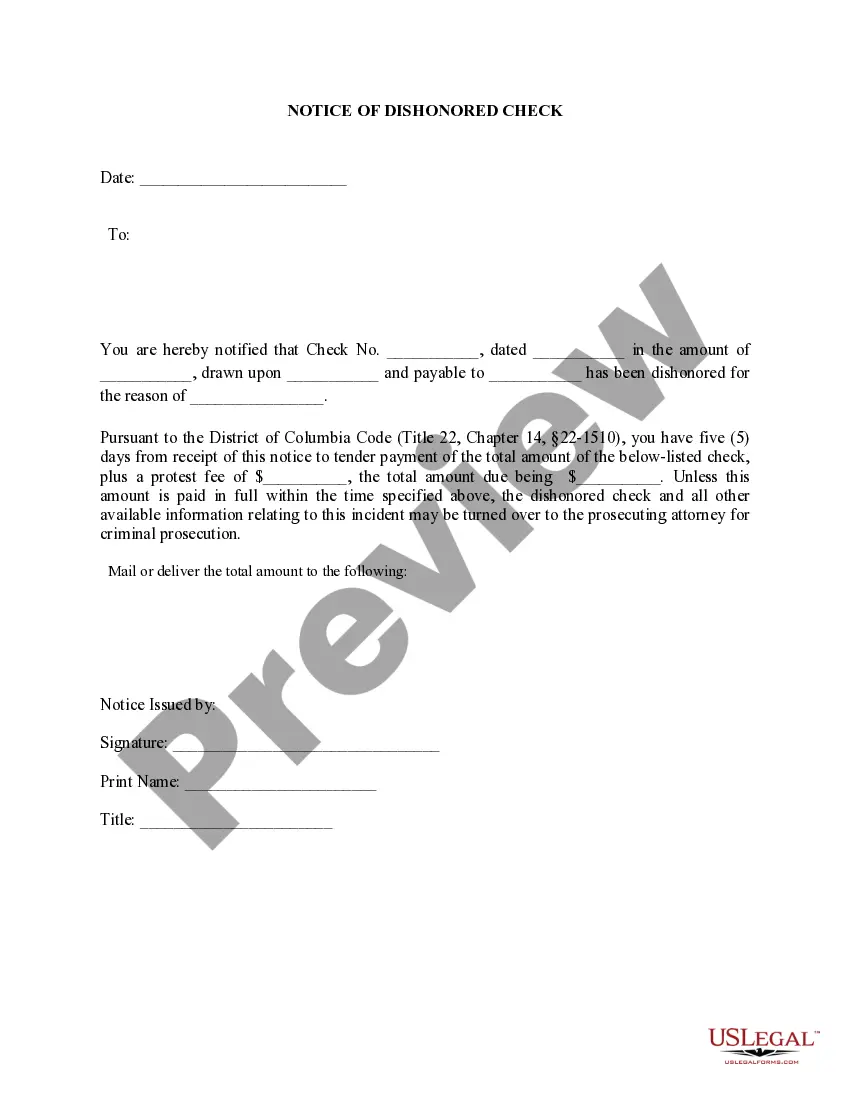
The Notice of Dishonored Check is a legal document used to inform an individual that a check they issued has bounced due to insufficient funds or because the account does not exist. This form serves as a formal notification and initiates the process for potential recovery of the funds. Unlike civil notices, this version emphasizes the criminal implications of issuing a bad check, underscoring the seriousness of the situation.
What’s included in this form
- Recipient's name and address: Ensure correct identification of the individual being notified.
- Details of the dishonored check: Include information such as check number, date, and amount.
- Payment deadline: Specifies that payment must be made within five days of receiving the notice.
- Protest fee: Indicates any additional fees that may apply for processing the dishonored check.
- Consequences of non-payment: Mentions that failure to pay may lead to criminal prosecution.


Situations where this form applies
This form should be used when you have received a check that has bounced, meaning that the account had insufficient funds or is nonexistent. Issuers of such checks must be notified of the dishonor to initiate recovery efforts. It is particularly useful for business owners and individuals seeking to formally document an attempt to collect funds owed to them for goods or services rendered.
Who this form is for
- Business owners who have received a bounced check as payment.
- Individuals who have been issued a bad check from someone.
- Creditors looking to formally notify debtors about the dishonored check.
- Anyone pursuing potential legal action related to a dishonored check.
How to prepare this document
- Identify the debtor: Enter the name and address of the person who issued the bad check.
- Provide check details: Include relevant information, such as the check number, date, and the amount of the dishonored check.
- Specify the protest fee: Indicate any applicable fees associated with the dishonored check.
- Set a payment deadline: Clearly state the five-day period for the debtor to make payment.
- Sign and date the notice: Ensure you sign the document to make it officially valid.
Does this form need to be notarized?
In most cases, this form does not require notarization. However, some jurisdictions or signing circumstances might. US Legal Forms offers online notarization powered by Notarize, accessible 24/7 for a quick, remote process.
Get your form ready online
Our built-in tools help you complete, sign, share, and store your documents in one place.
Make edits, fill in missing information, and update formatting in US Legal Forms—just like you would in MS Word.
Download a copy, print it, send it by email, or mail it via USPS—whatever works best for your next step.
Sign and collect signatures with our SignNow integration. Send to multiple recipients, set reminders, and more. Go Premium to unlock E-Sign.
If this form requires notarization, complete it online through a secure video call—no need to meet a notary in person or wait for an appointment.
We protect your documents and personal data by following strict security and privacy standards.

Make edits, fill in missing information, and update formatting in US Legal Forms—just like you would in MS Word.

Download a copy, print it, send it by email, or mail it via USPS—whatever works best for your next step.

Sign and collect signatures with our SignNow integration. Send to multiple recipients, set reminders, and more. Go Premium to unlock E-Sign.

If this form requires notarization, complete it online through a secure video call—no need to meet a notary in person or wait for an appointment.

We protect your documents and personal data by following strict security and privacy standards.
Mistakes to watch out for
- Failing to include accurate check details, such as the amount and check number.
- Not providing a clear payment deadline, leading to confusion for the debtor.
- Forgetting to sign and date the notice, which is necessary for its validity.
Advantages of online completion
- Convenience: Easily download and complete the form from anywhere.
- Editability: Modify the form as needed before submission.
- Reliability: The form is drafted by licensed attorneys, ensuring it meets legal standards.
Legal use & context
- This notice serves as a formal communication that helps establish intent to recover funds.
- Fulfilling this legal requirement may strengthen your case if you pursue further action.
- Be aware of the time limits within which the notice must be sent in order to comply with local laws.
What to keep in mind
- The Notice of Dishonored Check is crucial for notifying debtor about their bounced check.
- Timely notification is essential for potential recovery and to avoid legal complications.
- Ensure all details are accurate and the form is properly executed for it to be legally binding.
Looking for another form?

Form popularity
FAQ
When a check is dishonored, you should subtract the amount of the check from your account balance to accurately reflect your available funds. This will help you manage your finances better and avoid overdrafts, which can lead to additional fees. Keeping clear financial records is essential for handling bounced checks. Access USLegalForms for tools that can assist you in managing these entries effectively.
To record a dishonored check, note the details such as the check number, amount, date, and the reason for dishonor on your financial records. It is advisable to keep both a paper trail and digital records to ensure accuracy in case of disputes. Moreover, having a systematic approach can prevent confusion and legal issues in the future. USLegalForms offers templates and resources to help you with proper documentation.
The penalties for a bounced check can range from monetary fines to criminal charges, depending on the amount and intent. In the District of Columbia, the law takes bounced checks seriously, especially if they are deemed to be intentional bad checks. This can lead to significant legal troubles if not addressed promptly. Consider using USLegalForms to locate relevant information and templates to help you manage these situations.
Yes, writing a bounced check can lead to serious legal issues, including potential criminal charges. Laws regarding bounced checks vary by state, and in the District of Columbia, the penalties can be severe depending on the amount involved. It is crucial to resolve any bounced checks as soon as possible to avoid complications. Resources at USLegalForms can help you understand your rights and responsibilities in this matter.
When you deposit a bad check, your bank may reject it, leading to potential fees for both you and the check writer. Additionally, you may have to deal with the hassle of tracking down the issuer for payment. Having a clear process for managing bounced checks will help you avoid financial loss. Utilizing platforms like USLegalForms can provide you with the documentation necessary to handle these situations effectively.
Yes, you can face legal consequences for writing a bounced check, often considered a bad check. Depending on the amount and the circumstances, you may be subject to fines or even criminal charges in the District of Columbia. It is important to address any bounced checks promptly to avoid escalating issues. If you find yourself in this situation, explore resources on USLegalForms for guidance.
To effectively write a dishonored check on a check stub, begin by clearly marking the check as 'dishonored' or 'bounced.' Include the date the check was returned, the amount, and the reason for the dishonor, such as insufficient funds. Maintaining accurate records of all dishonored checks will help you in case you need to refer back to them. You can also check USLegalForms for templates that guide you through this process.
Fighting a bad check requires systematic action. Gather evidence such as the original check, communication with the issuer, and any returned notices. If necessary, consider pursuing legal action by filing a lawsuit in small claims court. A District of Columbia Notice of Dishonored Check can serve as important documentation in your case, supporting your claims about the bounced check and demonstrating your efforts to resolve the matter.
If someone writes you a bad check, first try to contact the issuer to notify them about the issue. If they do not cover the amount quickly, document everything related to the transaction and consider filing a report. Utilizing a District of Columbia Notice of Dishonored Check can formalize your complaint and help you recover the funds. Additionally, using resources like USLegalForms can provide you with templates and information to guide you through the process.
Disputing a bad check involves several steps. Start by contacting the individual who issued the check to inform them of your concerns. If they do not resolve the matter, you may need to file a complaint with your local authorities or pursue legal action. An important part of this process may include a District of Columbia Notice of Dishonored Check, which documents the bounced check and strengthens your position.