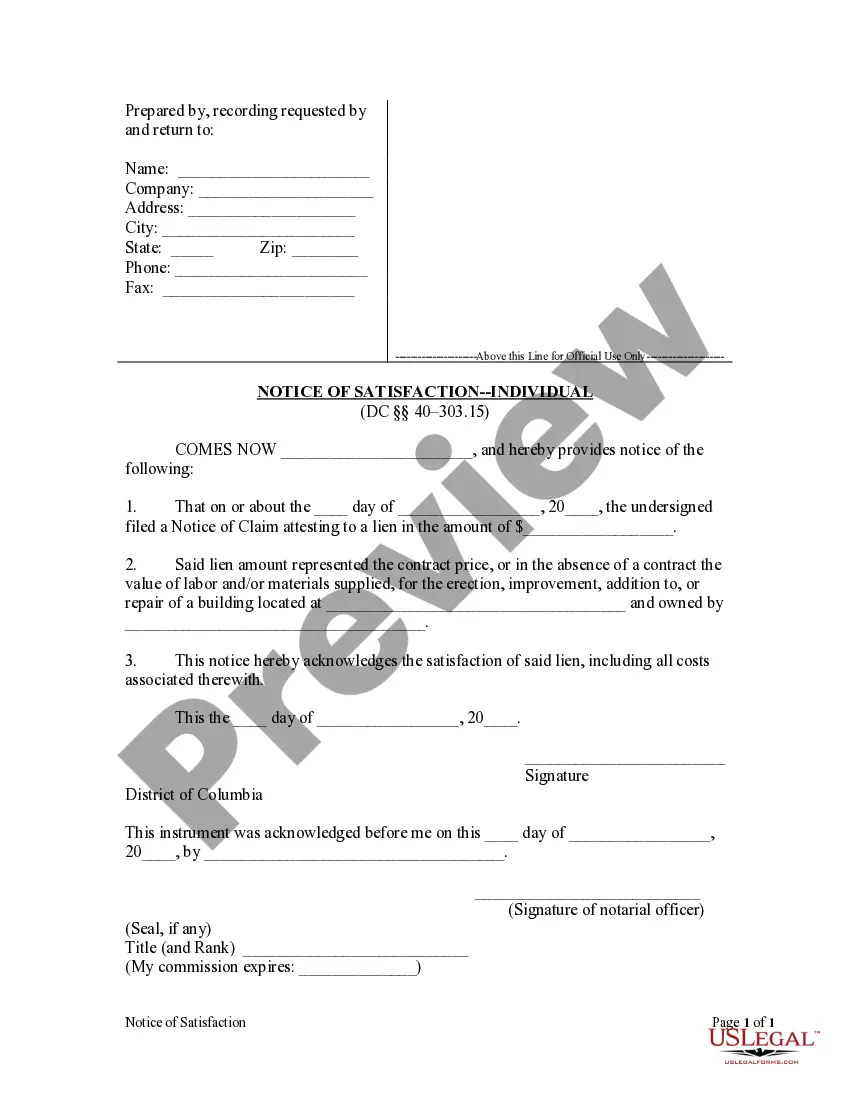
District of Columbia Notice of Satisfaction - Individual
What is this form?
The Notice of Satisfaction - Individual is a legal document used to formally acknowledge the satisfaction of a lien in the District of Columbia. This form is essential for lien holders to confirm that a lien has been resolved, distinguishing it from lien creation or claim forms. Properly filing this notice helps avoid penalties and protects the rights of parties involved in property transactions.
Key parts of this document
- Identification of the individual providing the notice.
- Details regarding the original Notice of Claim, including date and amount of the lien.
- Information about the property associated with the lien.
- Legal acknowledgment of lien satisfaction, including costs involved.
- Signature section for both the individual and notary (if applicable).
Common use cases
This form should be used when a party who has previously filed a Notice of Claim wishes to formally declare that the lien has been satisfied. Use it in scenarios such as completing payment obligations, finalizing construction contracts, or releasing property from a lien, thereby ensuring that all parties are clear that the debt has been resolved.
Intended users of this form
This form is intended for:
- Individuals who have filed a lien against a property in the District of Columbia.
- Property owners who need an official acknowledgment that a lien has been satisfied.
- Contractors or suppliers who are involved in property improvement and wish to release their lien on completion of payment.
How to prepare this document
- Identify the parties involved, including the lien holder and property owner.
- Specify the details of the original lien, including the date and amount.
- Describe the property associated with the lien.
- Provide the date of completion and signature of the individual acknowledging the satisfaction.
- Ensure the document is notarized if required, confirming the identities of the parties involved.
Is notarization required?
Yes, this form must be notarized to be legally valid. US Legal Forms offers integrated online notarization, accessible 24/7 via secure video call. This ensures that you can complete the notarization process without the need for travel.
Get your form ready online
Our built-in tools help you complete, sign, share, and store your documents in one place.
Make edits, fill in missing information, and update formatting in US Legal Forms—just like you would in MS Word.
Download a copy, print it, send it by email, or mail it via USPS—whatever works best for your next step.
Sign and collect signatures with our SignNow integration. Send to multiple recipients, set reminders, and more. Go Premium to unlock E-Sign.
If this form requires notarization, complete it online through a secure video call—no need to meet a notary in person or wait for an appointment.
We protect your documents and personal data by following strict security and privacy standards.

Make edits, fill in missing information, and update formatting in US Legal Forms—just like you would in MS Word.

Download a copy, print it, send it by email, or mail it via USPS—whatever works best for your next step.

Sign and collect signatures with our SignNow integration. Send to multiple recipients, set reminders, and more. Go Premium to unlock E-Sign.

If this form requires notarization, complete it online through a secure video call—no need to meet a notary in person or wait for an appointment.

We protect your documents and personal data by following strict security and privacy standards.
Mistakes to watch out for
- Neglecting to include all required details about the lien and property.
- Failing to notarize the form when necessary.
- Using incorrect dates or signature lines.
- Not keeping a copy of the submitted form for personal records.
Advantages of online completion
- Convenient access to the form anytime, without needing to visit an office.
- Easy to fill out and edit, allowing for quick correction of errors.
- Reliable templates drafted by licensed attorneys, ensuring legal compliance.
Looking for another form?








Form popularity
FAQ
Vacant properties in the District of Columbia are subject to a higher tax rate to encourage development and usage. Generally, the tax on vacant land can be significantly more than properties that are occupied. When addressing issues related to the District of Columbia Notice of Satisfaction - Individual, it's essential to consider the implications of owning vacant property. Utilizing services like US Legal Forms can help ensure you comply with local regulations effectively.
In Washington, D.C., the seller usually pays the recordation tax when a property changes ownership. This tax is necessary for the official recording of the property deed in the DC Office of the Recorder of Deeds. If you are conducting transactions involving the District of Columbia Notice of Satisfaction - Individual, being aware of who pays the recordation tax is important for proper financial preparation. Consult with local real estate professionals to clarify responsibilities and potential costs.
The taxes in the District of Columbia include property taxes, sales taxes, and income taxes, among others. Each of these taxes serves to fund local services and infrastructure. When dealing with the District of Columbia Notice of Satisfaction - Individual, it is crucial to understand how these taxes could impact your property's financial obligations. Utilizing tax resources or guidance from professionals can help you navigate these complexities effectively.
The property tax rate in Washington, D.C., can vary based on the property type. For residential properties, the rate is typically set at 0.85% of the assessed value. Understanding the tax implications is crucial when dealing with matters related to the District of Columbia Notice of Satisfaction - Individual, as these taxes directly affect your property's valuation. Consider consulting with a tax professional to better navigate D.C.'s tax regulations.
To obtain a certificate of good standing in DC, you must first request it from the Department of Consumer and Regulatory Affairs. Be prepared to provide your business name and entity number. After submission and payment, you should receive the certificate promptly. Utilizing the US Legal platform can simplify this process with step-by-step instructions.
When filling out a Certificate of service form, start with your name and address at the top. Then, include the date of service, the method used for delivery, and the names of those served. Double-check all entries to confirm their accuracy. You can find useful templates and guidelines on the US Legal website to streamline the process.
To fill out a membership Certificate, begin by entering the name of the individual and the organization. Next, provide the date of the membership and any relevant details regarding the type of membership. Ensure all information is accurate to avoid issues later. For assistance, consider using resources available through the US Legal platform.
The three main types of deeds in DC are warranty deeds, quitclaim deeds, and special warranty deeds. Each type serves a different purpose, with warranty deeds providing the strongest level of protection for the grantee. Understanding these options is essential when managing property transfers related to the District of Columbia Notice of Satisfaction - Individual, and resources from platforms like uslegalforms can help clarify each type.
Creating a deed in the District of Columbia requires specific information, including the names and addresses of the grantor and grantee, the legal description of the property, and the consideration amount. It is vital to have accurate details, as they help in the compliance surrounding the District of Columbia Notice of Satisfaction - Individual. Ensuring the completeness of this information smooths the process for both parties involved.
While it is not legally required to hire a lawyer to obtain a deed in DC, having legal assistance can simplify the process. A lawyer can help ensure that all documents, including the District of Columbia Notice of Satisfaction - Individual, are correctly prepared and filed. Their expertise can reduce the chances of errors, ensuring your property rights are well-protected.