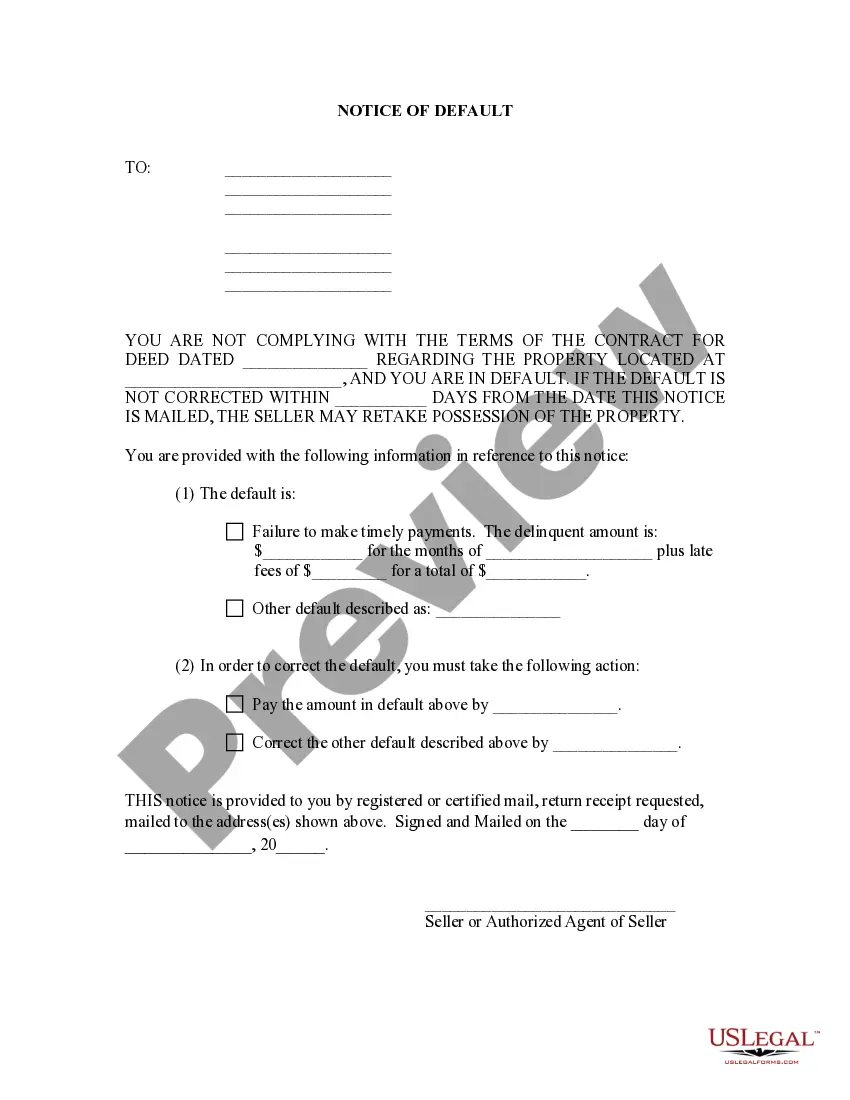
District of Columbia General Notice of Default for Contract for Deed
What this document covers
The General Notice of Default for Contract for Deed is a legal document used by a Seller to formally notify the Purchaser of default in a contract for deed. This notice outlines the reasons for the default, the specific actions required by the Purchaser to remedy the situation, and the Seller's intended course of action if the Purchaser fails to correct the default. Unlike other notices, this form is specific to contracts for deed, which are used to facilitate the sale of property while the title remains with the Seller until the Purchaser fulfills their obligations.
Key parts of this document
- Identification of the parties involved in the contract for deed.
- Clear statement outlining the reasons for the default.
- Details on what the Purchaser must do to cure the default.
- Description of the remedies the Seller may pursue if the default is not cured.
- Signatures of both parties to acknowledge receipt of the notice.
When this form is needed
This form is necessary when a Seller needs to formally communicate to a Purchaser that they have failed to meet the requirements of a contract for deed. Situations may include missed payments, failure to maintain the property, or breach of other terms specified in the agreement. This notice is a crucial first step in resolving the issue before taking further legal action.
Who can use this document
- Any Seller who has entered into a contract for deed and needs to notify the Purchaser of a default.
- Purchasers who need to understand the implications of receiving a default notice.
- Legal representatives assisting clients with property transactions involving contracts for deed.
How to prepare this document
- Identify the parties involved by entering their names and contact information.
- Clearly state the reasons for the default in the space provided.
- Specify the actions the Purchaser must take to remedy the default.
- Outline the potential remedies or actions the Seller may take if the Purchaser does not cure the default.
- Include the date and sign the document, ensuring both parties receive a copy of the notice.
Does this document require notarization?
To make this form legally binding, it must be notarized. Our online notarization service, powered by Notarize, lets you verify and sign documents remotely through an encrypted video session.
Get your form ready online
Our built-in tools help you complete, sign, share, and store your documents in one place.
Make edits, fill in missing information, and update formatting in US Legal Forms—just like you would in MS Word.
Download a copy, print it, send it by email, or mail it via USPS—whatever works best for your next step.
Sign and collect signatures with our SignNow integration. Send to multiple recipients, set reminders, and more. Go Premium to unlock E-Sign.
If this form requires notarization, complete it online through a secure video call—no need to meet a notary in person or wait for an appointment.
We protect your documents and personal data by following strict security and privacy standards.

Make edits, fill in missing information, and update formatting in US Legal Forms—just like you would in MS Word.

Download a copy, print it, send it by email, or mail it via USPS—whatever works best for your next step.

Sign and collect signatures with our SignNow integration. Send to multiple recipients, set reminders, and more. Go Premium to unlock E-Sign.

If this form requires notarization, complete it online through a secure video call—no need to meet a notary in person or wait for an appointment.

We protect your documents and personal data by following strict security and privacy standards.
Common mistakes to avoid
- Failing to provide a detailed explanation of the default.
- Not including necessary signatures from both parties.
- Neglecting to send the notice through a verified method of delivery.
- Using unclear language that may confuse the Purchaser regarding their responsibilities.
- Not adhering to state-specific requirements for notices of default.
Benefits of completing this form online
- Immediate access to a legally vetted notice template.
- Ability to customize the form to suit specific circumstances.
- Convenience of downloading and printing the form anywhere.
- Ensured compliance by following the latest legal standards.
Looking for another form?
Form popularity
FAQ
Writing a District of Columbia General Notice of Default for Contract for Deed involves clear, persuasive language detailing the breach of contract. Start with all parties' names, describe the default, and include a deadline for remedying the situation. US Legal Forms offers helpful templates that guide you through this process effectively, ensuring compliance with local regulations while providing clarity and professionalism.
Delivery methods for a District of Columbia General Notice of Default for Contract for Deed typically include certified mail, personal delivery, or electronic means, depending on local regulations. Ensure you keep proof of delivery, as this may be important in any future legal proceedings. Proper delivery ensures that all parties are aware of the default and have ample opportunity to address it.
A written notice of default is a formal document that informs a party about their failure to meet obligations under a contract, such as a District of Columbia General Notice of Default for Contract for Deed. This document not only identifies the issue but also outlines steps required to rectify the default. It's a critical tool for maintaining legal clarity and facilitating resolution.
A District of Columbia General Notice of Default for Contract for Deed must include essential elements, such as the names of the parties involved, a detailed description of the default, and any actions required to remedy the situation. It should also specify a deadline for compliance. Make sure to follow local laws to ensure that your notice is valid and enforceable.
To file a District of Columbia General Notice of Default for Contract for Deed, you need to prepare the notice according to local guidelines. Ensure it clearly states the default reason, relevant parties, and any applicable deadlines. After drafting the notice, submit it to the appropriate court or county office. Utilizing US Legal Forms can simplify this process by providing templates that meet legal requirements.
A notice of default on a house, such as the District of Columbia General Notice of Default for Contract for Deed, indicates that the homeowner has failed to make payments according to the terms of their contract. This document serves as a warning that foreclosure proceedings may begin if the default is not resolved promptly. Understanding this notice is vital for homeowners to take the necessary steps and possibly avoid losing their property.
As mentioned earlier, you can find District of Columbia General Notice of Default for Contract for Deed properties by utilizing real estate listing websites, local government resources, and public records searches. Many online platforms also aggregate this information, making it easier to locate properties in distress. Consider using these tools to your advantage to explore potential real estate opportunities.
Yes, a District of Columbia General Notice of Default for Contract for Deed is considered public record. This means anyone can access this information through your local government office or online databases. This public accessibility allows potential buyers and investors to stay informed about property statuses and help maintain transparency in real estate transactions.
You can find District of Columbia General Notice of Default for Contract for Deed properties by searching local government websites and real estate listings. Additionally, online platforms that specialize in real estate can offer insights into properties currently in default. These resources can help you identify potential investment opportunities or homes for sale due to default.
To file a District of Columbia General Notice of Default for Contract for Deed, you will need to complete the necessary forms provided by your local court or office. Ensure that you provide all required information and submit any applicable fees. It's essential to follow the specific filing procedures to ensure that your notice is legally recognized and enforceable.