District of Columbia Final Notice of Forfeiture and Request to Vacate Property under Contract for Deed
What is this form?
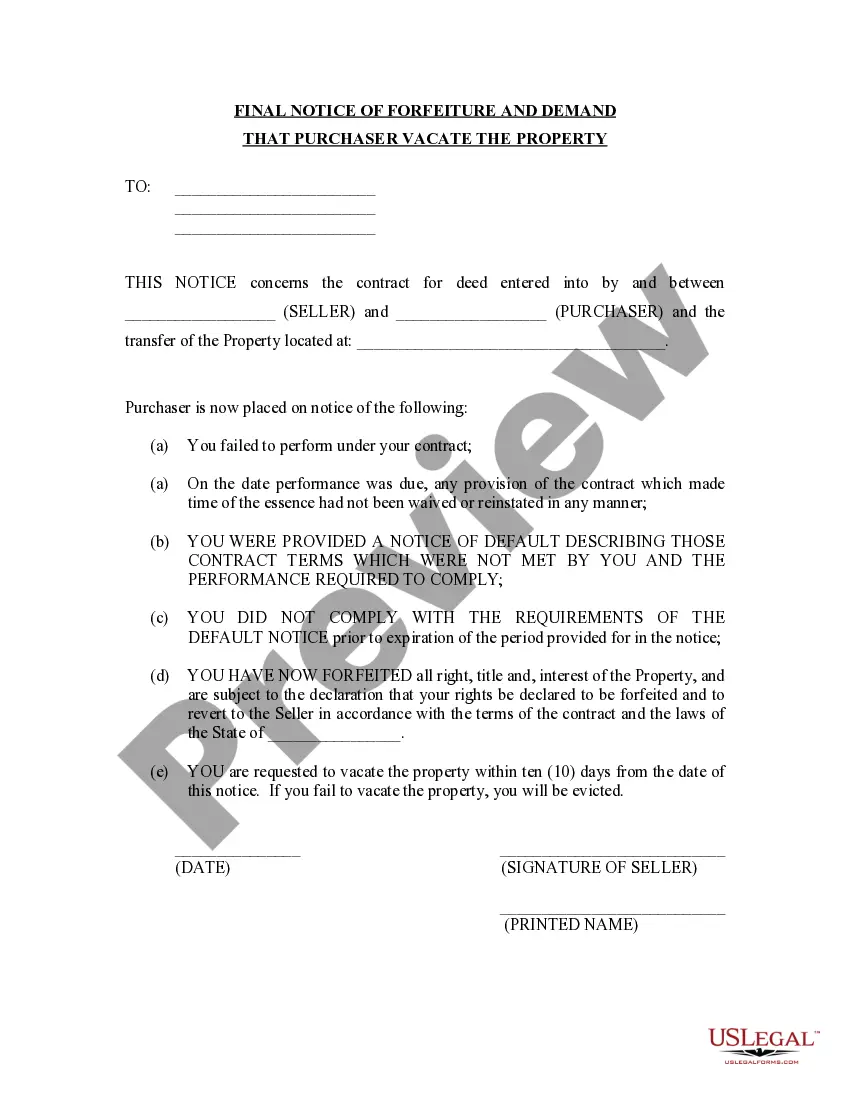
The Final Notice of Forfeiture and Request to Vacate Property under Contract for Deed is a legal document that informs the purchaser that their contract for deed has been canceled by the seller. This notification occurs after the seller has already sent prior notices of breach that remain unresolved. The form indicates that all previous payments made by the purchaser are forfeited and that any continued occupancy may lead to legal action.
Key parts of this document
- Notification of cancellation of the contract for deed.
- Statement regarding forfeiture of all previous payments made by the purchaser.
- Information on the legal consequences of continued occupancy.
- Details on the breach of contract and prior notices sent.
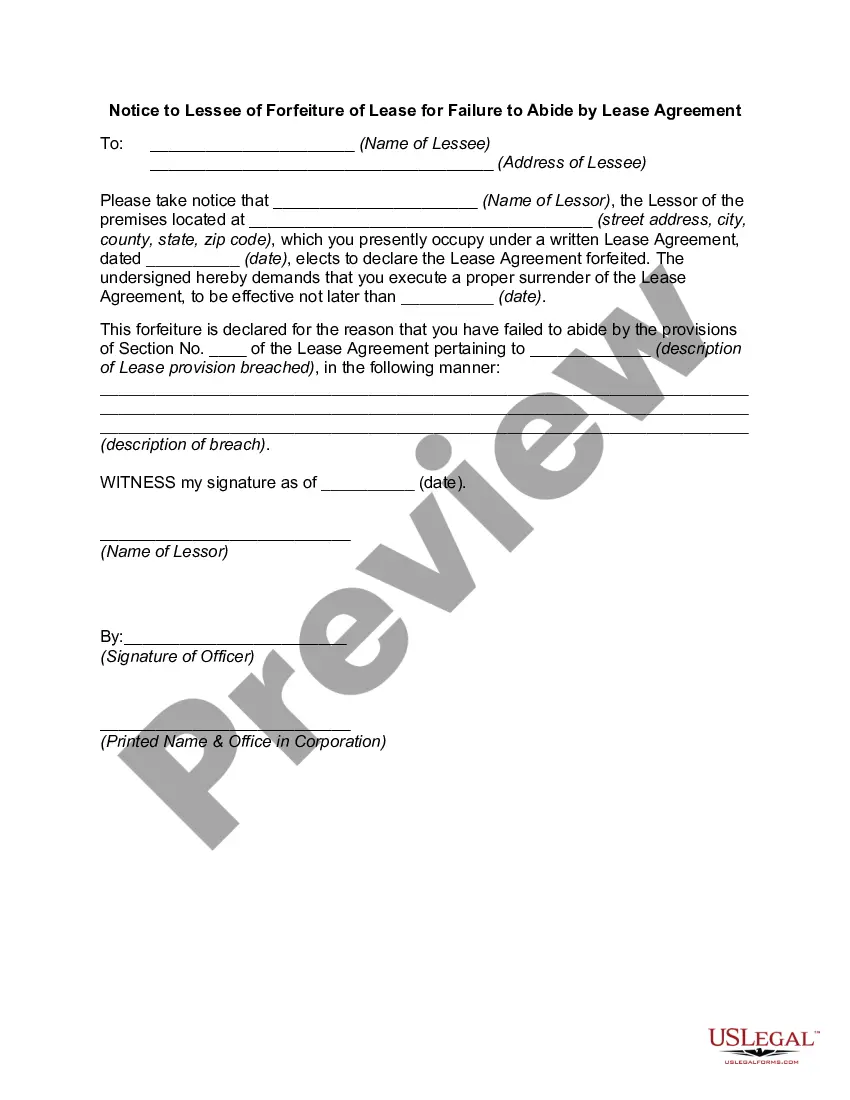
Situations where this form applies
This form should be used when a seller decides to cancel a contract for deed due to the purchaser's failure to remedy breaches after being given proper notice. It is particularly applicable in situations where previous attempts to resolve the issue have not been successful, and the seller wishes to formally notify the purchaser to vacate the property.
Who should use this form
- Sellers who have entered into a contract for deed with a purchaser.
- Property owners who need to notify buyers of contract forfeiture.
- Real estate professionals handling contracts for deed on behalf of clients.
Instructions for completing this form
- Identify the seller and purchaser involved in the contract.
- Provide details regarding the property subject to the contract for deed.
- Include a reference to the prior notices that were issued for breach.
- State the forfeiture of payments and any implications of continued occupancy.
- Gather necessary signatures to finalize the document.
Notarization guidance
This form does not typically require notarization unless specified by local law. It is advisable to confirm local requirements to ensure compliance and the form's legal standing.
Get your form ready online
Our built-in tools help you complete, sign, share, and store your documents in one place.
Make edits, fill in missing information, and update formatting in US Legal Forms—just like you would in MS Word.
Download a copy, print it, send it by email, or mail it via USPS—whatever works best for your next step.
Sign and collect signatures with our SignNow integration. Send to multiple recipients, set reminders, and more. Go Premium to unlock E-Sign.
If this form requires notarization, complete it online through a secure video call—no need to meet a notary in person or wait for an appointment.
We protect your documents and personal data by following strict security and privacy standards.

Make edits, fill in missing information, and update formatting in US Legal Forms—just like you would in MS Word.

Download a copy, print it, send it by email, or mail it via USPS—whatever works best for your next step.

Sign and collect signatures with our SignNow integration. Send to multiple recipients, set reminders, and more. Go Premium to unlock E-Sign.

If this form requires notarization, complete it online through a secure video call—no need to meet a notary in person or wait for an appointment.

We protect your documents and personal data by following strict security and privacy standards.
Avoid these common issues
- Failing to include all parties' correct names and addresses.
- Not providing adequate details regarding the previous breach notifications.
- Overlooking signature requirements for the form to be valid.
Why use this form online
- Convenient download and immediate access to the form.
- Editable fields allow you to tailor the document to your specific situation.
- Reliability as the forms are drafted by licensed attorneys.
Legal use & context
- This form serves as an essential tool for sellers in addressing contract breaches.
- Notes the importance of complying with notification requirements to maintain enforceability.
- Can trigger potential court actions if the buyer does not vacate as requested.
Key takeaways
- The form finalizes the cancellation of a contract for deed due to buyer default.
- It is critical for sellers to follow proper legal procedures when issuing this notice.
- Any buyer failing to comply risks legal eviction processes.
Looking for another form?
Form popularity
FAQ
DC Code 42 3505.01 C outlines the procedures for landlords regarding notices and information essential to tenant evictions in the District of Columbia. This code helps ensure that tenants are well-informed of their rights and responsibilities. If you have received a District of Columbia Final Notice of Forfeiture and Request to Vacate Property under Contract for Deed, reviewing this code will aid in understanding your legal standing and options.
A notice to correct or vacate in the District of Columbia is a formal communication that informs a property owner of needed repairs or actions to maintain occupancy. Failure to address these notices can lead to legal consequences, such as eviction proceedings. If you find yourself in a situation involving a District of Columbia Final Notice of Forfeiture and Request to Vacate Property under Contract for Deed, understanding this notice becomes crucial for determining your next steps.
A quitclaim deed allows a property owner to transfer their interest in a property to another party quickly. This method is often used during family transfers or to clear up titles, where the focus is on expressing the intent to convey property rather than warranty of title. If you receive a District of Columbia Final Notice of Forfeiture and Request to Vacate Property under Contract for Deed, using a quitclaim deed can simplify the process of transferring your claim or interest.
Personal use and occupancy allows landlords to reclaim their property for their own use, provided they follow specified legal requirements. This section of the law outlines the necessity for landlords to provide valid reasons and notifications prior to reclaiming the property. If you're receiving a District of Columbia Final Notice of Forfeiture and Request to Vacate Property under Contract for Deed, understanding this aspect can help you respond appropriately.
No, a notice to vacate is simply a request for a tenant to leave the property, while an eviction involves legal proceedings that may require a court order. A notice to vacate is often the first step landlords take before proceeding to eviction. Knowing the distinction is vital, especially when dealing with the District of Columbia Final Notice of Forfeiture and Request to Vacate Property under Contract for Deed, as understanding your rights can make a difference.
D.C. landlords must adhere to strict eviction rules, including providing proper notice and following court procedures. Tenants must be informed about their rights and given enough notice to vacate their property. Understanding the District of Columbia Final Notice of Forfeiture and Request to Vacate Property under Contract for Deed is critical if you find yourself navigating the eviction process.
You can order a property to vacate template easily through online legal form services like USLegalForms. These templates provide clear instructions and frameworks to ensure compliance with D.C. law. When confronting a District of Columbia Final Notice of Forfeiture and Request to Vacate Property under Contract for Deed, having the correct template can streamline the process significantly.
Rent control in the District of Columbia limits how much landlords can increase rent for certain rental properties. This law protects tenants from excessive rent hikes, ensuring affordability in a competitive market. If you're facing a District of Columbia Final Notice of Forfeiture and Request to Vacate Property under Contract for Deed, understanding rent control could help defend your rights against unfair eviction processes.
In Washington D.C., tenants have the right to receive notice if their landlord plans to sell the property. Tenants can remain in the property until the lease ends, even if it's under contract for deed. If a District of Columbia Final Notice of Forfeiture and Request to Vacate Property under Contract for Deed is issued, tenants should understand their rights to security and notice before any eviction actions occur.
Typically, the District of Columbia allows a maximum of two people per bedroom, although local building codes might influence this number. This means that a two-bedroom apartment could accommodate up to four people comfortably, depending on the living arrangement. When thinking about residency, keep in mind the implications of the District of Columbia Final Notice of Forfeiture and Request to Vacate Property under Contract for Deed, especially if you're considering multiple occupants.