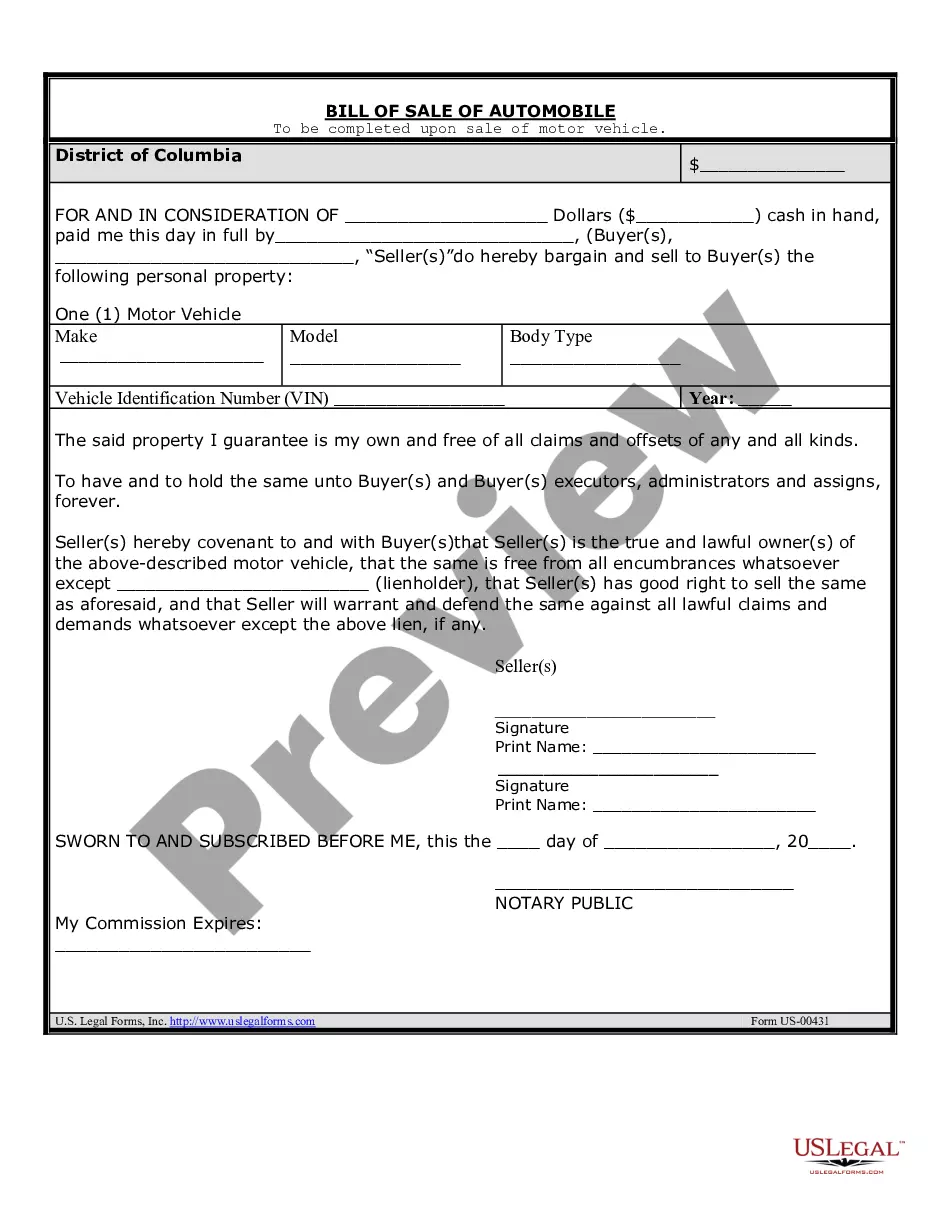
District of Columbia Bill of Sale of Automobile and Odometer Statement
Understanding this form
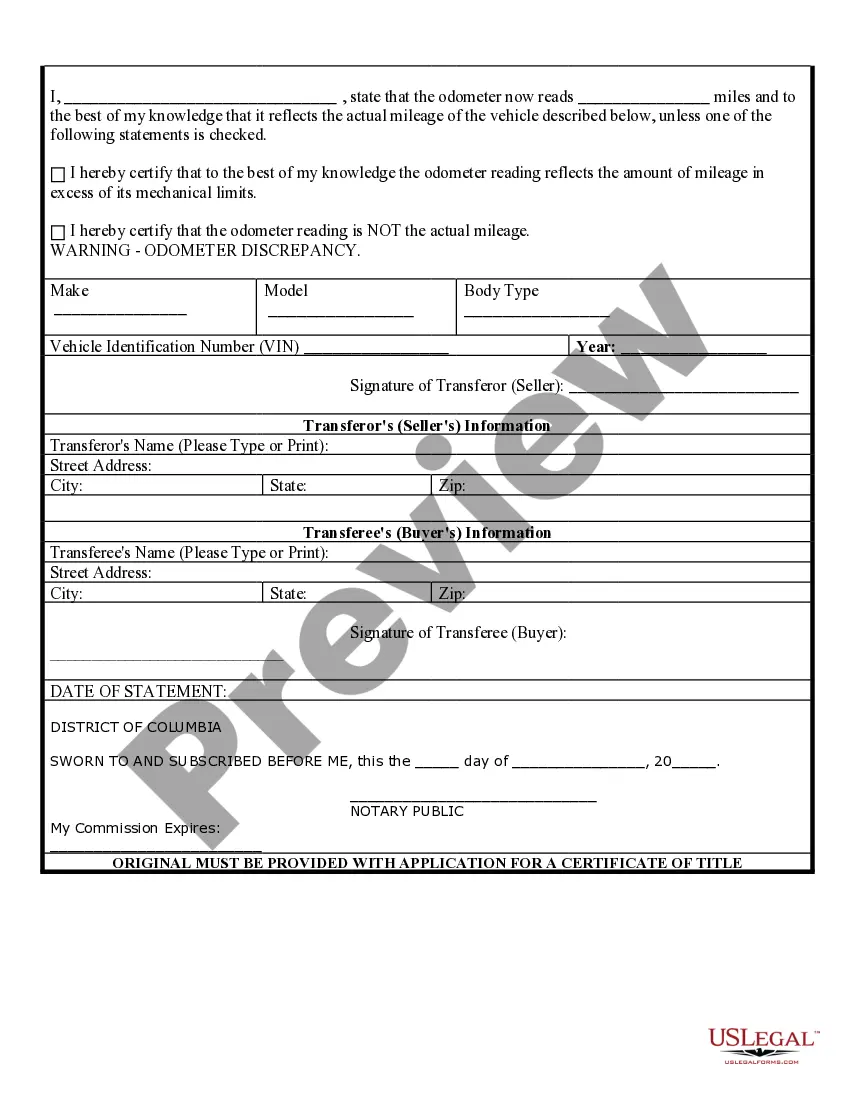
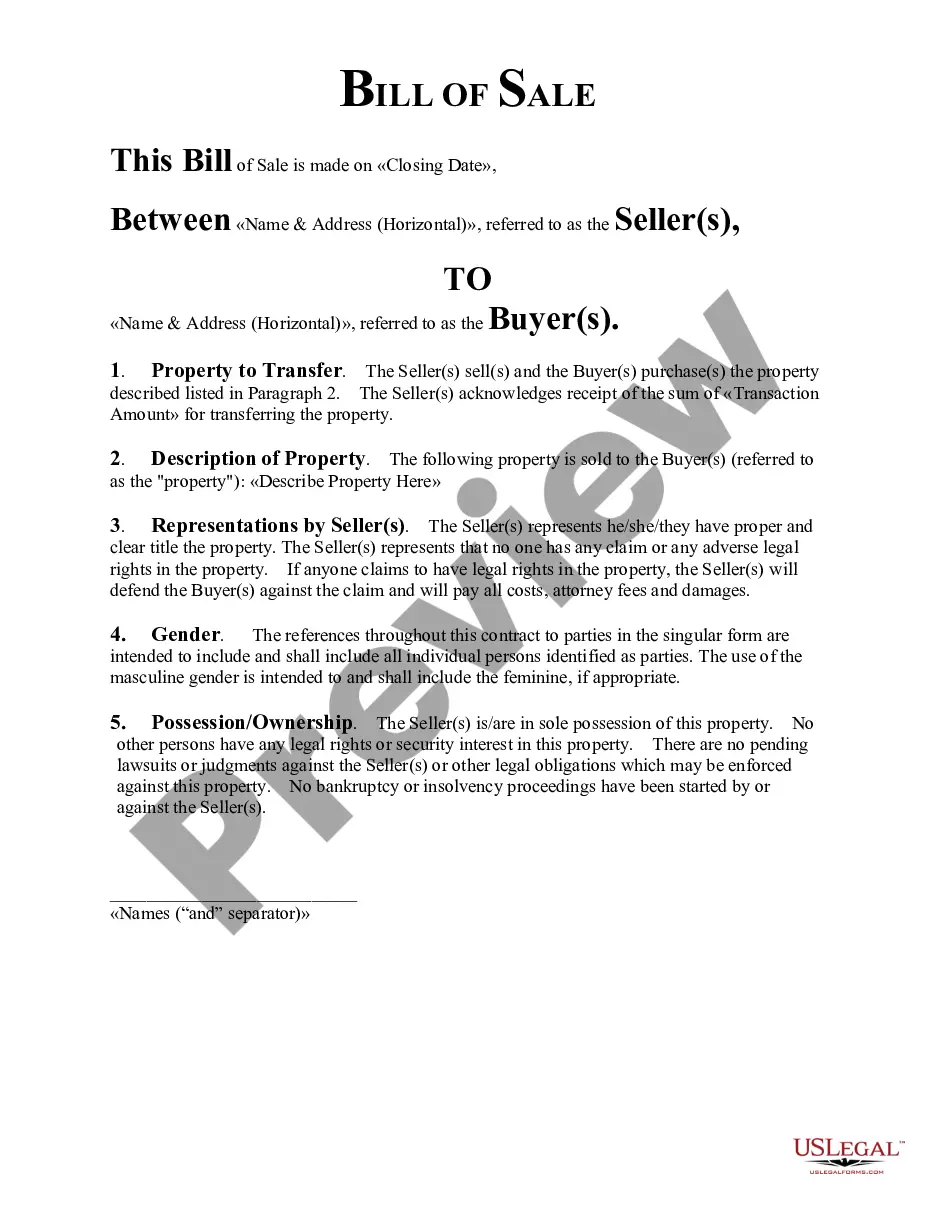
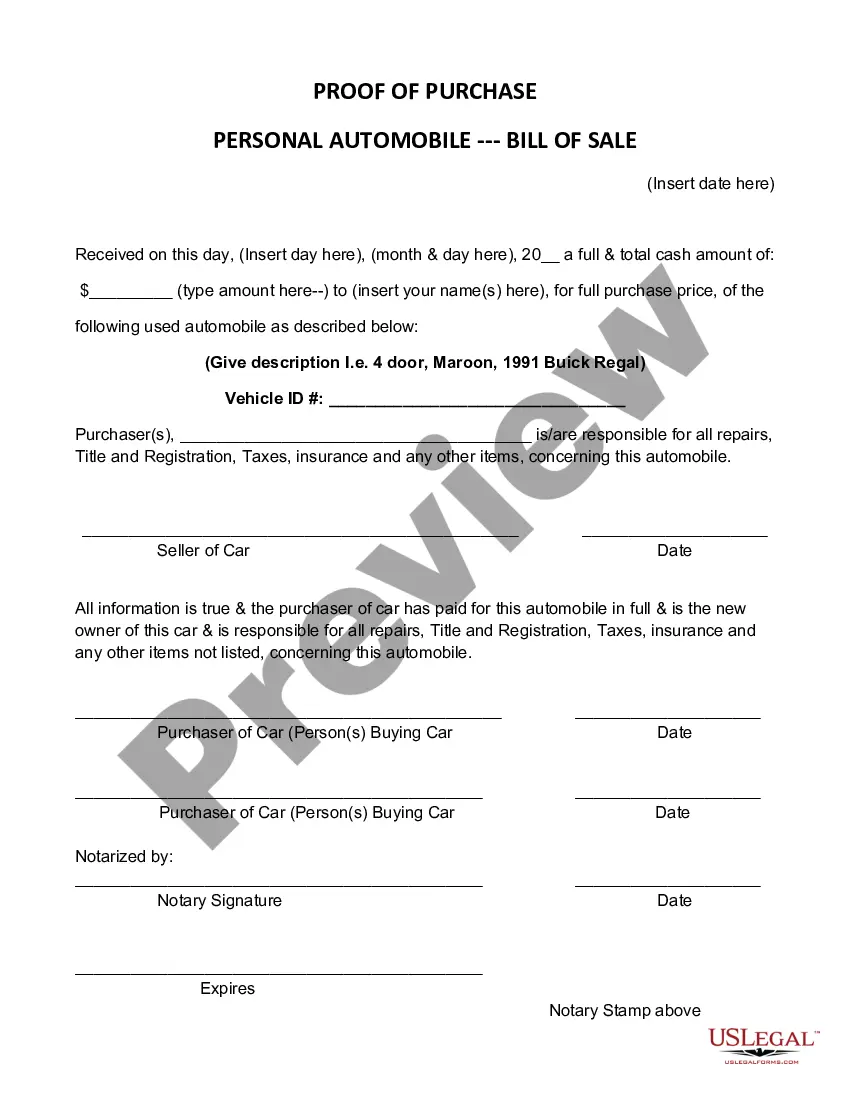
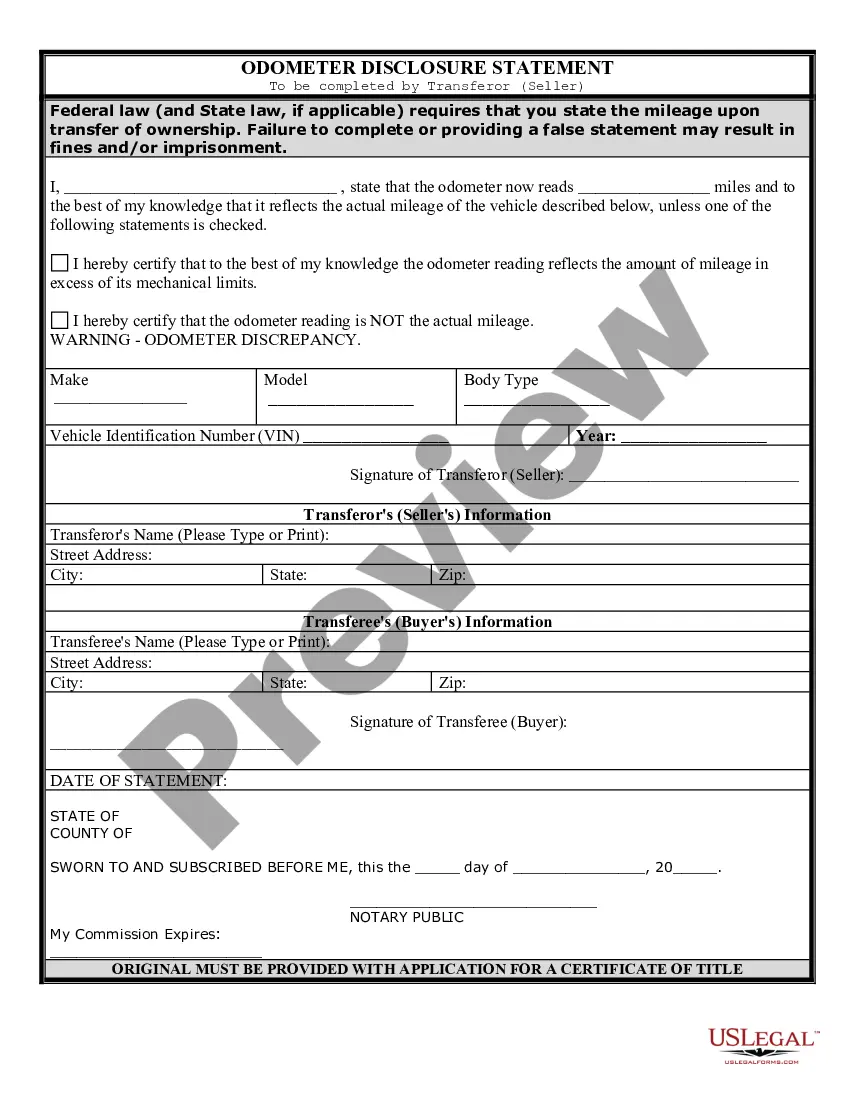
The Bill of Sale of Automobile and Odometer Statement is a legal document used to document the transfer of ownership of a motor vehicle from a seller to a buyer. This form ensures that the transaction is transparent and protects the rights of both parties. Unlike generic sales agreements, this form includes an Odometer Disclosure Statement required by federal law, making it essential for compliance and legitimacy in vehicle sales.
Key parts of this document
- Identification of the parties involved: buyer and seller details.
- Description of the vehicle: make, model, VIN, year, and body type.
- Sale consideration: purchase price of the vehicle.
- Guarantee of ownership: seller affirms they own the vehicle free of claims.
- Odometer Disclosure Statement: mandated information regarding the vehicle's mileage.
- Notary acknowledgment: verification of signatures by a notary public.
Common use cases
This form is needed whenever you are buying or selling a motor vehicle. It is commonly used in private sales, at dealerships, or when transferring ownership between family members. Use this Bill of Sale to ensure that both parties have a clear record of the transaction to avoid disputes in the future.
Who can use this document
- Individuals buying or selling a used automobile.
- Dealers involved in the sale of automobiles.
- Family members transferring ownership of a vehicle.
- Anyone needing to document the sale of a vehicle for legal or financial reasons.
How to prepare this document
- Identify the parties involved by entering the names and addresses of the seller and buyer.
- Provide the vehicle details including make, model, VIN, year, and body type.
- Specify the sale price in numeric and written formats.
- Sign the document in front of a notary public to authenticate the transaction.
- Complete the Odometer Disclosure Statement, ensuring accurate mileage reporting.
Notarization guidance
This document requires notarization to meet legal standards. US Legal Forms provides secure online notarization powered by Notarize, allowing you to complete the process through a verified video call, available 24/7.
Get your form ready online
Our built-in tools help you complete, sign, share, and store your documents in one place.
Make edits, fill in missing information, and update formatting in US Legal Forms—just like you would in MS Word.
Download a copy, print it, send it by email, or mail it via USPS—whatever works best for your next step.
Sign and collect signatures with our SignNow integration. Send to multiple recipients, set reminders, and more. Go Premium to unlock E-Sign.
If this form requires notarization, complete it online through a secure video call—no need to meet a notary in person or wait for an appointment.
We protect your documents and personal data by following strict security and privacy standards.

Make edits, fill in missing information, and update formatting in US Legal Forms—just like you would in MS Word.

Download a copy, print it, send it by email, or mail it via USPS—whatever works best for your next step.

Sign and collect signatures with our SignNow integration. Send to multiple recipients, set reminders, and more. Go Premium to unlock E-Sign.

If this form requires notarization, complete it online through a secure video call—no need to meet a notary in person or wait for an appointment.

We protect your documents and personal data by following strict security and privacy standards.
Typical mistakes to avoid
- Failing to include accurate details of the vehicle, particularly the VIN.
- Not completing the Odometer Disclosure Statement correctly.
- Omitting signatures from both the buyer and seller.
- Not having the document notarized when required.
Advantages of online completion
- Convenient access to professionally drafted templates available for download.
- Editable fields allow for customized agreements suitable for specific transactions.
- Reliable format that meets legal standards for motor vehicle sales.
Looking for another form?





Form popularity
FAQ
Yes, you can use a bill of sale if you do not have a title. The District of Columbia Bill of Sale of Automobile and Odometer Statement is designed to support your transaction and prove ownership, even without the title. Make sure to include all relevant details about the vehicle and both parties' information to ensure the document's validity.
While the West Virginia Department of Motor Vehicles (WV DMV) does not always require a bill of sale for vehicle registrations, it is often recommended for clarity during transactions. Similar to the District of Columbia Bill of Sale of Automobile and Odometer Statement, having this document can simplify the transfer of ownership and can help clarify any issues that might arise during the registration process.
To write a bill of sale without the title, you can include essential details such as the vehicle identification number (VIN), a description of the vehicle, and the names of both parties involved. The District of Columbia Bill of Sale of Automobile and Odometer Statement allows you to document the sale and can be used as a temporary proof of ownership until the title is obtained. Make sure both parties sign the bill to validate the transaction.
In the District of Columbia, a bill of sale is not strictly required for every vehicle transaction. However, having a District of Columbia Bill of Sale of Automobile and Odometer Statement can provide clear evidence of the sale, protecting both the buyer and seller. Additionally, it helps in the registration process and transfers of ownership, making it a beneficial document in most situations.
Unfortunately, some dealers attempt to manipulate odometers, although it is illegal and unethical. Such practices can lead to serious legal consequences for the dealer. Always ensure you have a clear record of the vehicle's mileage, which should accurately reflect on the District of Columbia Bill of Sale of Automobile and Odometer Statement. This protects you as a buyer.
Yes, odometer rollback is considered a felony and is treated seriously under the law. This practice involves intentionally altering or tampering with an odometer to display less mileage than has actually occurred. When preparing a District of Columbia Bill of Sale of Automobile and Odometer Statement, maintaining honest and accurate mileage disclosures is crucial to avoid legal issues.
In Washington, D.C., to verify odometer mileage, obtain a vehicle history report using the Vehicle Identification Number (VIN). This report provides detailed information, including past mileages at various points. Ensuring you document the odometer reading on your District of Columbia Bill of Sale of Automobile and Odometer Statement can protect you in case of future disputes.
To verify an odometer, you can check vehicle history reports through services like Carfax or AutoCheck that often include mileage records. Typing the vehicle's VIN into these databases will show you any discrepancies or potential odometer issues. When completing a sale, ensure you include the verified mileage in the District of Columbia Bill of Sale of Automobile and Odometer Statement.
Checking mileage on an odometer involves simply reading the display on your dashboard. Make sure to do this before completing any sale of the vehicle. Record the exact mileage in the District of Columbia Bill of Sale of Automobile and Odometer Statement to ensure transparency and avoid potential disputes after the sale.
To ensure your odometer is accurate, routinely compare it to mileage records from previous services or maintenance. Regular checks with a trusted mechanic can also help identify any discrepancies. If you notice significant differences, you may need professional assistance to verify the odometer. Utilize the District of Columbia Bill of Sale of Automobile and Odometer Statement to document the current mileage during a sale.