Connecticut Warranty Deed from Individual to Trustees of Revocable Trust
What is this form?
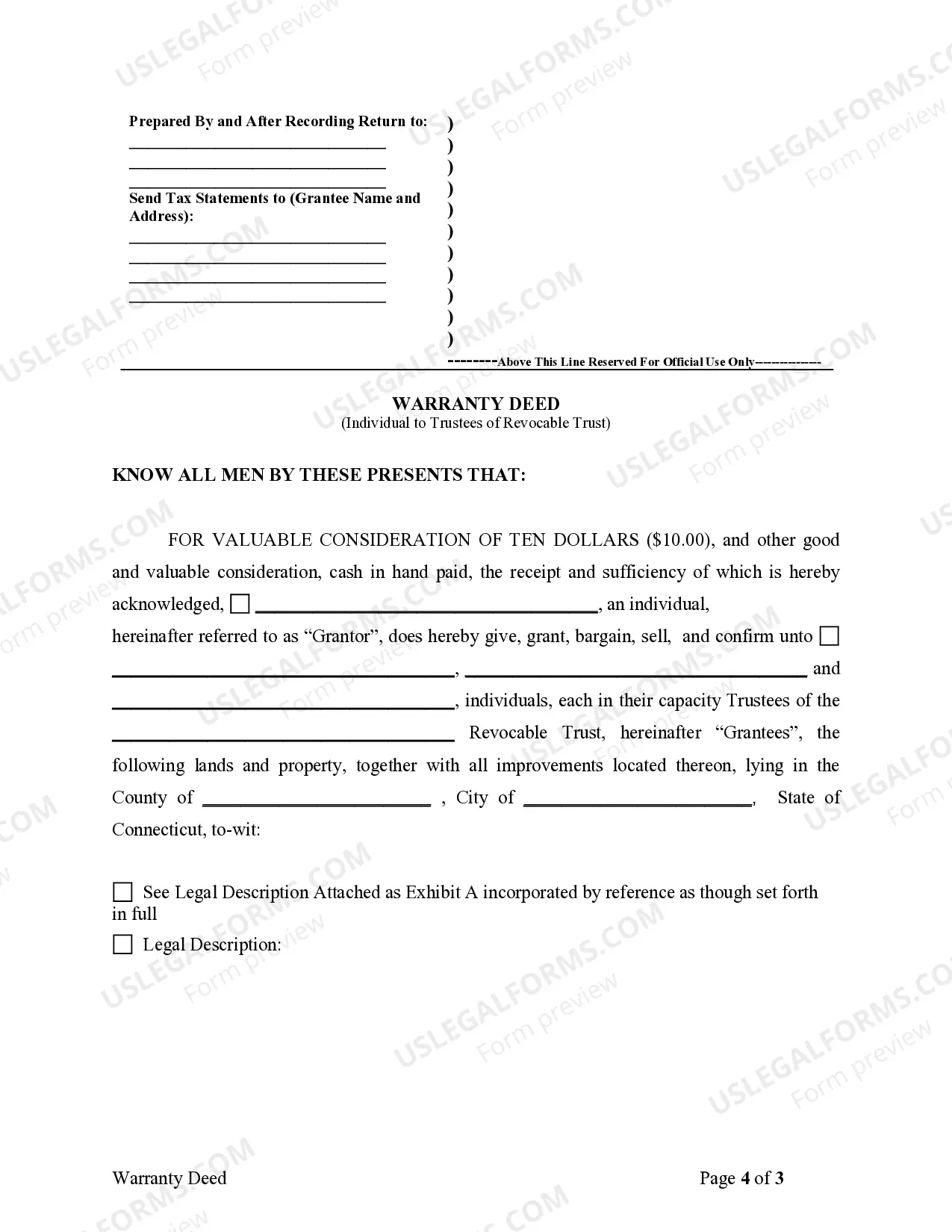
The Warranty Deed from Individual to Trustees of Revocable Trust is a legal document that facilitates the transfer of property from an individual (grantor) to trustees representing a revocable trust (grantees). This form ensures that the property is conveyed with a warranty, meaning that the grantor guarantees clear title to the property, free of any claims or encumbrances. Unlike other property transfer documents, this specific deed offers protection for the grantees against potential title issues, making it a reliable choice for those looking to transfer property to a trust structure.
What’s included in this form
- Identification of the grantor and grantees, including their roles in the transaction.
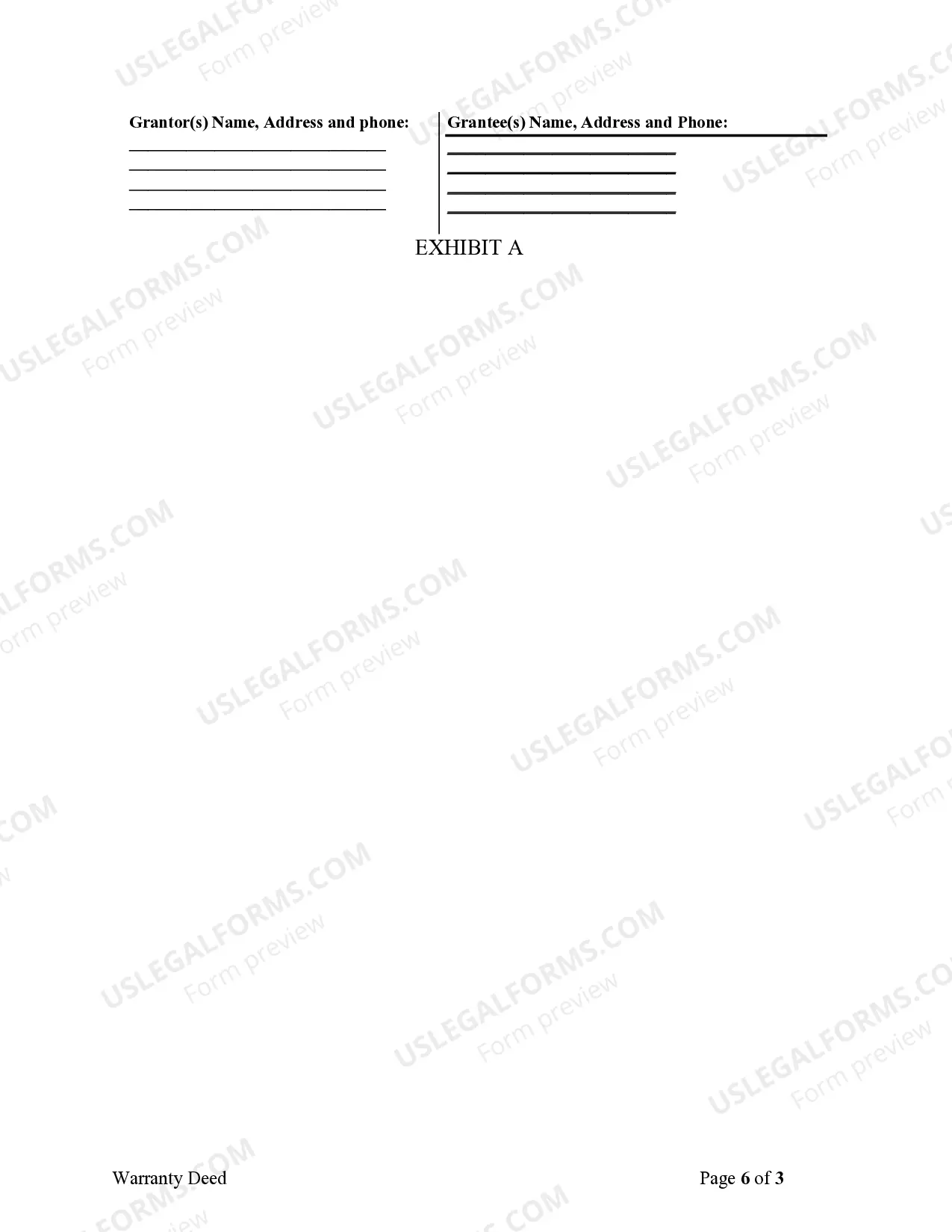
- A legal description of the property being transferred, typically included as an attachment.
- Language confirming that the grantor is providing a warranty of clear title.
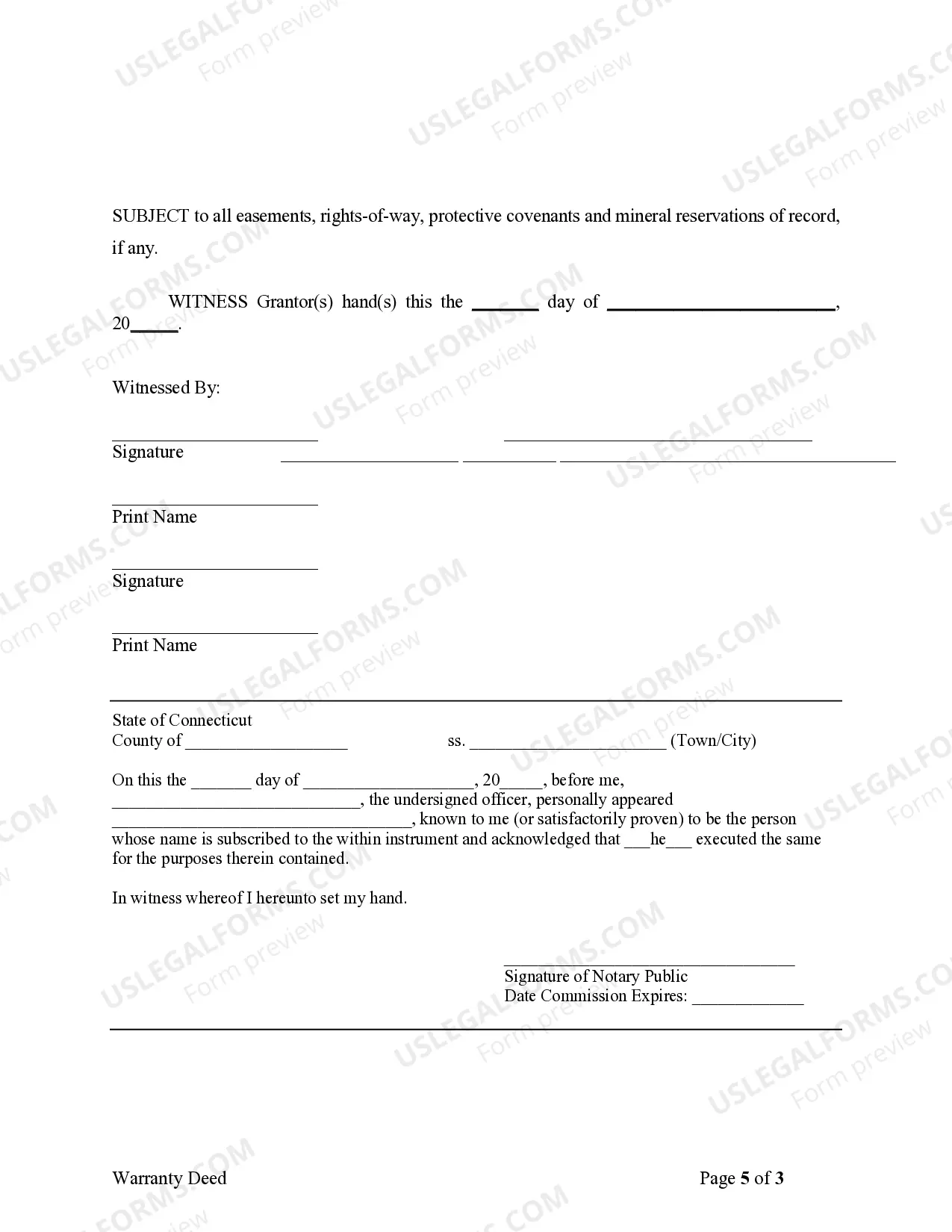
- Signatures of the grantor and a notary public, which may be required for validation.
- Information about the tax statements and where they should be sent.





When to use this document
This form should be used when an individual wishes to transfer real estate property to trustees of a revocable trust. Common scenarios include estate planning where property is placed in a trust for the benefit of the grantorâs family or as part of a larger asset management strategy. It is particularly useful when the grantor wants to ensure that the property is managed according to their wishes after their passing.
Intended users of this form
- Individuals who are transferring property to a revocable trust.
- Property owners looking to establish clear title protection for the trustees of the trust.
- Estate planners seeking to securely convey real estate as part of their overall asset management plans.
Instructions for completing this form
- Identify the parties involved, entering the grantor's information first, followed by the trustees' names.
- Provide a detailed legal description of the property being transferred, which can be attached as Exhibit A.
- Insert the date and sign the document in the designated areas for the grantor.
- Have the document notarized by a qualified notary public to ensure its validity.
- Complete any remaining information regarding tax statements and the grantees' contact details.
Does this form need to be notarized?
Yes, this form must be notarized to be legally valid. Notarization adds an additional layer of verification, ensuring that the identities of the parties involved are confirmed. If you use US Legal Forms, you can take advantage of their integrated online notarization service, available 24/7 through secure video calls, making it easy to get your document notarized without the need for travel.
Get your form ready online
Our built-in tools help you complete, sign, share, and store your documents in one place.
Make edits, fill in missing information, and update formatting in US Legal Forms—just like you would in MS Word.
Download a copy, print it, send it by email, or mail it via USPS—whatever works best for your next step.
Sign and collect signatures with our SignNow integration. Send to multiple recipients, set reminders, and more. Go Premium to unlock E-Sign.
If this form requires notarization, complete it online through a secure video call—no need to meet a notary in person or wait for an appointment.
We protect your documents and personal data by following strict security and privacy standards.

Make edits, fill in missing information, and update formatting in US Legal Forms—just like you would in MS Word.

Download a copy, print it, send it by email, or mail it via USPS—whatever works best for your next step.

Sign and collect signatures with our SignNow integration. Send to multiple recipients, set reminders, and more. Go Premium to unlock E-Sign.

If this form requires notarization, complete it online through a secure video call—no need to meet a notary in person or wait for an appointment.

We protect your documents and personal data by following strict security and privacy standards.
Common mistakes
- Failing to include a complete and accurate legal description of the property.
- Not having the form notarized, which could render it invalid.
- Incorrectly filling out the names and addresses of grantor and grantees.
Why use this form online
- Easy access to legal forms that are prepared by licensed attorneys.
- Ability to fill in the form directly on your computer, minimizing errors.
- Convenience of downloading and printing the form from home.
Looking for another form?


Form popularity
FAQ
Transferring property to a trust provides numerous benefits, such as avoiding probate and ensuring privacy regarding your estate. When you use a Connecticut Warranty Deed from Individual to Trustees of Revocable Trust, you can streamline the management of your assets while planning for the future. This strategy helps protect your property and simplifies wealth transfer to your heirs, ensuring your intentions are honored.
Yes, putting your house in a trust can help manage tax implications effectively. By utilizing a Connecticut Warranty Deed from Individual to Trustees of Revocable Trust, you can gain certain tax benefits while ensuring your property is appropriately handled during your lifetime. This approach also allows you to maintain control over the property, making it easier to transfer wealth to your beneficiaries.
To avoid paying capital gains tax on an inherited property transferred to a trust, consider using a Connecticut Warranty Deed from Individual to Trustees of Revocable Trust. This method facilitates a step-up in basis for the property, meaning you may not owe any tax when the property is sold. By placing the property in a trust, you can effectively manage its value and protect it during your lifetime.
Yes, a trustee can give a warranty deed, as they act on behalf of the trust. When property is transferred under a revocable trust, the trustee holds the authority to execute a Connecticut Warranty Deed from Individual to Trustees of Revocable Trust, thereby ensuring that the specified property is conveyed with proper legal protections in place. This action safeguards the interests of the beneficiaries involved.
The choice between a quitclaim deed and a trust depends on your specific needs. A quitclaim deed transfers ownership without guarantees, which may leave you exposed to risks. On the other hand, a revocable trust, especially via a Connecticut Warranty Deed from Individual to Trustees of Revocable Trust, offers more robust protection and management of your assets, retaining control as the trust grantor.
A warranty deed is typically created by the seller of the property, who might also be the trustee in the case of a revocable trust. The process involves drafting the deed with the necessary legal descriptions and terms, often with the assistance of legal professionals. Tools available on platforms like US Legal Forms can simplify creating a Connecticut Warranty Deed from Individual to Trustees of Revocable Trust, ensuring accuracy and compliance.
The grantor, or the individual who creates the trust, selects the trustee in a deed of trust. This can be a family member, friend, or a professional entity capable of managing the trust assets. It is important to choose a reliable trustee, as they hold significant responsibility over the management and transfer of property through a Connecticut Warranty Deed from Individual to Trustees of Revocable Trust.
A warranty deed can be issued by the current property owner, which might include an individual or an authorized trustee. In the context of a Connecticut Warranty Deed from Individual to Trustees of Revocable Trust, the individual transferor must be the grantor of the revocable trust. The deed ensures that the property title is clear and legitimate, protecting all parties involved in the transaction.
Yes, a revocable trust can be transferred. The grantor, who is the individual establishing the trust, retains the right to change or revoke the trust during their lifetime. Therefore, by executing a Connecticut Warranty Deed from Individual to Trustees of Revocable Trust, the ownership of the property can be easily transferred to the trustees, ensuring flexibility in managing your assets.
Not everyone can be a trustee on a deed of trust, as specific eligibility requirements exist. Generally, a trustee must be an adult who is legally capable of managing financial matters. When creating a Connecticut Warranty Deed from Individual to Trustees of Revocable Trust, you should ensure that the chosen trustee meets these requirements to avoid complications.