Arkansas Quitclaim Deed from Individual to Corporation
About this form
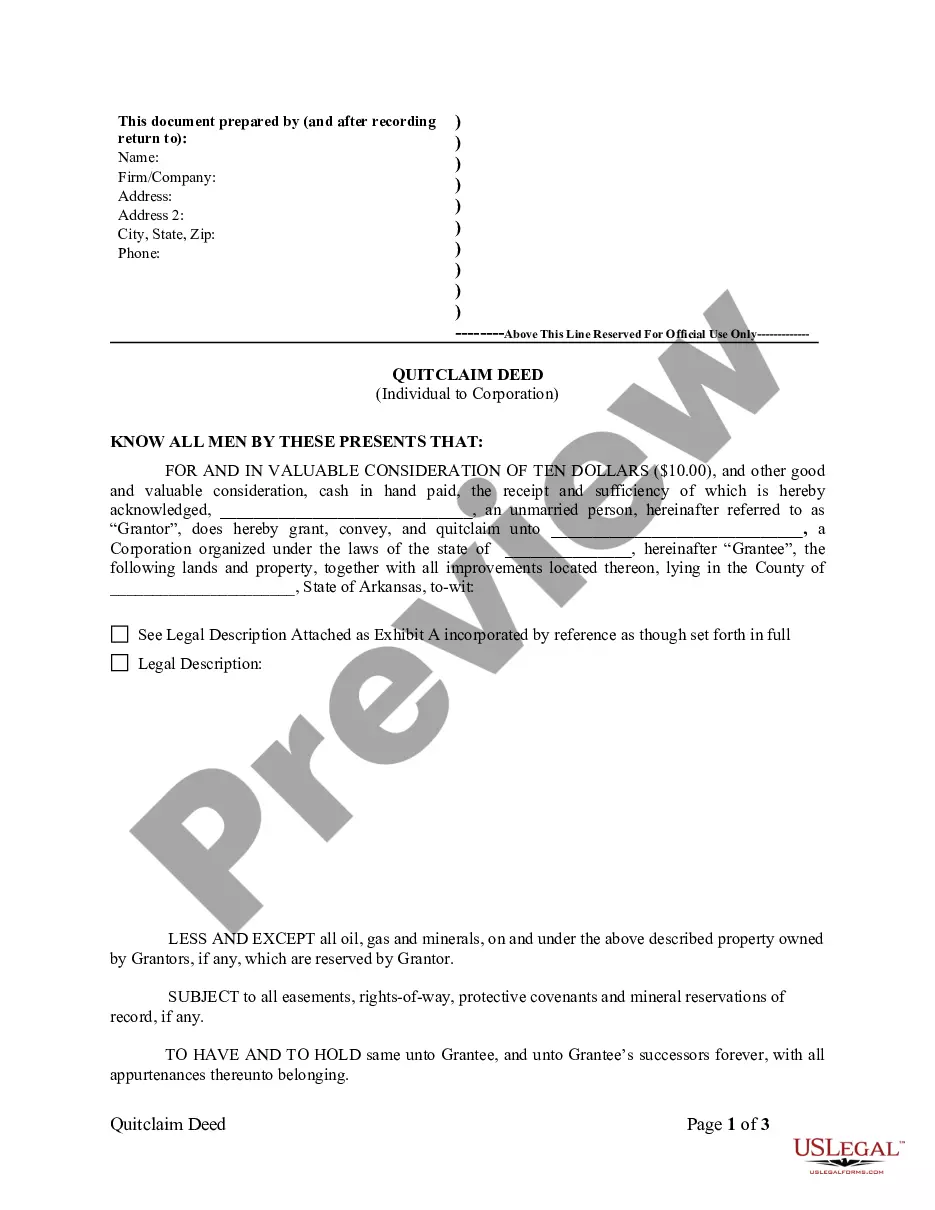
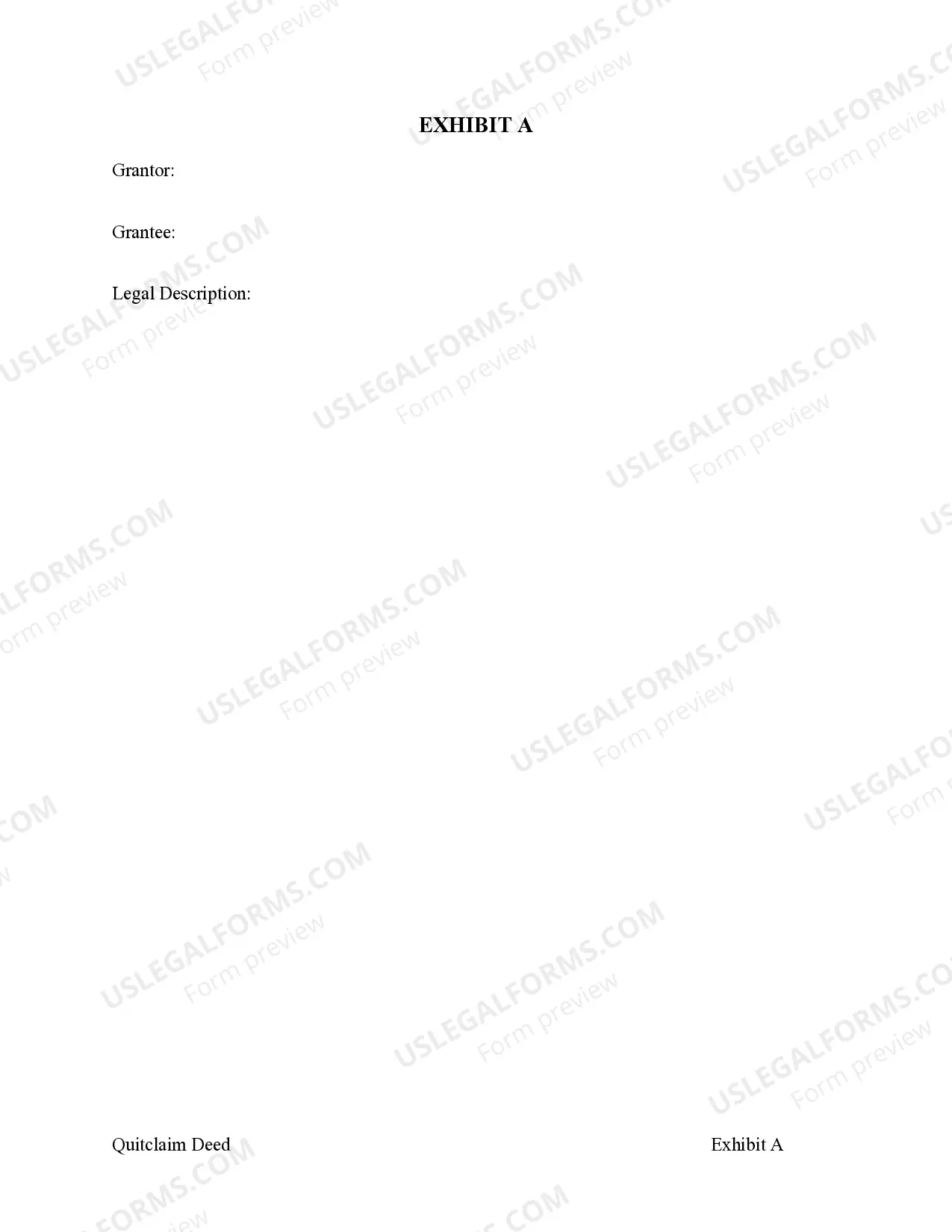
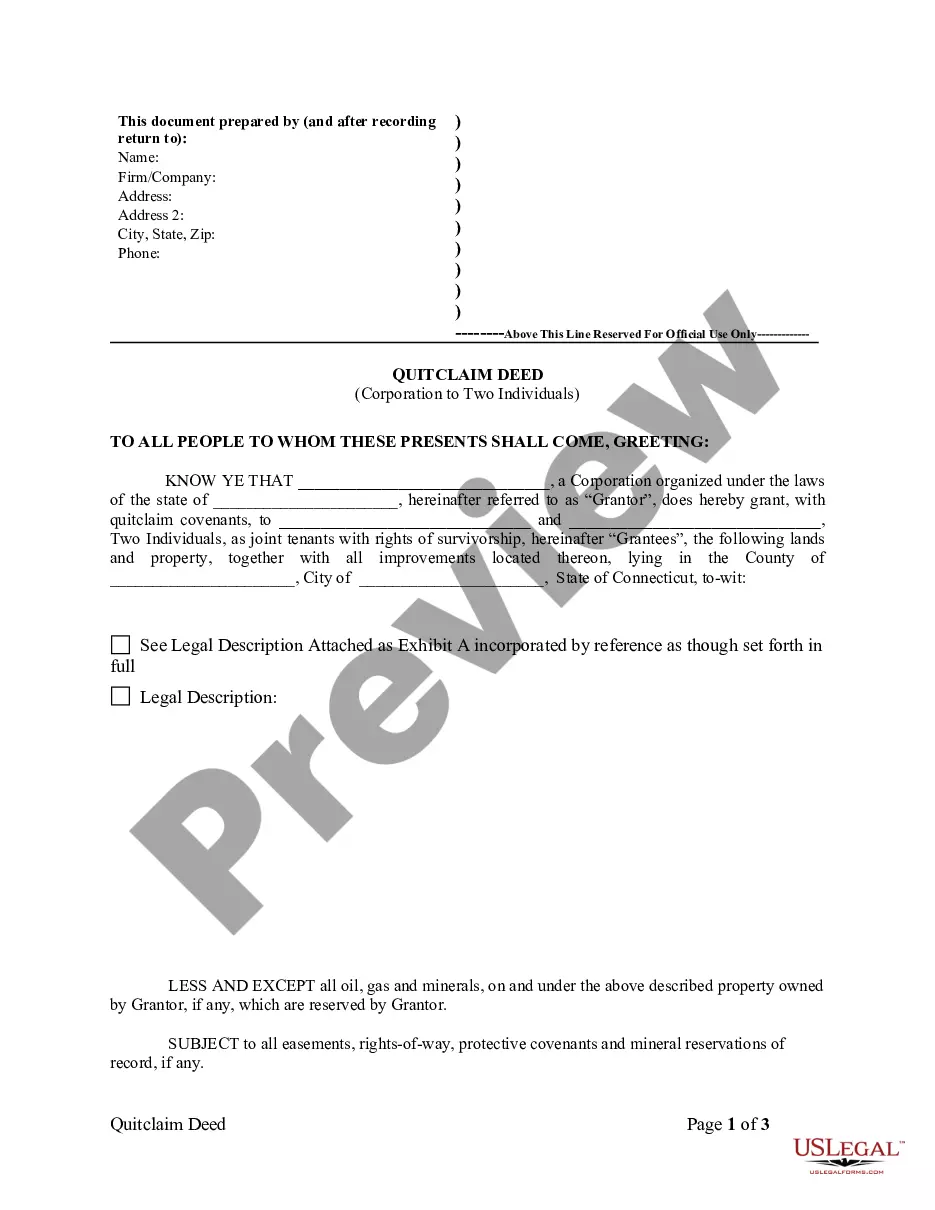
The Quitclaim Deed from Individual to Corporation is a legal document used to transfer property ownership from an individual (the grantor) to a corporation (the grantee). Unlike a warranty deed, which provides guarantees about the title, a quitclaim deed offers no warranties and simply conveys the grantor's interest in the property. This type of deed is commonly used when the transfer is between parties who know each other, such as a sale to a corporation owned by the grantor.
Key components of this form
- Identification of the grantor and grantee, including names and addresses.
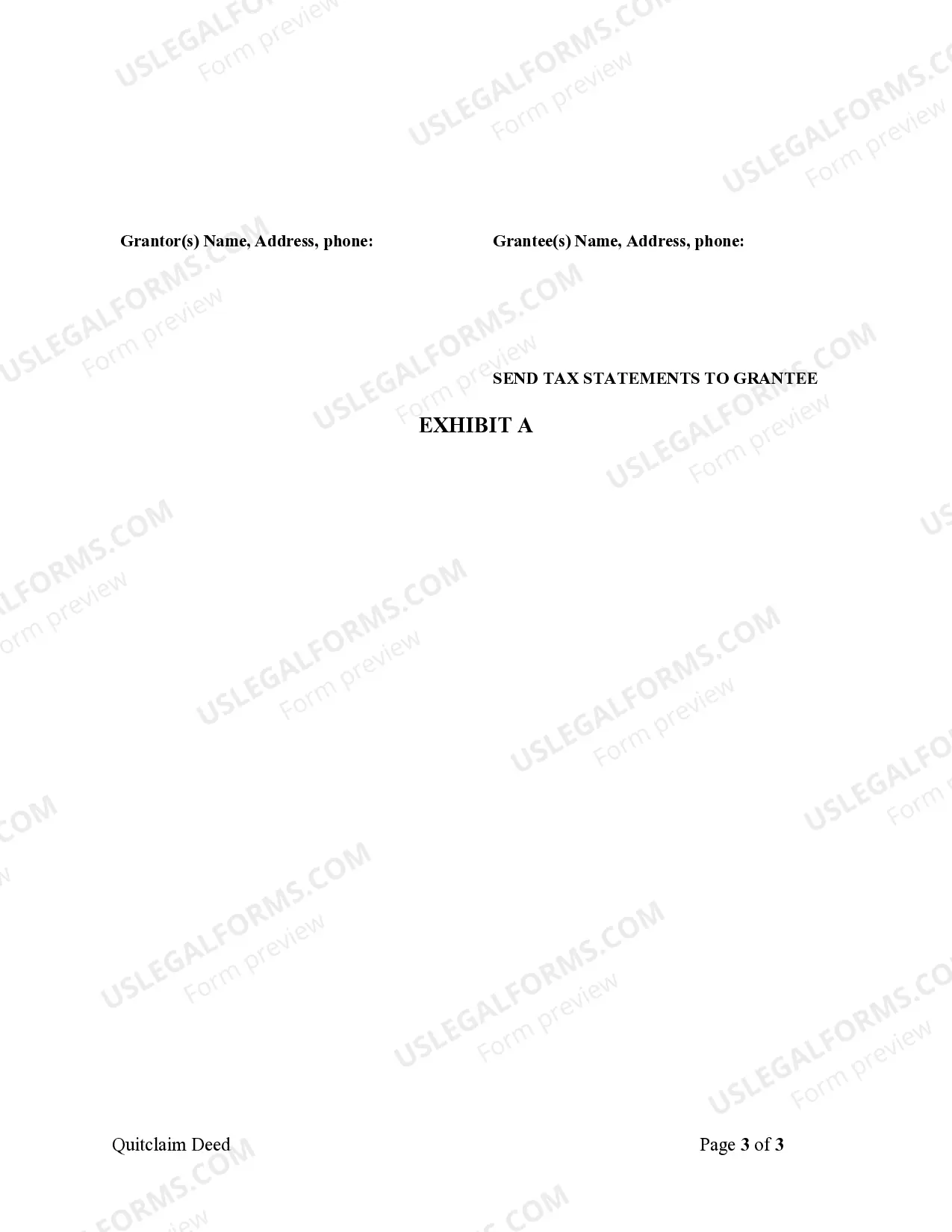
- Legal description of the property being transferred.
- Special reservations, such as the exclusion of oil, gas, and minerals from the grant.
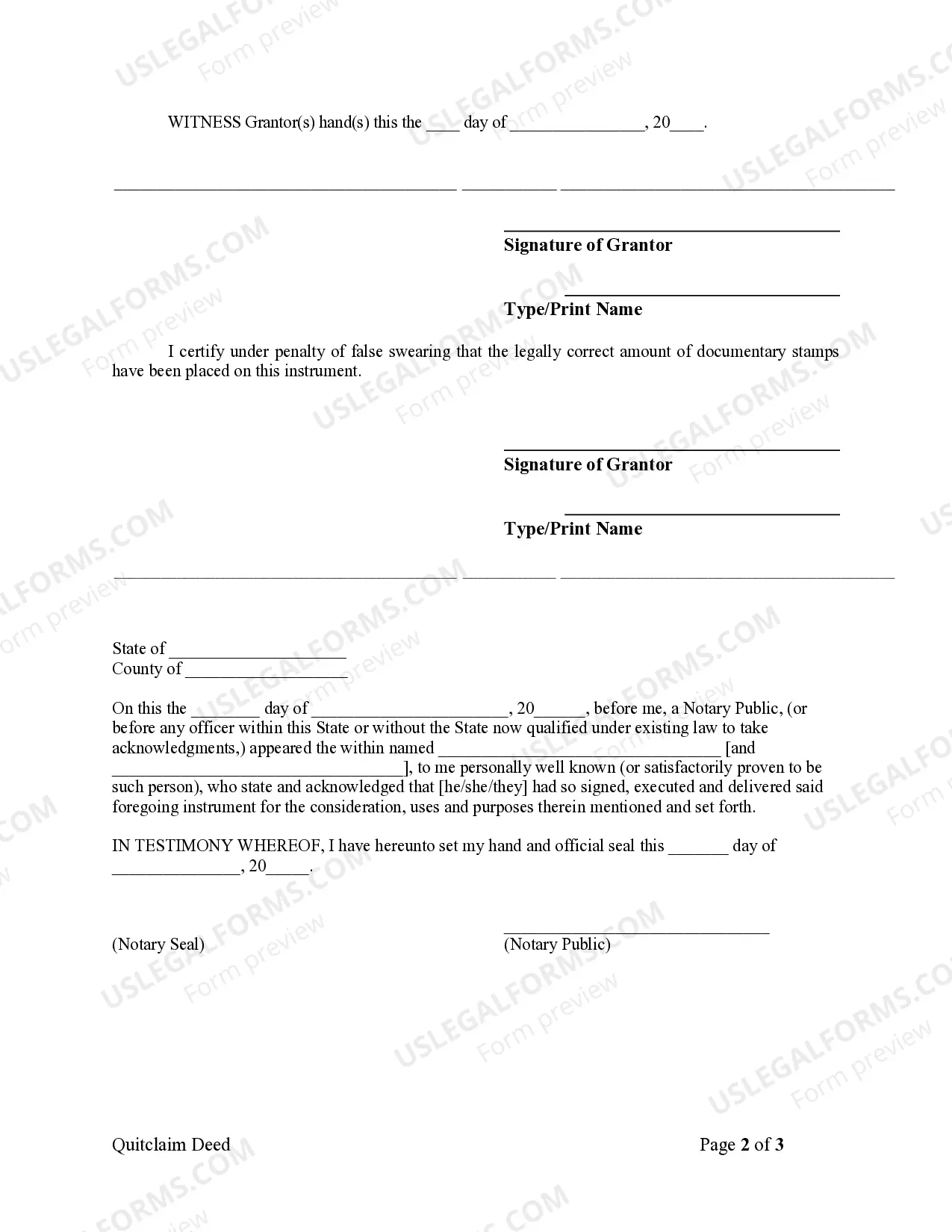
- Signature line for the grantor, including space for the date of execution.


When to use this document
This form is used when an individual wants to transfer real estate ownership to a corporation, often for the purpose of business operations or asset management. It is suitable in situations such as transferring personal investment properties to a newly formed company or when an individual seeks to formalize an ownership change related to a business venture.
Who this form is for
- Individuals transferring property to their own corporation.
- Business owners or partners who wish to simplify property ownership within their corporate structure.
- Parties engaging in property transactions where formal warranties are not necessary.
How to complete this form
- Identify the grantor and grantee, ensuring accurate names and addresses are included.
- Provide a legal description of the property, detailing its boundaries and location.
- List any reservations concerning the property, such as the exclusion of resources like oil and gas.
- Have the grantor sign and date the deed to finalize the transfer.
- Consider having the deed notarized to enhance its legality and acceptance.
Notarization requirements for this form
This form must be notarized to be legally valid. US Legal Forms provides secure online notarization powered by Notarize, allowing you to complete the process through a verified video call.
Get your form ready online
Our built-in tools help you complete, sign, share, and store your documents in one place.
Make edits, fill in missing information, and update formatting in US Legal Forms—just like you would in MS Word.
Download a copy, print it, send it by email, or mail it via USPS—whatever works best for your next step.
Sign and collect signatures with our SignNow integration. Send to multiple recipients, set reminders, and more. Go Premium to unlock E-Sign.
If this form requires notarization, complete it online through a secure video call—no need to meet a notary in person or wait for an appointment.
We protect your documents and personal data by following strict security and privacy standards.

Make edits, fill in missing information, and update formatting in US Legal Forms—just like you would in MS Word.

Download a copy, print it, send it by email, or mail it via USPS—whatever works best for your next step.

Sign and collect signatures with our SignNow integration. Send to multiple recipients, set reminders, and more. Go Premium to unlock E-Sign.

If this form requires notarization, complete it online through a secure video call—no need to meet a notary in person or wait for an appointment.

We protect your documents and personal data by following strict security and privacy standards.
Common mistakes to avoid
- Failing to provide a complete legal description of the property.
- Not including necessary reservations when transferring property with exclusions.
- Neglecting to sign and date the document properly.
Why complete this form online
- Convenient access to downloadable forms, saving time and effort.
- Editability allows for quick adjustments tailored to specific transactions.
- Reliability from templates drafted by licensed attorneys, ensuring compliance with legal standards.
Looking for another form?
Form popularity
FAQ
When a corporation transfers ownership of property, the deed must be signed by a corporate officer authorized to act on behalf of the corporation, typically according to the corporation's bylaws. Ensuring that the Arkansas Quitclaim Deed from Individual to Corporation is properly signed guarantees the validity of the ownership transfer. Furthermore, notary acknowledgment is required to finalize the deed.
One major disadvantage of placing property in an LLC is the potential for increased costs, such as formation fees, annual maintenance, and potential tax implications. Additionally, financing options may be limited, as some lenders may be hesitant to provide loans to an LLC. Understanding these factors is crucial when considering an Arkansas Quitclaim Deed from Individual to Corporation.
To transfer a deed to an LLC in Arkansas, you fill out an Arkansas Quitclaim Deed from Individual to Corporation, which clearly identifies the property and the new owner as the LLC. The owner must sign the deed with a notary present to ensure it is legally binding. Finally, you should file the executed deed with the county recorder to finalize the transfer.
In Arkansas, a valid quit claim deed must include the names of the grantor (person transferring the property) and grantee (new owner), a property description, and the date of transfer. Additionally, both parties need to sign the deed, have it notarized, and record it with the county clerk. Utilizing an Arkansas Quitclaim Deed from Individual to Corporation can simplify the transfer process significantly.
Many individuals place their property in an LLC to protect personal assets from liability and to simplify property management. An LLC also can provide tax advantages, as income and losses can pass through to individual members. The Arkansas Quitclaim Deed from Individual to Corporation becomes a key document in this process, as it officially transfers ownership to the LLC.
A quit claim deed can be voided if it lacks the necessary elements for validity, such as signatures, notarization, or a proper description of the property. Additionally, if the property is sold or another deed is executed after the Arkansas Quitclaim Deed from Individual to Corporation, the initial deed may become invalid. Lastly, fraud or a mistake in the deed’s execution can also void it.
In general, a deed for an LLC must be signed by a member or manager who is authorized to act on behalf of the company. This ensures that the Arkansas Quitclaim Deed from Individual to Corporation has the proper authority behind it. It's important to check the LLC's operating agreement for specific signing requirements.
To transfer property using an Arkansas Quitclaim Deed from Individual to Corporation, the current owner must complete the deed form, including the property description and the recipient's information as the LLC. Both parties need to sign the deed, and it must be notarized. After completing these steps, you should file the deed with the local county recorder for it to be legally recognized.
Yes, you can change a quitclaim deed, but the process involves creating a new deed to replace the original. This includes making necessary modifications to reflect new parties or updated property details. Because the Arkansas Quitclaim Deed from Individual to Corporation entails legal complexities, it is wise to seek assistance from legal professionals or platforms such as USLegalForms to ensure proper handling.
To obtain a quitclaim deed in Arkansas, you need to complete the required form, ensuring all information is accurate. You may find these forms on various online legal platforms, including USLegalForms, which simplifies the process significantly. After filling out the form, you must sign it in front of a notary public and then file it with the local county recorder.