Alabama Letter from Tenant to Landlord containing Request for permission to sublease
What is this form?
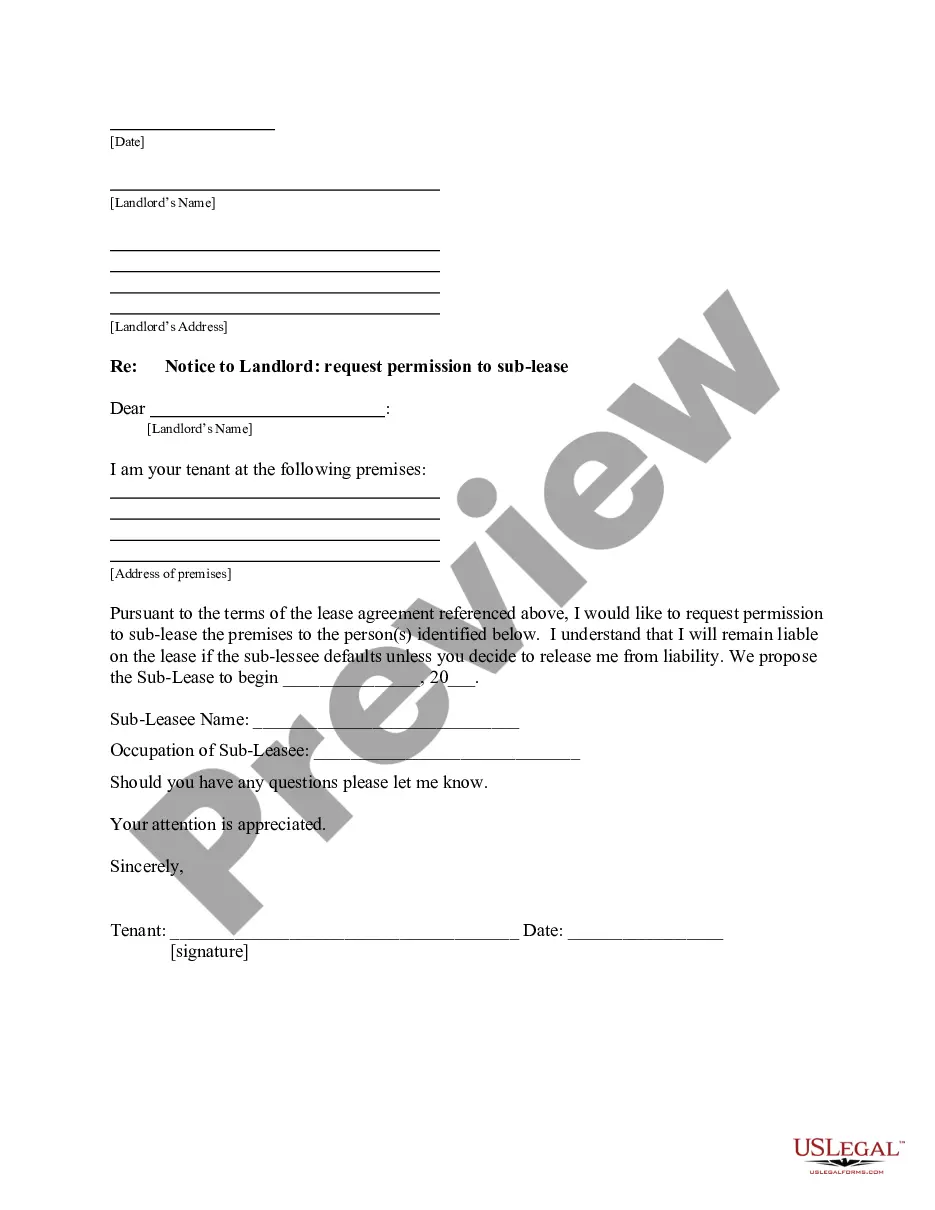
This Letter from Tenant to Landlord containing Request for Permission to Sublease is a formal communication from a tenant to their landlord. The purpose of this letter is to request the landlord's consent to sublease rental property to a specified subtenant. This form clarifies that the tenant will remain liable for the lease obligations unless the landlord agrees to relieve them of this responsibility. This form is crucial for tenants looking to ensure compliance with rental agreements while seeking to share their rental space with another occupant.
Form components explained
- Sub-Leasee name: The name of the person the tenant intends to sublease the property to.
- Occupation of Sub-Leasee: The job of the intended subtenant, which may be relevant for the landlordâs approval.
- Tenant's signature: A space for the tenant's signature to validate the request.
- Date: A field for the tenant to enter the signing date of the letter.
- Proof of delivery: Instructions for confirming that the landlord has received the request.

When to use this form
This form is necessary when a tenant wishes to sublet their rental unit and needs to formally request permission from their landlord. It is commonly used in situations where a tenant is either relocating temporarily or needs assistance with rent and is considering sharing the space with another qualified individual. The form establishes the tenant's intention and adherence to any agreements with their landlord regarding subleasing.
Who should use this form
- Current tenants looking to sublease their rental properties.
- Tenants who wish to comply with their lease requirements regarding subletting.
- Individuals intending to find a temporary occupant for their apartment or rental unit.
- Persons who want to clear any potential conflicts with their landlord's subleasing policies.
How to prepare this document
- Identify the subleasee: Enter the full legal name of the person to whom you intend to sublease the property.
- Specify the occupation: Fill in the occupation of the potential subtenant to provide the landlord with relevant information.
- Date the letter: Include the date you are submitting the request to the landlord.
- Sign the letter: Provide your signature to confirm the validity of the request.
- Deliver the letter: Follow the proof of delivery instructions to ensure the landlord receives the request.
Is notarization required?
This form does not typically require notarization unless specified by local law. It is important to check your local regulations to ensure compliance when submitting your request to the landlord.
Get your form ready online
Our built-in tools help you complete, sign, share, and store your documents in one place.
Make edits, fill in missing information, and update formatting in US Legal Forms—just like you would in MS Word.
Download a copy, print it, send it by email, or mail it via USPS—whatever works best for your next step.
Sign and collect signatures with our SignNow integration. Send to multiple recipients, set reminders, and more. Go Premium to unlock E-Sign.
If this form requires notarization, complete it online through a secure video call—no need to meet a notary in person or wait for an appointment.
We protect your documents and personal data by following strict security and privacy standards.

Make edits, fill in missing information, and update formatting in US Legal Forms—just like you would in MS Word.

Download a copy, print it, send it by email, or mail it via USPS—whatever works best for your next step.

Sign and collect signatures with our SignNow integration. Send to multiple recipients, set reminders, and more. Go Premium to unlock E-Sign.

If this form requires notarization, complete it online through a secure video call—no need to meet a notary in person or wait for an appointment.

We protect your documents and personal data by following strict security and privacy standards.
Mistakes to watch out for
- Failing to include the full legal name of the subleasee.
- Not signing or dating the letter, which can invalidate the request.
- Ignoring local regulations on subleasing, which might require additional documentation.
- Assuming verbal consent is enough; always use a written request.
Advantages of online completion
- Convenience: Easily download and complete the form at your convenience.
- Editability: Customize the document to fit your specific needs before submitting it.
- Reliability: Access professionally drafted templates that comply with legal standards.
Quick recap
- The letter is essential for tenants wishing to sublease their rental property legitimately.
- Clear information and a formal request can prevent disputes with the landlord.
- Local regulations may influence how this form should be completed.
Looking for another form?







Form popularity
FAQ
The form is a formal tenant-to-landlord communication asking for consent to sublease a rental unit to a specified subtenant. It clarifies that the tenant remains liable unless the landlord relieves them of responsibility. Use it when a tenant plans to sublet and wants to document the request, including the sub-leasee’s name, occupation, the tenant’s signature, date, and proof of delivery.
A consent to sublease is the landlord’s permission to allow a tenant to sublet the rental property. This Alabama form serves as the tenant’s written request for that consent and includes the sub-leasee’s name and occupation, as well as the tenant’s signature, date, and proof of delivery to document the submission.
The form provides a space for the tenant’s signature to submit the request and does not include a landlord signature field. Final permission to sublease comes from the landlord’s consent, which would be obtained separately after reviewing the request.
A landlord consent letter is a document seeking the landlord’s permission to sublease. This Alabama form serves that purpose by identifying the sub-leasee, noting their occupation, and capturing the tenant’s signature, date, and proof of delivery to formalize the request under Alabama leasing terms.
A landlord consent form records the landlord’s approval of a sublease. In this Alabama form, it functions as the tenant’s formal request for that consent, specifies the sub-leasee and their occupation, and includes the tenant’s signature, date, and proof of delivery to confirm the submission.
This form is a tenant-initiated request tailored to Alabama leases, designed to obtain the landlord’s consent and to clarify that the tenant remains liable unless relieved. A generic consent to sublease typically documents the landlord’s grant of permission rather than initiating the request itself, and may not include Alabama-specific language or delivery proof fields.