Texas Partial Release of Property From Deed of Trust for Corporation
What this document covers
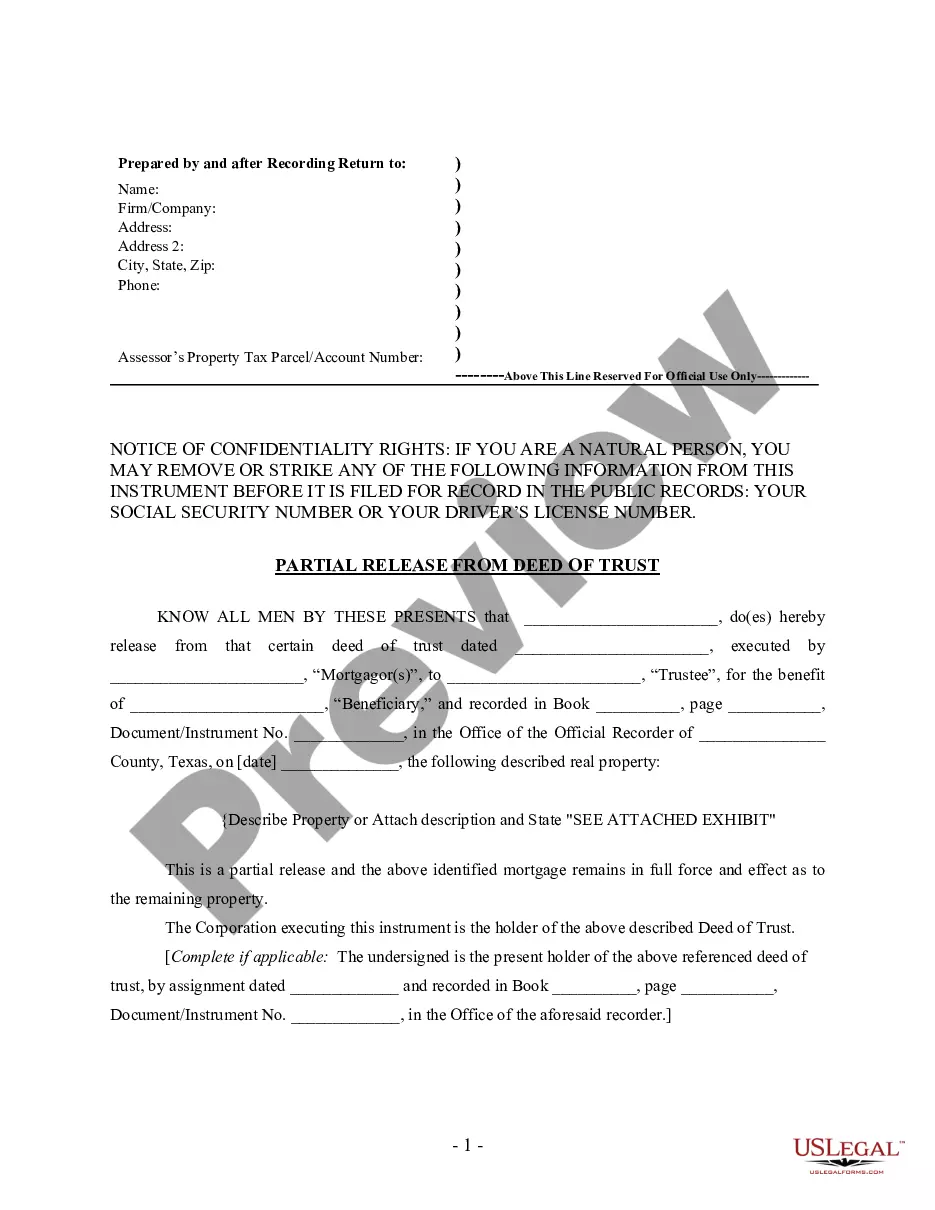
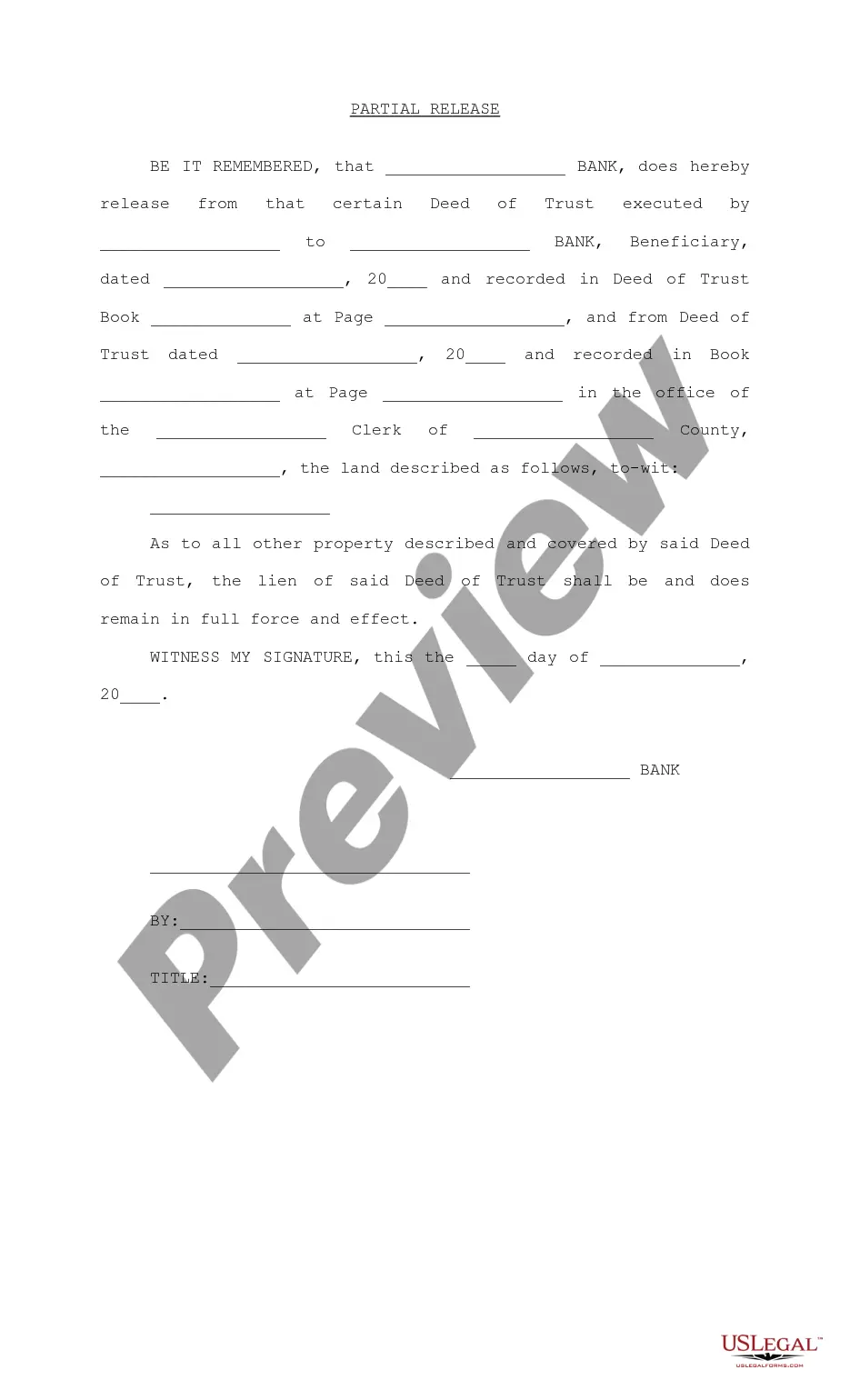
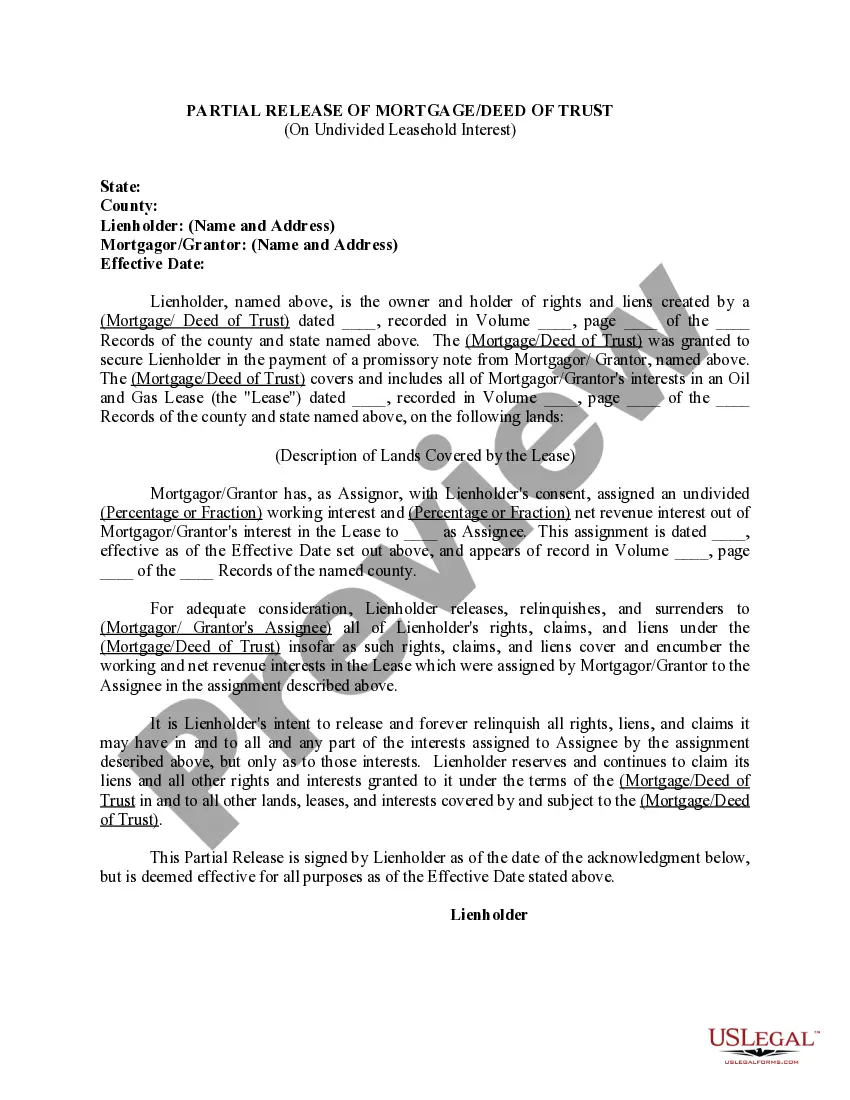
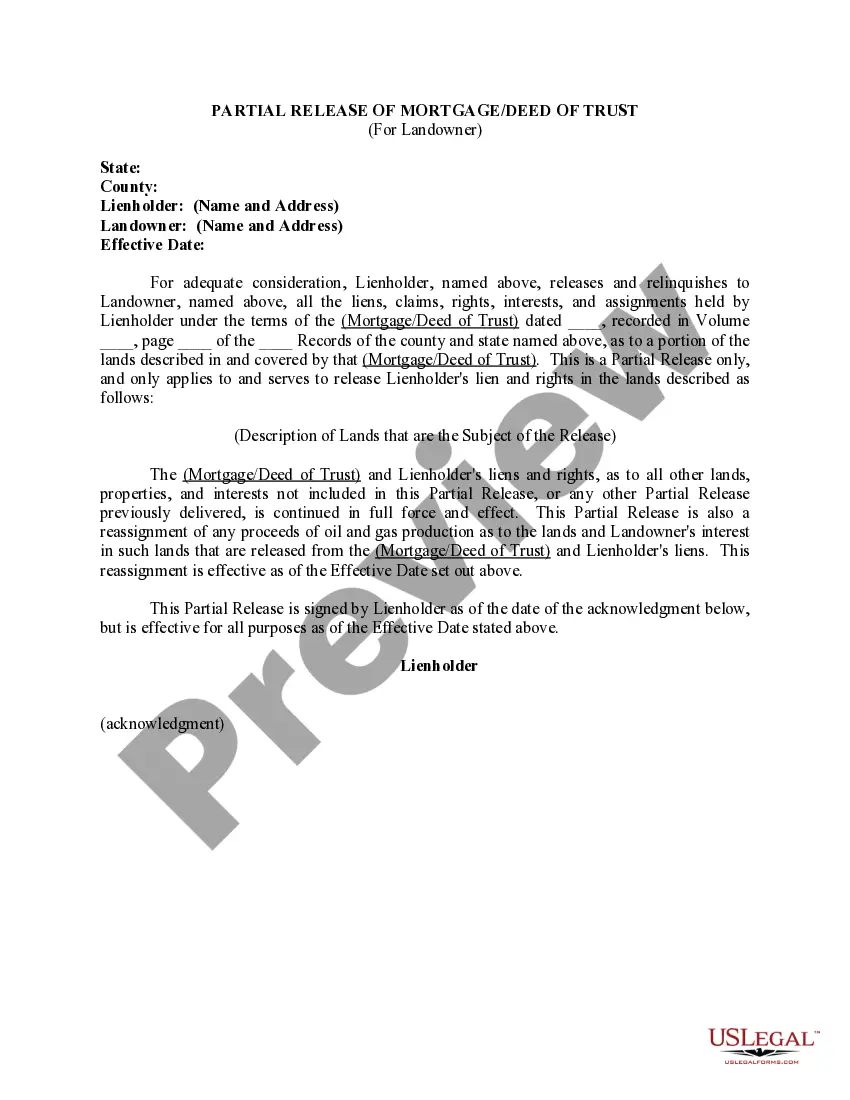
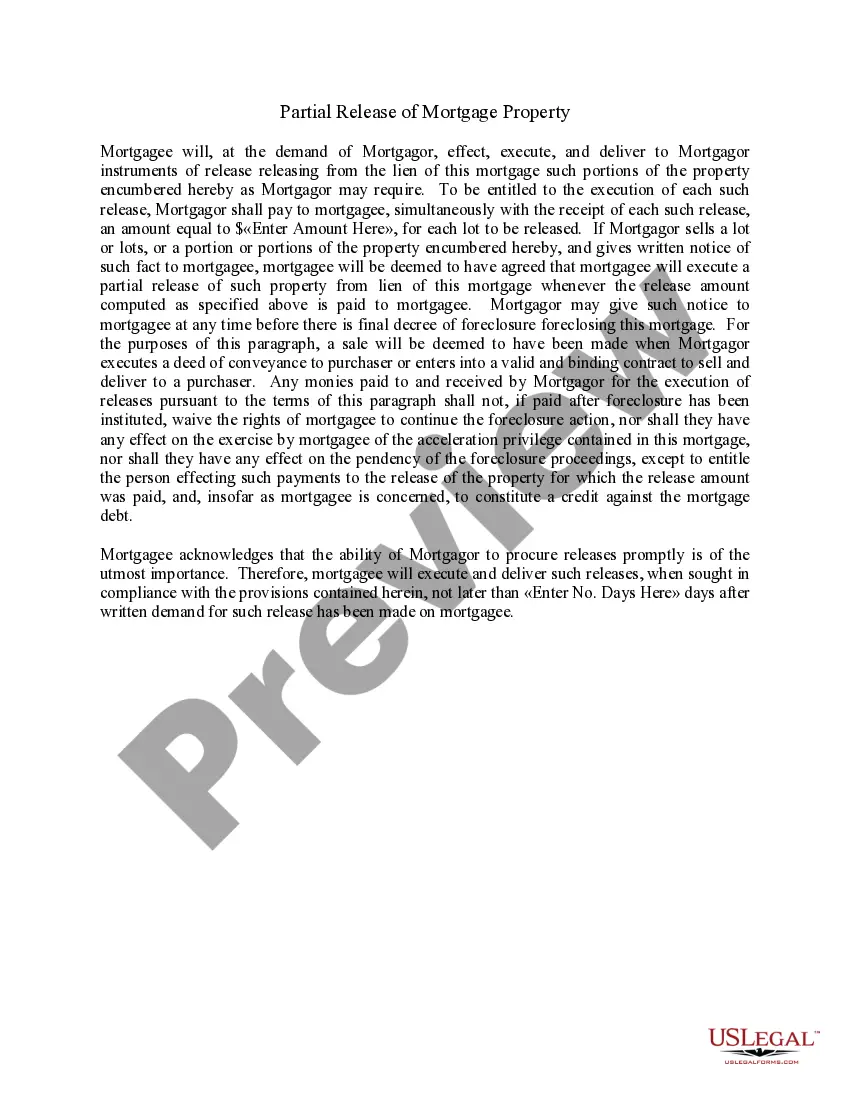
The Partial Release of Property From Deed of Trust for Corporation is a legal document that allows a corporation to release part of the property secured by a deed of trust. This form is specifically designed for situations where a corporation, as the holder of the deed of trust, conveys their interest in a specific piece of real estate while maintaining the validity of the deed for the remaining property. This form is essential in managing real property and mortgage obligations effectively.
Main sections of this form
- Identification of the corporation releasing the property.
- Details of the original deed of trust, including dates and document numbers.
- Description of the specific property being partially released.
- Clarification that this release does not affect the remaining properties secured by the deed.
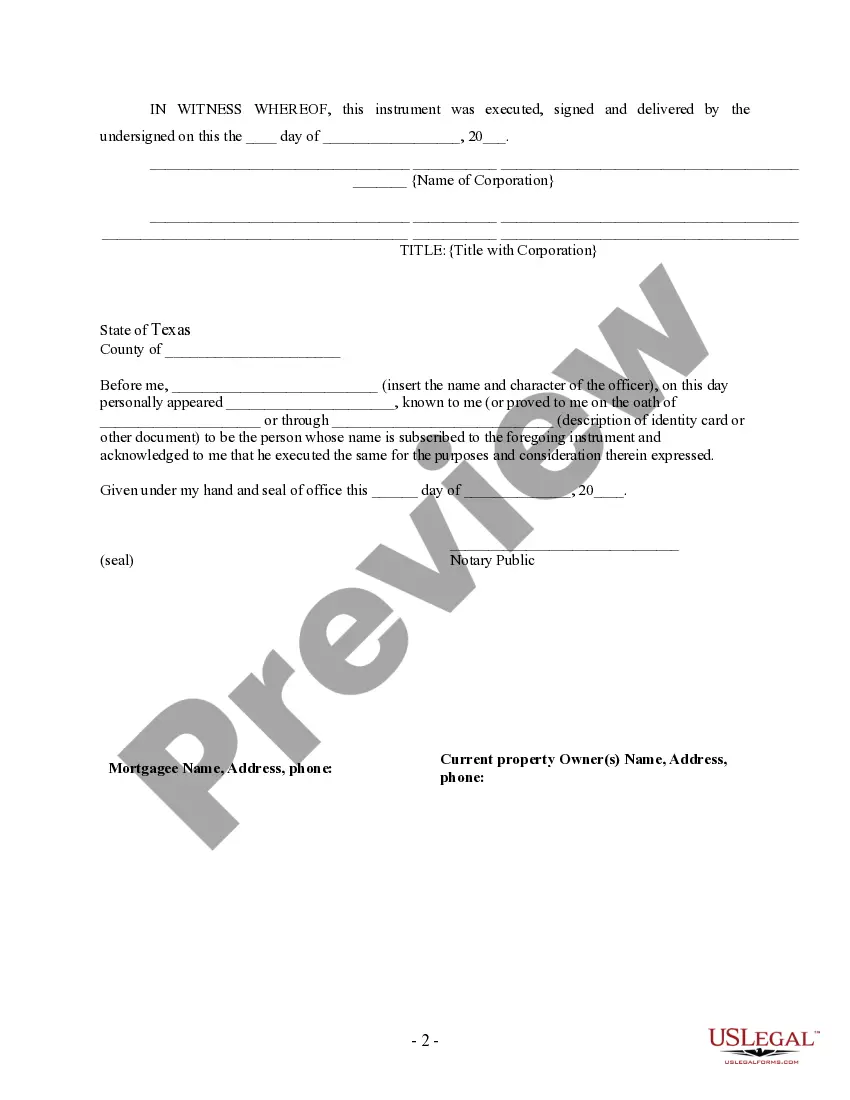
- Signature and title of the corporate officer executing the form.
- Notarial acknowledgment to ensure legality.
When to use this form
This form should be used when a corporation wishes to release a specific piece of property from a larger deed of trust. This may occur during refinancing, selling part of a property, or satisfying obligations tied to specific collateral. It is particularly important for corporate entities managing multiple properties under a single deed of trust.
Intended users of this form
- Corporations holding a deed of trust on multiple properties.
- Corporate officers responsible for real estate transactions.
- Legal professionals assisting corporations with property matters.
- Stakeholders involved in the sale or refinancing of part of a corporate-owned property.
Completing this form step by step
- Identify the corporate entity and the date of the original deed of trust.
- Insert the names of the mortgagors and trustee, along with the beneficiary information.
- Provide a detailed description of the property being partially released.
- Record relevant document numbers and county information as specified.
- Have the corporate officer sign and date the form, including their title.
- Complete the notarial acknowledgment to finalize the document.
Does this form need to be notarized?
Notarization is required for this form to take effect. Our online notarization service, powered by Notarize, lets you verify and sign documents remotely through an encrypted video session, available 24/7.
Get your form ready online
Our built-in tools help you complete, sign, share, and store your documents in one place.
Make edits, fill in missing information, and update formatting in US Legal Forms—just like you would in MS Word.
Download a copy, print it, send it by email, or mail it via USPS—whatever works best for your next step.
Sign and collect signatures with our SignNow integration. Send to multiple recipients, set reminders, and more. Go Premium to unlock E-Sign.
If this form requires notarization, complete it online through a secure video call—no need to meet a notary in person or wait for an appointment.
We protect your documents and personal data by following strict security and privacy standards.

Make edits, fill in missing information, and update formatting in US Legal Forms—just like you would in MS Word.

Download a copy, print it, send it by email, or mail it via USPS—whatever works best for your next step.

Sign and collect signatures with our SignNow integration. Send to multiple recipients, set reminders, and more. Go Premium to unlock E-Sign.

If this form requires notarization, complete it online through a secure video call—no need to meet a notary in person or wait for an appointment.

We protect your documents and personal data by following strict security and privacy standards.
Avoid these common issues
- Failing to properly describe the property being released.
- Omitting the required signatures or titles of corporate officers.
- Not providing accurate or complete information on the original deed of trust.
- Neglecting to obtain notarization, if required.
Benefits of using this form online
- Instant access to professionally drafted legal forms saves time.
- Easy customization allows users to fill in specific details conveniently.
- Reliable, up-to-date templates ensure legal compliance.
Legal use & context
- This form assists in legally modifying the terms of a deed of trust.
- Partial releases can have significant implications in securing financing or transferring property rights.
- It's essential to ensure no adverse legal effects arise from the partial release, such as misunderstandings about remaining obligations.
Main things to remember
- The Partial Release of Property From Deed of Trust is essential for corporations managing their collateral in real estate transactions.
- Ensure accuracy in the property description and sign the document correctly.
- Consult with legal professionals for specific local regulations and implications.
Looking for another form?
Form popularity
FAQ
Yes, you can challenge the release deed/ relinquishment deed after the death of the person. but to challenge it you need to have solid grounds and proof stating that the deed was made fraudulently. if you dont have any proof then their is no point challenging it as the case may not sustain merit in the court.
In the context of a California mortgage transaction, a trust deed also transfer ownership. Only this time, the title is being placed in the hands of a third-party trustee, who holds the property on behalf of the lender and the homeowner-borrower until the mortgage is paid.
A deed of release literally releases the parties to a deal from previous obligations, such as payments under the term of a mortgage because the loan has been paid off. The lender holds the title to real property until the mortgage's terms have been satisfied when a deed of release is commonly entered into.
Parties need a deed of release to bring a dispute or agreement to an end.Alternatively, if you are an employer, you may want a departing employee to sign a deed of release to agree that they won't make any employment claims against you once they have gone.
A deed of release or release deed is a legal document that removes the claim of a person from an immovable property and transfers his/her share to the co-owner. The release deed procedure is executed in the sub-registrars office and both the parties are required to be present for signing it.
In order to clear the Deed of Trust from the title to the property, a Deed of Reconveyance must be recorded with the Country Recorder or Recorder of Deeds. If the Trustee/Beneficiary fails to record a satisfaction within the set time limits, the Trustee/Beneficiary may be responsible for damages as set out by statute.
A deed of trust involves three parties: a lender, a borrower, and a trustee. The lender gives the borrower money. In exchange, the borrower gives the lender one or more promissory notes. As security for the promissory notes, the borrower transfers a real property interest to a third-party trustee.
The person who owns the property usually signs a promissory note and a deed of trust. The deed of trust does not have to be recorded to be valid.
A deed conveys ownership; a deed of trust secures a loan.