New Mexico Warranty Deed for Husband and Wife to Three Individuals as Joint Tenants with the Right of Survivorship
Overview of this form
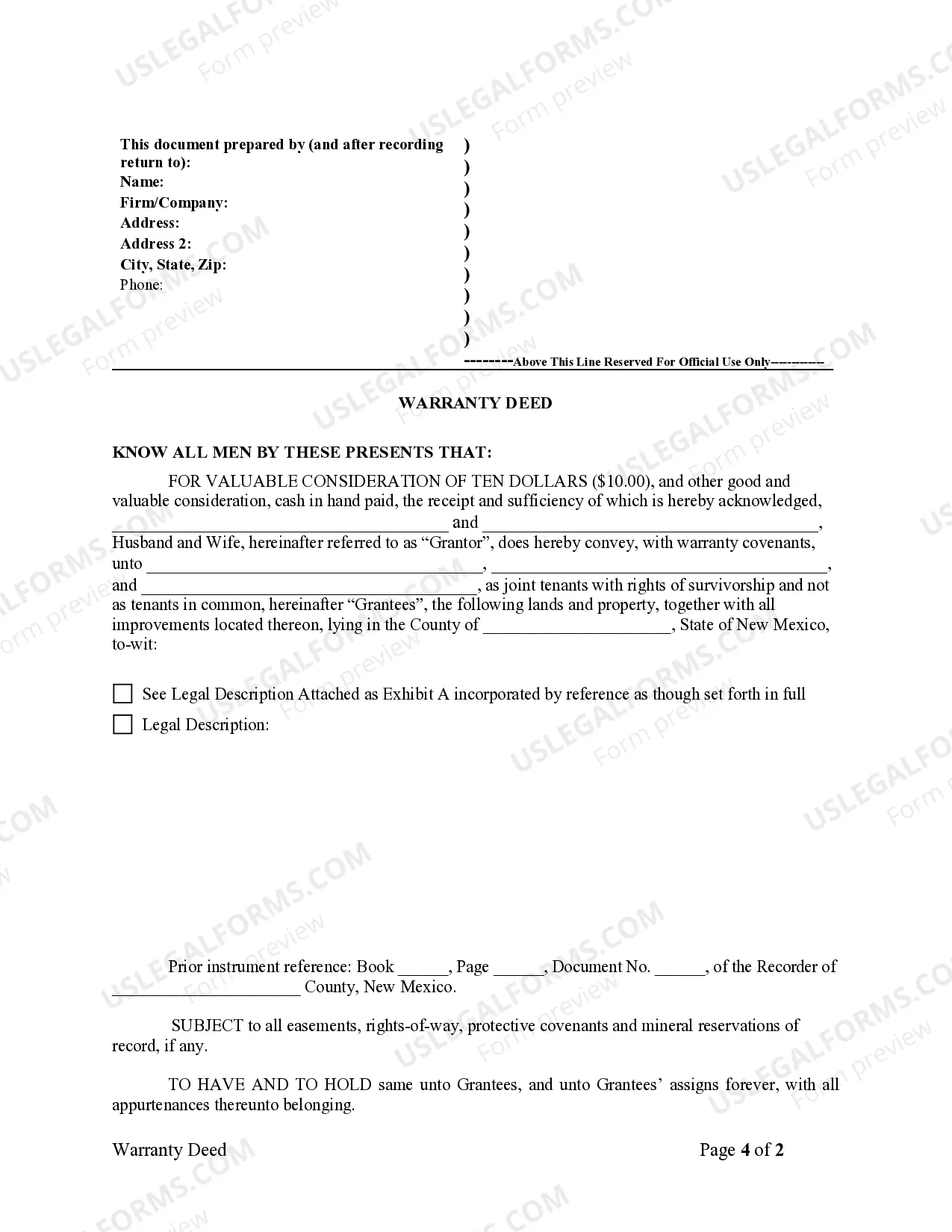
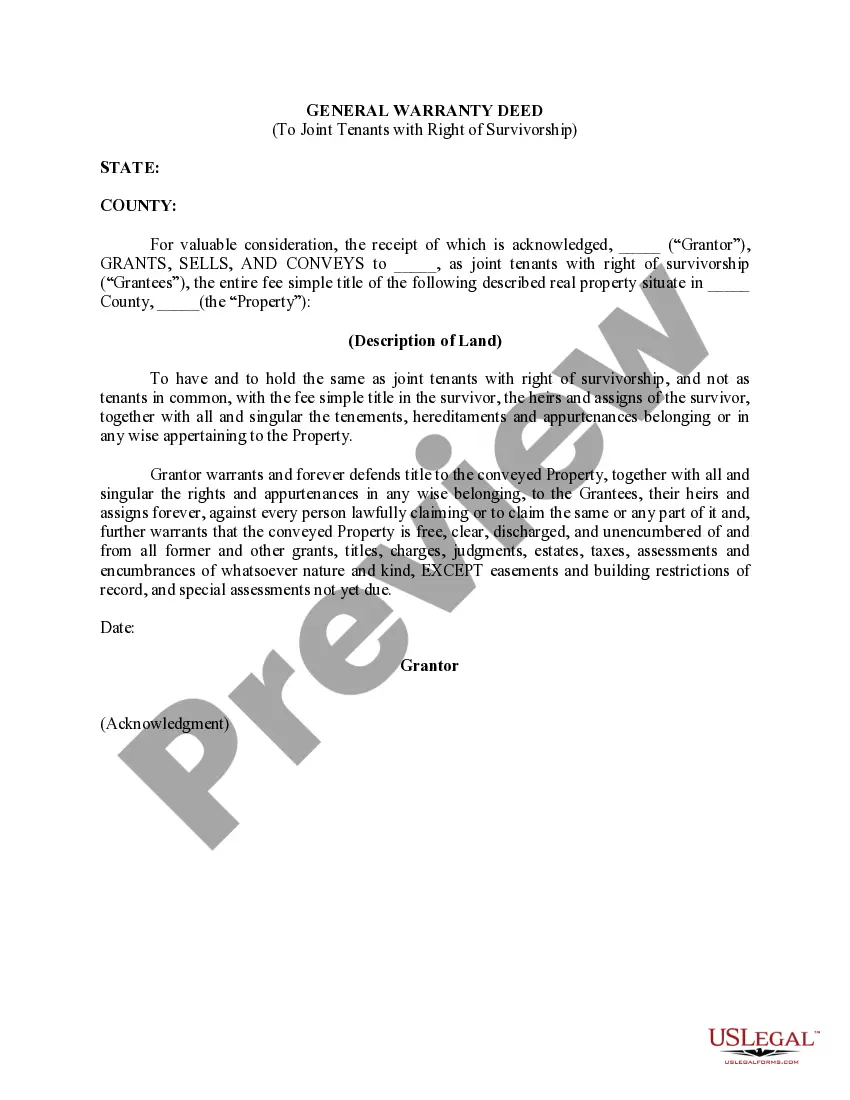
The Warranty Deed for Husband and Wife to Three Individuals as Joint Tenants with the Right of Survivorship is a legal document used to transfer property ownership from a married couple to three individuals. This form establishes the property holders as joint tenants, meaning that all share the property equally and have rights of survivorship. This means that in the event of one owner's death, their share automatically passes to the surviving owners, rather than going through probate. This form is distinct from other types of deeds, such as quitclaim deeds, which do not provide the same level of protection for the grantees.
What’s included in this form
- Identifies the grantors (husband and wife) and grantees (three individuals).
- Specifies the property being transferred.
- Includes a statement of joint tenancy and right of survivorship.
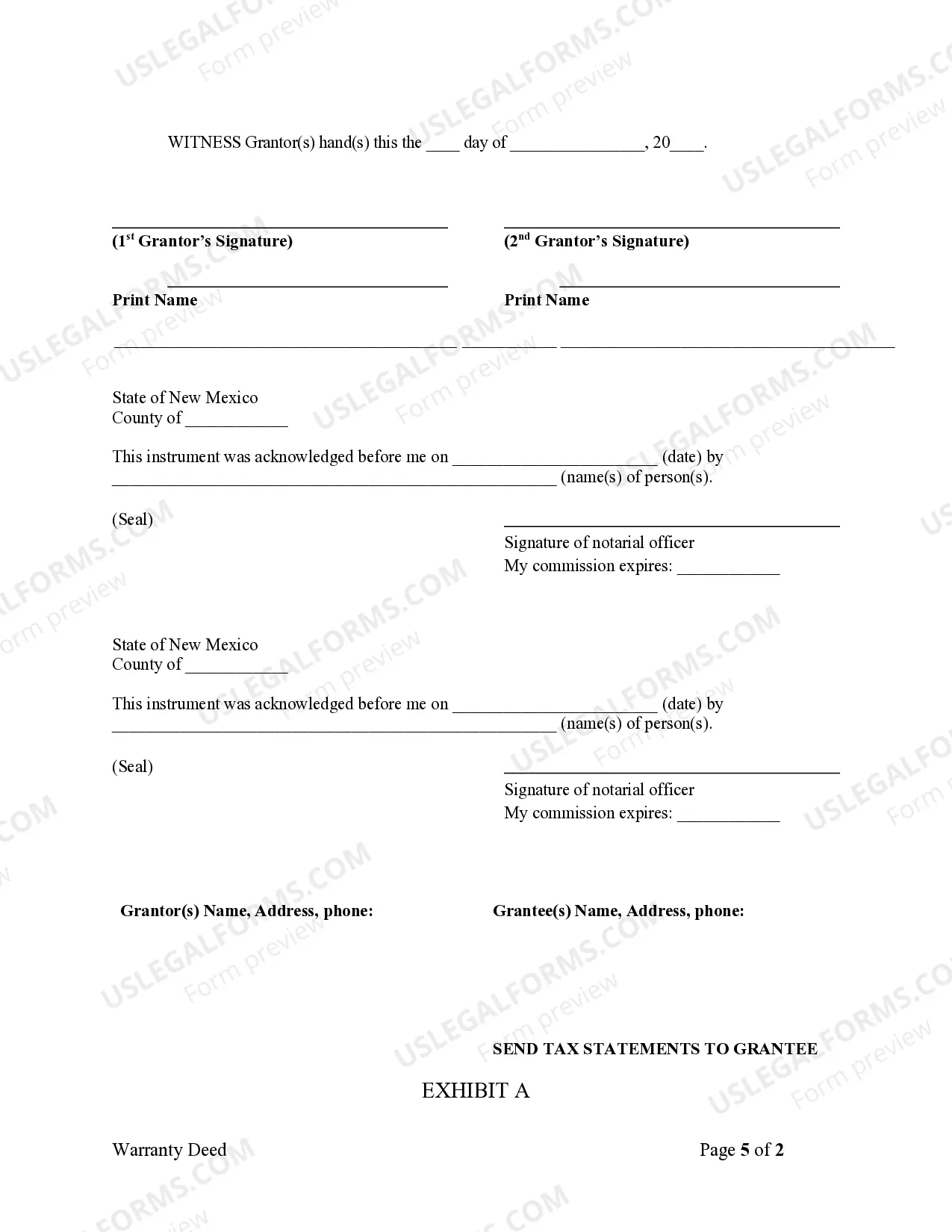
- Requires signatures from both grantors.
- Includes legal descriptions of the property.
- May include notary and witness requirements based on local laws.



Situations where this form applies
This warranty deed is suitable in various scenarios. Use this form when a married couple wishes to transfer property ownership to multiple individuals while ensuring that the property will pass directly to the surviving owners upon the death of any owner. This situation often arises in family arrangements, business partnerships, or investment agreements where joint ownership is desired.
Who needs this form
This form is intended for:
- Married couples looking to transfer property as joint tenants.
- Individuals or families wishing to establish shared property interests.
- Real estate professionals assisting clients in property transactions.
- Investors who want to create joint ownership structures with survivorship rights.
How to complete this form
- Identify the grantors by entering the names of the husband and wife.
- Specify the grantees by entering the names of the three individuals who will hold ownership.
- Provide a detailed legal description of the property.
- Include the date of execution, ensuring both grantors sign the document.
- If necessary, arrange for notarization and witnesses as required by local law.
Does this document require notarization?
To make this form legally binding, it must be notarized. Our online notarization service, powered by Notarize, lets you verify and sign documents remotely through an encrypted video session.
Get your form ready online
Our built-in tools help you complete, sign, share, and store your documents in one place.
Make edits, fill in missing information, and update formatting in US Legal Forms—just like you would in MS Word.
Download a copy, print it, send it by email, or mail it via USPS—whatever works best for your next step.
Sign and collect signatures with our SignNow integration. Send to multiple recipients, set reminders, and more. Go Premium to unlock E-Sign.
If this form requires notarization, complete it online through a secure video call—no need to meet a notary in person or wait for an appointment.
We protect your documents and personal data by following strict security and privacy standards.
Make edits, fill in missing information, and update formatting in US Legal Forms—just like you would in MS Word.
Download a copy, print it, send it by email, or mail it via USPS—whatever works best for your next step.
Sign and collect signatures with our SignNow integration. Send to multiple recipients, set reminders, and more. Go Premium to unlock E-Sign.

If this form requires notarization, complete it online through a secure video call—no need to meet a notary in person or wait for an appointment.

We protect your documents and personal data by following strict security and privacy standards.
Common mistakes
- Failing to include the legal description of the property accurately.
- Not obtaining the required signatures from both grantors.
- Overlooking notarization or witness requirements depending on local laws.
- Forgetting to specify the joint tenancy clause.
Advantages of online completion
- Convenient access to legal forms from anywhere with an internet connection.
- Edit and customize the form easily to fit specific needs.
- Instant downloads for immediate use.
- Secure and compliant with legal standards to ensure validity.
Looking for another form?

Form popularity
FAQ
One of the main differences between the two types of shared ownership is what happens to the property when one of the owners dies. When a property is owned by joint tenants with survivorship, the interest of a deceased owner automatically gets transferred to the remaining surviving owners.
A Yes, you will have to draw up new wills if you decide to own your home as tenants in common by severing your joint tenancy.
Tenancy by the entirety, another joint-owned property option, is when the parties are husband and wife. In this case, each spouse has an equal and undivided interest in the property. If one spouse dies, the full title of the property automatically passes to the surviving spouse.
When one joint owner (called a joint tenant, though it has nothing to do with renting) dies, the surviving owners automatically get the deceased owner's share of the joint tenancy property.The surviving joint tenant will automatically own the property after your death.
' Spouses typically acquire title as tenants by the entireties, which only applies to spouses. Sometimes you will see a couple who acquired the property before marriage. In some states, a premarital joint tenancy automatically becomes tenants by the entireties upon marriage.
As with the tenancy-in-common, a joint tenancy can exist in three or more people. Obviously, each party must have an interest that is equal to one divided by the total number of joint tenants. If one of the joint tenants dies, the others share his or her interest and they remain joint tenants with each other.
Joint tenancy can only be created if the four people obtain their interest at the same time. In other words, if three people own a building, they cannot add a fourth person to the deed and create a joint tenancy.
The following applies to joint tenancy and to tenancy in common. Up to four people can be named as legal owners. If there are more than four owners then ownership is through the device of a trust. The additional owners (and there can be any number) can be named as beneficiaries of the resulting trust for sale.
With a Survivorship Deed in place, when one of the parties in a joint tenancy dies, the other party (or parties) takes over the deceased party's interest in the property instead of it passing to the deceased's heirs or beneficiaries.